
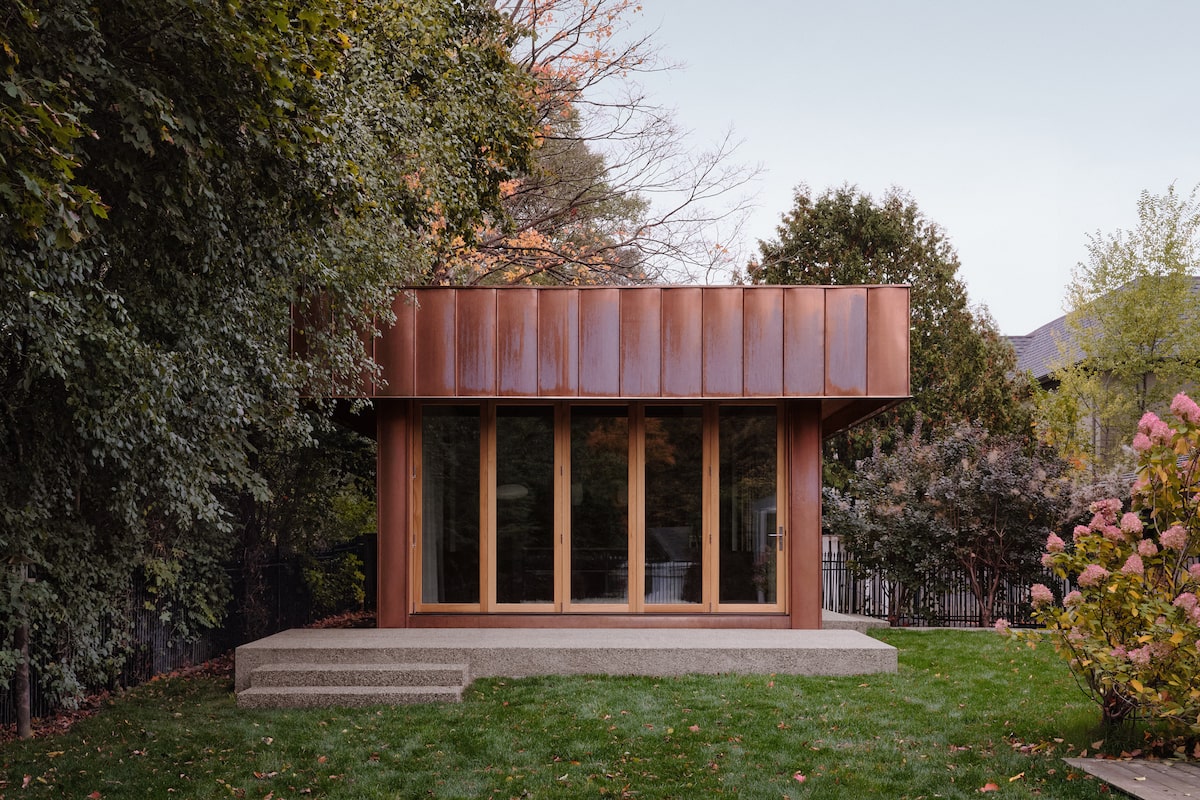
The suite’s simple exterior is built with a thick copper roof, wood and glass.Alex Lesage/Alex Lesage
While few Canadian newspapers wrote about the 1951 drama, in Illinois, a great deal of ink was spilt over the feud between Chicago-based Dr. Edith Farnsworth, physician (and almost a concert violinist, 1903-1977) and famed German architect Ludwig Mies van der Rohe (last director of the Bauhaus school, 1886-1969).
By then, Ms. Farnsworth’s famous all-glass country house – designed in 1946 – was nearly complete, completely overbudget and the lawsuits were flying. After funds stopped flowing following a dispute about curtains, Mr. Mies sued the good doctor, and despite approvals and multiple visits to the construction site, Ms. Farnsworth countersued him in October. While she famously said that the house was too transparent to be livable and smacked of “glib, false sophistication,” rumours began to circulate that suggested she was, rather, the jilted (and bitter) lover of the stout, cigar-smoking architect.
If Ms. Farnsworth had built a garden suite instead – the City of Toronto defines them as a “self-contained living accommodation … usually located in the rear yard” – it’s possible none of that drama would’ve unfolded.
The 60-square-metre building has all-wood windows, a wood-clad core and mostly wood kitchen.Alex Lesage/Alex Lesage
“I asked François to give me something with glass,” says Bridle Path homeowner Colette Wang as she stands in her living room and looks out at her handsome new building.
“Like, full glass,” architect François Abbott says with a laugh. Formerly based in Montreal, Mr. Abbott, 35, opened Fabrication Studio, a firm that specializes in ADUs (Accessory Dwelling Units) after relocating to Toronto for love during the pandemic.
After a chat with her two grown sons about privacy – the ADU backs onto a public park – it was decided to add a few walls. But not very many: “It’s very selective, some of the public-facing walls can open,” says Mr. Abbott. “On the private side of the building there are very deliberate views onto the park.” There is also, continues the tall, bearded architect, a continuous curtain track that encircles the interior so occupants can “choose what’s happening [and] where.”
The kitchen features a quartzite countertop and backsplash, while the floors are polished concrete.Alex Lesage/Alex Lesage
But what is happening, visually, for those standing at the big, backyard-facing windows of the main dwelling (as our little group finds itself) or for dog-walkers on the other side of the fence? Today, it’s a restrained, oblong glass box dressed in sections of shining, seamed copper but, in a few years, verdigris will blend the diminutive, 60-square-metre building completely into the background. Well, maybe not completely: copper that’s shielded from the elements will stay copper-coloured, which will give the building a dappled, and very dapper, appearance.
Speaking of dappled things, while a weak February sun and lack of foliage conspire against us, for seven or eight months of the year “the play of the shadows of leaves on the floor” from the living room and bedroom windows will be “so desirable.” Even without that floor show, as Mr. Abbott and I enter the little building and move through it, light and shadow change and intertwine dramatically.
The bathroom is furnished with off-white tile and simple fixtures.Alex Lesage/Alex Lesage
That’s because it’s all been choreographed: open the north-facing door and step into a narrow corridor (it wraps around the plumbing/bathroom core) and things are somewhat moody and semidark. Walk east to the plushly furnished living area and light pours in from a big, unobstructed sky (it’s a corner lot, so there are no neighbours on this side). In the middle, light rains down from above alongside cleansing water from the shower head. In the west-facing bedroom, sunsets will be muted due to the building’s position, which is quite close to the neighbour’s fence.
“It’s basic neuroscience,” says Mr. Abbott. “When the sun is low, very warm light, and you’re supposed to be winding down at the end of the day, you’re switching your nervous system over … and when the sun is high, or in the morning, that blue light creates cortisol, and as a mammal I’m supposed to get out and find water [and food].” Which is why it drives Mr. Abbott (and this writer) into an architectural rage when he walks by houses all lit up at night with 5000K fixtures … it’s no wonder people can’t sleep.
Despite being a third the size of the Farnsworth house, the materials palette, workmanship and furniture choices approach that of Mr. Mies’s masterpiece. For tactility, Mr. Abbott chose all-wood windows (unlike Ms. Farnsworth), along with a wood-clad core and mostly wood kitchen (like the Farnsworth house). The kitchen also sports a richly veined quartzite countertop/backsplash that resembles a swirling nebula in the night sky. The flooring, although not Mr. Mies’s favourite, travertine, is a highly polished, aggregate-speckled concrete and there are no bulkheads to sully the rigid geometry of the ceiling. The bathroom is calming, muted and Modernist, with off-white tile and simple fixtures.
The suite has a continuous curtain track encircling the interior.Alex Lesage/Alex Lesage
The exteriors are a study in Zen-like simplicity. A thick copper roof with a generous overhang, wood and glass – and that’s it. Raised, pebbly patio-pads hug the building’s north and east façades, but when the snow melts, Ms. Wang’s guests will notice that the building itself floats above the ground on helical piles.
“The reasoning is to protect all of these huge tree root systems,” says Mr. Abbott. “You don’t need a foundation, you don’t need to go below the frost-line … and the water can redistribute itself below grade.”
Four years after changes to zoning bylaws made garden suites possible, here is the gold standard, but dressed in copper. It’s elegant, understated, luxurious, and completely gorgeous. It proves that with a healthy budget, a trusting client, and a talented architect, any backyard can house great architecture.
Plus, adds Ms. Wang, it may lure your kids out of the house: “Every time my son goes there, he sleeps much longer than he sleeps in his bedroom here … because it’s very quiet [and] the oxygen is better.”