
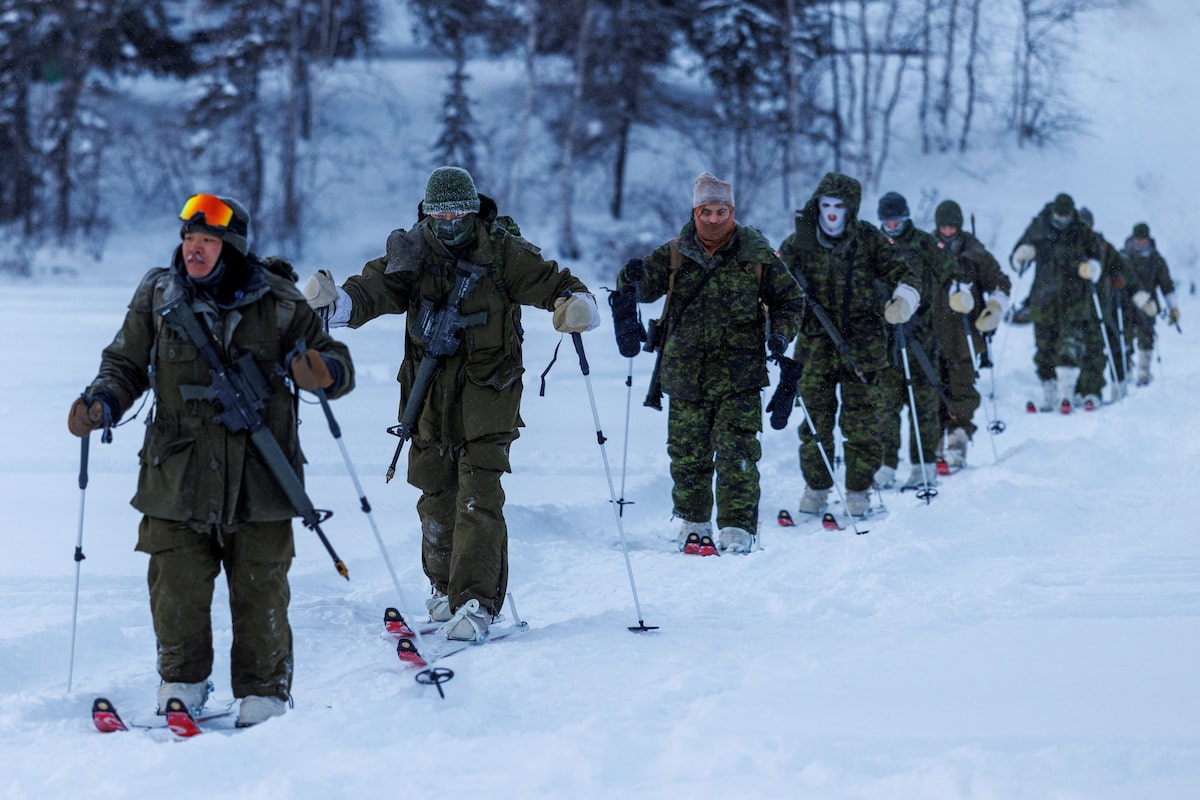
Members of 41 Canadian Brigade Group on patrol in Yellowknife, Northwest Territories, during the annual Operation Nanook-Nunalivut exercises. Under newly announced Express Entry categories, Ottawa aims to bring in ‘highly skilled foreign military applicants’ recruited by CAF in roles such as military doctors, nurses and pilots.Carlos Osorio/Reuters
The federal government is shaking up its main economic immigration program to facilitate the entry of high-skilled military recruits for the Canadian Armed Forces, part of Ottawa’s renewed focus and spending push on the defence sector.
On Wednesday, Immigration, Refugees and Citizenship Canada announced new categories for selecting immigrants via Express Entry, a points-based system that is the main entryway for skilled workers seeking permanent residency.
Among the changes, Ottawa will bring in “highly skilled foreign military applicants” recruited by the Canadian Armed Forces in roles such as military doctors, nurses and pilots.
The government did not publish any targeted numbers of military recruits from this new pathway.
Carney says new defence industrial strategy will reduce reliance on U.S. for gear
The immigration department is also creating categories to recruit researchers and senior managers with Canadian work experience, as well as applicants with experience in transport occupations, including pilots, aircraft mechanics and inspectors.
“By refining Express Entry to focus on the skills our communities truly need, we are strengthening our labour market, supporting provincial priorities and ensuring newcomers can contribute from day one,” Immigration Minister Lena Metlege Diab said in a statement.
The announcement was made just a day after Prime Minister Mark Carney unveiled his $500-billion defence industrial strategy, which aims to increase Canada’s “sovereign capabilities” and reduce reliance on the United States in the midst of the trade war and President Donald Trump’s repeated threats to make Canada part of the U.S.
Ms. Metlege Diab said the skilled foreign military applicant category was in line with the government’s defence strategy, and aimed to strengthen the Canadian Armed Forces.
Federal government data from March 2025 showed that there were 65,700 regular armed forces members, and 23,450 primary reserve force members, 12,350 short of current overall targets. The CAF is particularly short of fighter pilots, according to a September, 2025, report from Department of National Defence that evaluated the retention strategy of the CAF.
Opinion: Canada’s new defence policy must do away with the old orthodoxies
Category-based immigrant selection is a relatively new method of granting permanent residency through the Express Entry system.
Before, successful applicants were selected solely based on their scores, which took various factors into account, such as an individual’s Canadian work experience, proficiency in English or French and level of educational attainment.
However, in 2023, IRCC started to invite candidates with specific skills and work experiences in fields that the government deemed had a labour shortage. The switch to category-based selection has been contentious, with some immigration experts arguing that strong candidates are often bypassed in favour of people with lower scores, but desirable work experience in the government’s eyes.
Mikal Skuterud, a labour economist at the University of Waterloo who has long been critical of category-based selection, said that IRCC’s latest announcement only adds uncertainty to current immigration policy, because it continues to focus on present labour-market needs at the expense of stability and predictability.
“Category-based selection has turned the immigration selection system into a lottery, which is incentivizing top talent graduating from Canada’s best universities to look elsewhere,” he said in an e-mail to The Globe.
Opinion: Data Dive with Nik Nanos: Canadians are clamouring for a stronger military
As part of Wednesday’s release, IRCC said it will maintain recruitment categories for candidates with French-language proficiency, along with workers in STEM occupations, health care and skilled trades.
In 2025, IRCC data showed that prospective immigrants who are fluent in French were granted the highest number of invitations for permanent residency, compared with people with recent work experience in Canada, those in health care or the trades. The successful French-speaking candidates tend to have much lower scores than those recruited through other categories.
Foreign medical doctors with at least one year of Canadian work experience are another key group for recruitment.
In December, the immigration department created a new category for international doctors already working in Canada. The first selection of medical doctors will take place in the coming days, Ms. Metlege Diab said in Wednesday’s press release.
The federal government began tightening immigration rules in late 2024, after years of rapid population growth owing primarily to a sharp increase in the number of international students and temporary foreign workers coming to Canada during the pandemic years. Ottawa is aiming to reduce its temporary resident population, which currently hovers at about 7 per cent of the total population, to 5 per cent by the end of 2027.
IRCC recently suspended multiple immigration streams, such as the Home Caregivers Pilot Program, a dedicated immigration pathway for child caregivers and personal support workers. Starting this year, the government also suspended the sponsorship of parents and grandparents of Canadians for permanent residency, a popular family reunification program that had been around for decades.