
Updated February 18, 2026 03:21PM
When I look in my garage, I feel like I am looking at an episode of “Hoarders: The Mountain Sports Edition.” Crampons, bike computers, ski boots, and USB charging cables of every variety are strewn about. Lifting up some shipping receipts often reveals a set of replacement lenses or a Silca multi-tool that I had completely forgotten about. It feels ridiculous to complain about it, but the task of managing equipment from sponsors for five different sports is significant, and when you’re exhausted from a day of doing intervals in the pool and bagging a peak, the last thing you want to do is try to wax skis or mount tubeless tires.
Having been a “privateer” for the better part of a month, I am quickly realizing that comparing the World Tour (WT) with gravel is not as seamless as I had originally thought. Yes, both disciplines require similar physiologies; however, I am now far more aware of how much of a team I had behind me as a WT rider. Over the past decade, I typically trained 20-30+ hours per week, with little to no concern for anything else in my life. My travel plans were covered, my training schedule was reviewed with a fine-toothed comb, and my bikes were neatly organized. For some parts of the year, I even had my soigneur, Jon Adams, crashing at my place and preparing my bottles. I now realize that without this support, putting in those consistent hours—especially as a father—is a far trickier task. The management of sponsor obligations, traditionally handled by a media team, and the influx of gear into my garage—which includes dealing with customs and shipping companies—has taken up hours of my week. These tasks, once handled by the staff at my team’s service course, have become my biggest responsibility. I had massively underestimated these challenges in taking on this calendar because my team was so good at managing them.
Knowing what I know now, and having trained as I have in the past, it makes me ask the question: as a privateer, is it even possible to be as physically capable as a WT pro?
With this in mind, and based on my extreme training regimen over the past few months—a regimen that feels more like the training montage from *Rocky IV*—I have had some reservations about my preparedness for my first race on my calendar, Santa Vall. Therefore, I attended the NSN Development Team Camp in Denia, Spain, three weeks ago to get a better measure of where I stand.
As one of the top continental teams in the world, the NSN developmental team has consistently graduated 1-2 riders into the WT each year. Graduates from the program include recent Giro d’Italia fourth place finisher Derek Gee and podium finisher at Cadel Evans’ Great Ocean Road Race, Brady Gilmore. The young riders on this team are impressive, and when I attended this year’s camp, I could see why. There was no point during my stay with the team and while riding around the Valencian roads with men half my age where I felt like I wasn’t on a WT team. The staff, food, meetings, and equipment were all well organized, a far cry from the development path I took to reach the sport’s top tier. A rider at this camp could easily sub into the WT and not feel out of place, whereas when I came into Cannondale in 2016, I felt like the sandlot baseball team visiting Richie Rich’s house for the first time.
Although my main role at the camp was to serve as a mentor and sounding board for the aspiring riders, I also had selfish aims. I knew that on day two of the camp, the boys would be doing an uphill test on arguably one of the biggest measuring sticks in road cycling, Coll de Rates. None other than Tadej Pogačar sits atop the leaderboard on this climb, but Jonas Vingegaard and countless other iconic riders have used it as an early-season benchmark. I thought this would be the perfect opportunity to measure where I stood from a cycling perspective going into Santa Vall. I went all out on this climb, paced it perfectly, and finished with a solid time of 14:05, averaging 420 watts for the effort. Had I not been packing an extra 5 kg (I currently weigh 65.5 kg) compared to my 60.5 kg at the Tour, I reckon I could have posted a pretty competitive time with those numbers. However, the muscle I have already gained from swimming, skiing, and not abstaining from extra slices of my daughter’s birthday cake has made me a bit less vertically adept, at least on the bike, and I was a full 2 minutes and 8 seconds off Pogačar’s fastest time. More importantly, there were three riders at the camp who went faster than I did that day. I finished 36 seconds behind the fastest rider on the team.
This gave me a clear picture of where I stand in the echelon of pro cycling. Were I 19 years old, WT teams would be looking at me and thinking, “This guy has potential. If we could trim him down a bit, get him some experience, he might be worth taking a shot on in a year or two.” However, as a 39-year-old, there’s not a chance in hell that I would be getting a WT contract, and if I were in the WT, I would need some wizard-level racing skills to get any race starts. Therefore, based on my testing and how I rode for the rest of the ride, I would say that as far as cycling form goes, I am sitting comfortably in the bottom 5% of the WT and the top 20% of the continental level. I occupy that space where many neo-pros don’t realize they are, and where too many older riders on their final contract find themselves: 10 months from being out of a job. It wasn’t where I wanted to be, but I had hoped it would leave me somewhat competitive at this event.
Then, while standing in line at the race registration for Santa Vall on Friday, I ran into Romain Bardet. To me, Romain is a damn classy bike rider. His palmarès reads like a much better version of mine. At one point, he was the great French hope in cycling, and he always carried that pressure with style and charisma. There are a couple of things that I saw him do in races that are burned in my brain. I can still see him coming around me in the final corner of a finish in the Basque Country back in 2017, leaning the bike so far over that the handlebars almost touched the ground in an attempt to outfox a charging Alejandro Valverde. It was a thing of beauty.
However, as we made small talk and stood in line with a bunch of people munching halved bananas provided by the race organizer, I thought, “Maybe this isn’t going to be as easy as I had hoped.” Romain is a skilled racer; he loves to race, and even if he hasn’t been training as much as he used to or has “retired,” his talent and class can get him across a lot of finish lines first—he had already won a race in Australia a few weeks ago.
I was also a bit more concerned when we both got to registration, and I caught a glimpse of him receiving an entry in the first starting box of the race. When the woman signing me in approached, she gave me a bib number and entry into box two. Although, unlike Romain, I hadn’t earned the points at the Gravel Earth Series required to be in the front box for the start, I was still not looking forward to spotting him, along with guys like Mads Wurdz Schmidt, 50-80 positions ahead of me right out of the gate.
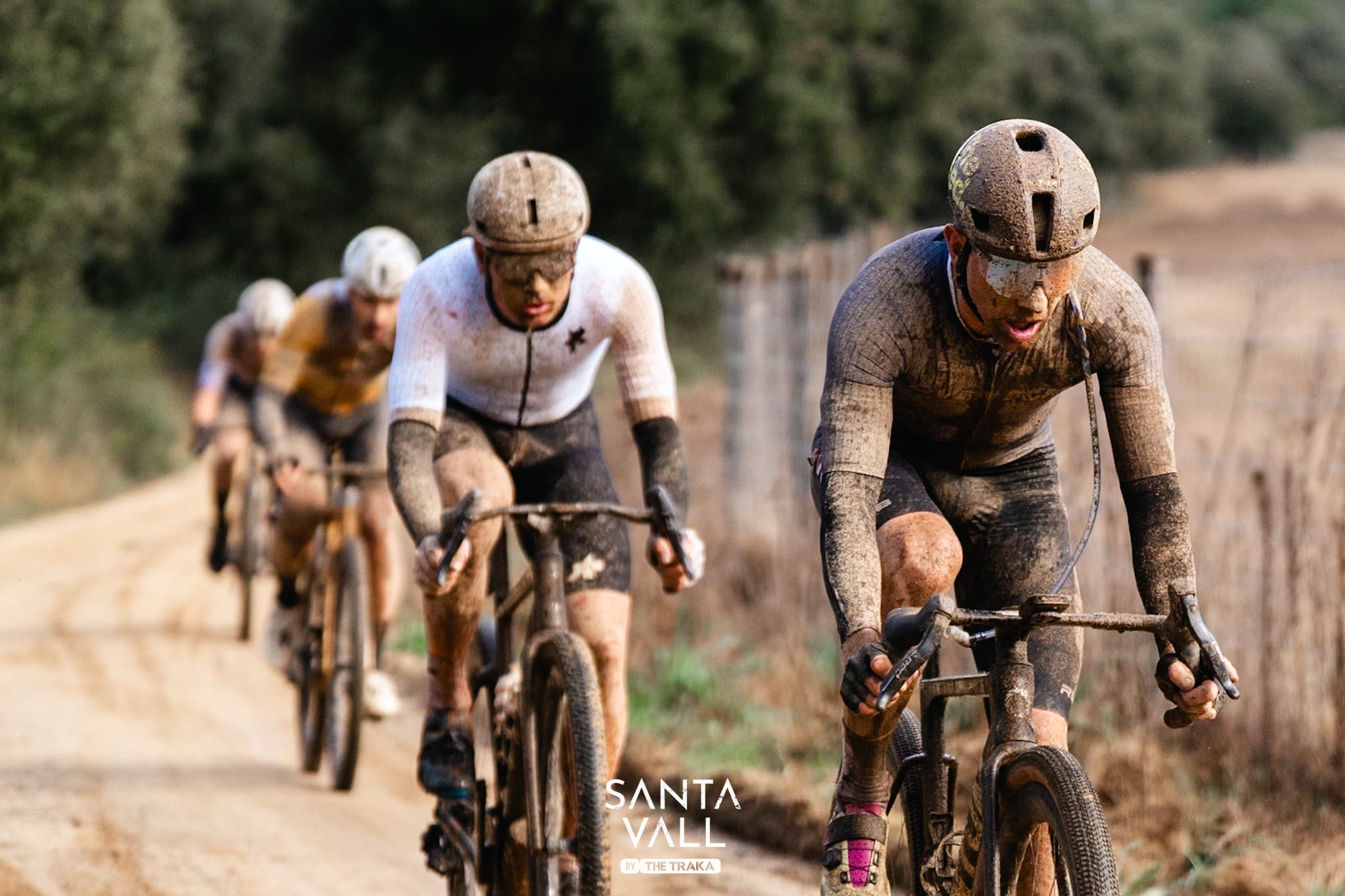 Mike Woods races Santa Vall. (Photo: ©Santa Vall)
Like everything in this world, sports across all disciplines have modernized. This realization hit me hard on the 120 km stage 1 of Santa Vall. Starting in box two, I had 10 km to get in position for the first technical gravel section of the race. I knew that, given how wet and technical the course was, if I entered that sector in the top 20 riders, I would likely be good until the first big climb 30 km later. However, over those first 10 km, I would have the daunting task of trying to pass 80 riders on twisting, greasy, and narrow roads. I had heard stories, from years past, where maneuvering through a pack of gravel riders was, for a WT rider, like cutting through butter with a hot knife. However, from the outset of Santa Vall, I felt like I had been dropped into some sketchy Belgian semi-classic. Belgians and Dutch riders were swearing and banging bars with me like we were fighting for the final corner instead of the first.
I hate racing against Belgians. In Belgium, cycling, for many, is still a blue-collar sport. Unlike North America, most guys who get into cycling in Belgium haven’t done so because their dad thought it would be cool to take the family for a cycling trip to Tuscany. They are sons of farmers and tradesmen, and they really don’t mind getting shit between their teeth. This is what sets Belgians apart when it comes to racing on crazy roads; they don’t think like a guy who has a business undergrad degree and a fallback plan to intern at dad’s law firm. To say they have a higher threshold for risk isn’t fair because, to them, not taking a line underneath you in a corner presents the bigger risk of maybe not getting a result and then not having, or getting, a job.
This was the first thing that struck me about Santa Vall and how much the sport of gravel racing has evolved. More money is being put into the discipline from manufacturers and sponsors, and therefore strong riders who don’t see a clear path to the WT can now test their chops and carve out a living. Ten years ago, it would have been unheard of to see a young Belgian rider banging bars anywhere else but in a kermesse.
Secondly, I was struck by the skill level and peloton skills that many of the riders around me had. Because of YouTube, Strava, and Eurosport, what took athletes of earlier generations years of mistakes to figure out can now be learned in minutes. Access to information is incredible—my swimming and skiing have been big beneficiaries of these tools. Young riders all around me raced like seasoned road pros. However, what can’t be learned from YouTube is how much crashing hurts, and from the start of the race, bodies were everywhere.
Through some old tricks and some big efforts, I did manage to make it to the front of the group for the first key sector and thought to myself, “Wasn’t fighting for every inch of the road and taking big risks the exact reason why I retired?”
I tried to push this thought out of my head; I followed the wheels and felt like I could finally start thinking about actually racing my bike. Then, while going straight on a descent, my 50 mm tire caught a rut in the gravel, and I went sideways. Before I knew it, I was doing exactly what I had sworn I wouldn’t—I was crashing. The crash, due to the sloppy conditions and incessant rain the day before, was innocuous. My bike and body were intact, but it would be the last time I ever saw the front of the race.
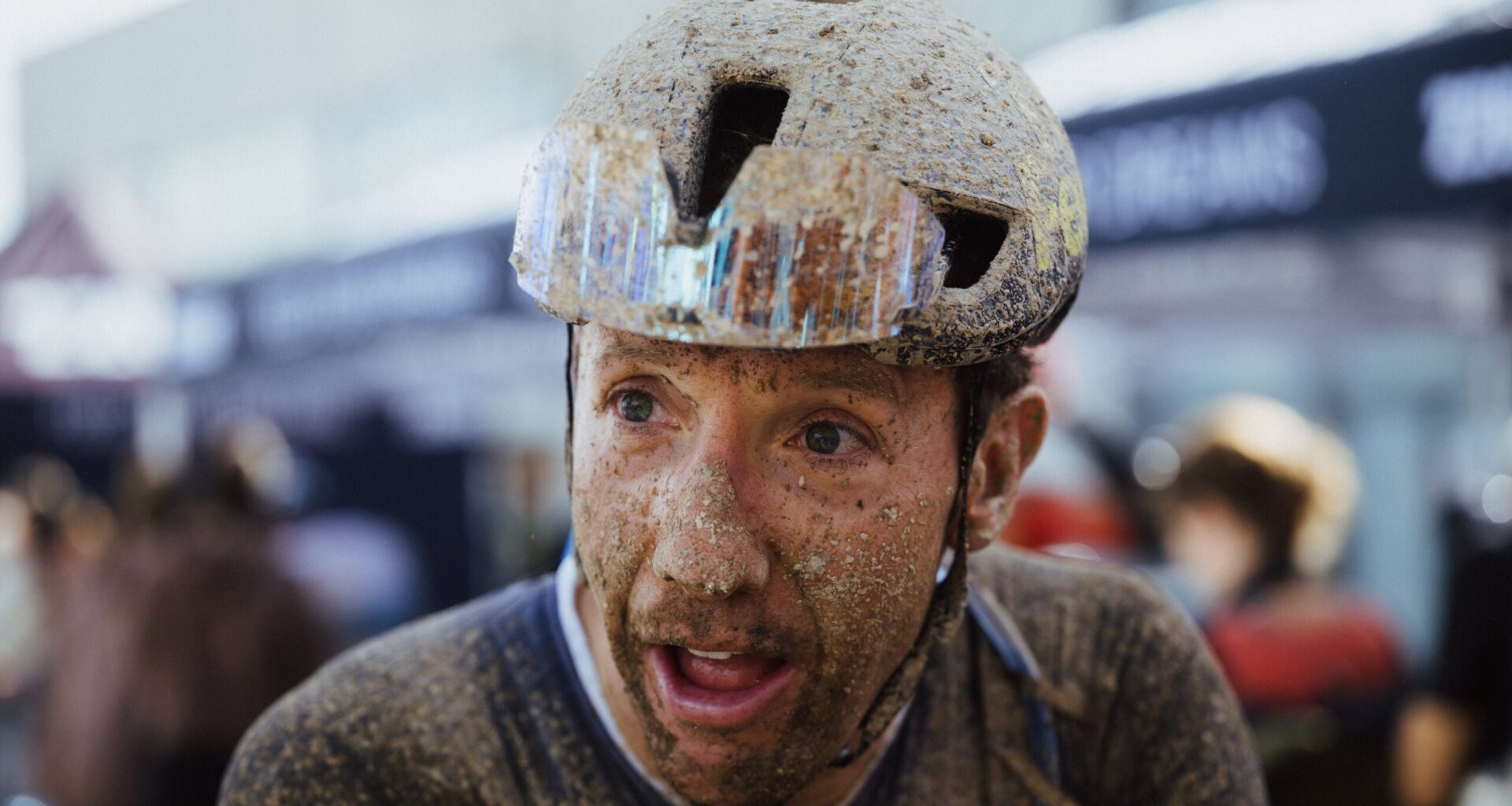
As a North American living in Catalunya and Andorra for the past decade, I am always blown away by the freedom that living in a non-litigious society affords. A few years ago, my daughter ran a free kids’ trail race in the area, and one of the kids disappeared for hours. Searches were commenced, the firefighters were called, and eventually, the boy was found; everybody hugged and high-fived, and the next year the race happened again. The ease with which organizers can put on events, without the threat of lawsuits, means that Santa Vall can create a course that would have lawyers salivating back home. I didn’t get a license to enter this race. The official route was only revealed less than 24 hours before the start. The paved and gravel roads were completely open to traffic. We crisscrossed farmers’ fields and launched down descents filled with debris and rocks. At one point, we literally raced through a river for a significant period of time, and it is a minor miracle that I didn’t get E. coli poisoning from all of the cow shit and mud that was kicked up into my mouth. Basically, Santa Vall is like the Isle of Man TT, but the roads are open to traffic, and the race is a mass start, and nobody knows the true course until they race it. But here, unlike in North America, there is an idea of “you signed up for this.” Once I started questioning every decision that had brought me to be racing in this event, I had to tell myself just that.
For the next 30 km, we raced through what was the equivalent of the last day of Woodstock ’69. The rain from the day before had turned the first third of the course, the lowest-lying part of the area, into a soup. If there was a line to ride, there was only one, and by the time I finally made it to the second group, the race was already over. The leaders had gone up the road, or semblance of a road, or goat path, or whatever you want to call it, and I was left to battle it out with all of the other broken men.
This event was less than 4 hours long, but it was a massive shock to the system, and it reminded me so much of my first forays into road racing. Many mistakes were made, feeds were missed, regrets were felt, and a massive hunger flat in the closing kilometers left me absolutely buckled. Santa Vall, if you are ever looking for a motto, it should be: “you signed up for this.”