
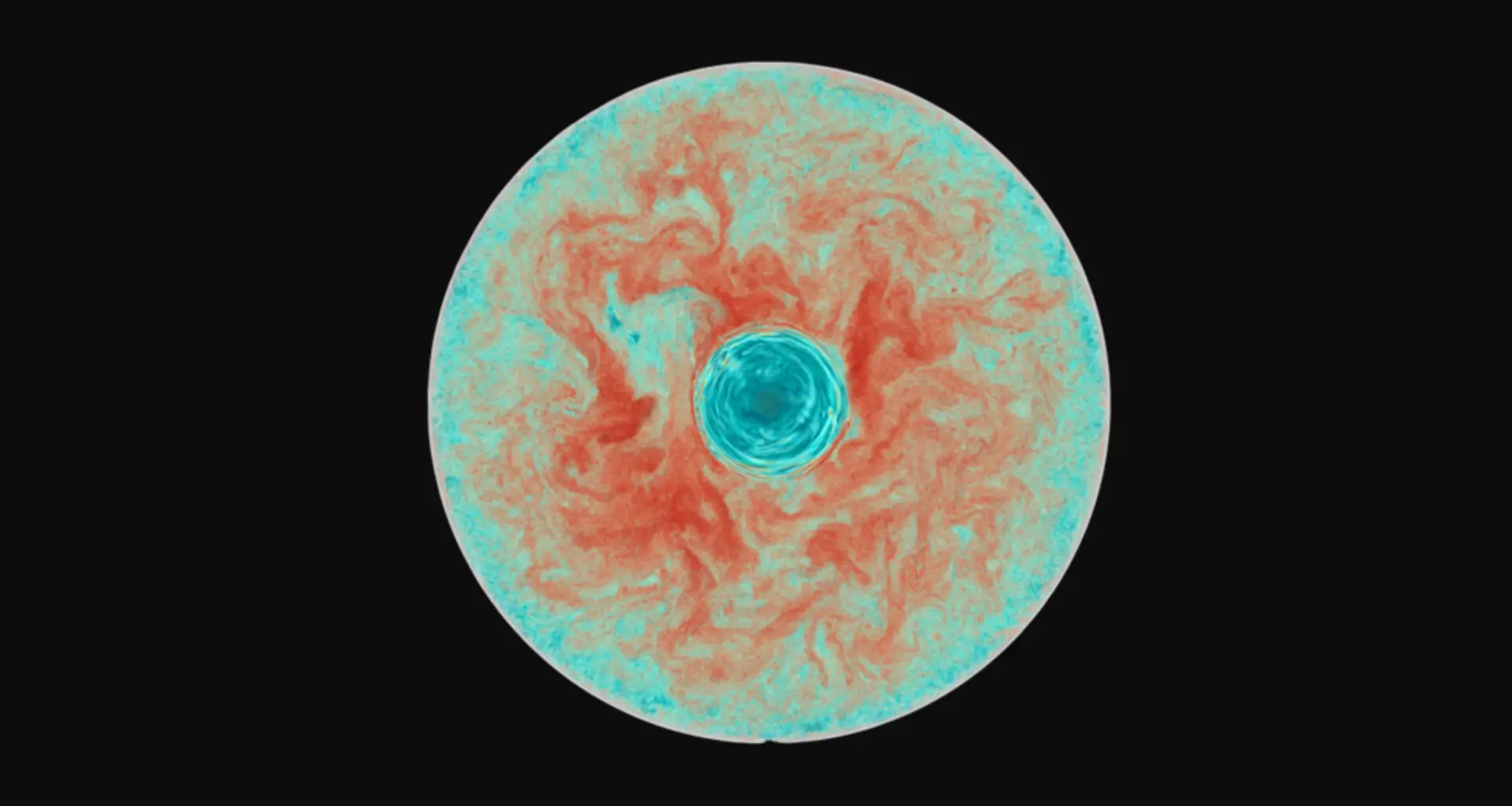
Advances in supercomputing have made solving a long-standing astronomical conundrum possible: How can we explain the changes in the chemical composition at the surface of red giant stars as they evolve?
For decades, researchers have been unsure exactly how the changing chemical composition at the centre of a red giant star, caused by nuclear burning, connects to changes in composition at the surface. A stable layer acts as a barrier between the star’s interior and the outer connective envelope, and how elements cross that layer remained a mystery.
In a recent Nature Astronomy paper, researchers at the University of Victoria’s (UVic) Astronomy Research Centre (ARC) and the University of Minnesota solved the problem.
The answer? Stellar rotation.
“Using high-resolution 3D simulations, we were able to identify the impact that the rotation of these stars was having on the ability for elements to cross the barrier,” says Simon Blouin, lead researcher and postdoctoral fellow at UVic. “Stellar rotation is crucial and provides a natural explanation for the observed chemical signatures in typical red giants. This discovery is another step forward in understanding how stars evolve.”
Scientists have long known that after Sun-like stars exhaust their core hydrogen, they expand into red giants up to 100 times their original size. Since the 1970s, scientists have observed changes to the surface composition of these stars during expansion, including a decline in carbon-12 to carbon-13 ratios. These compositional changes can only be explained by the transport of material from the nuclear-burning interior to the surface, but until now, researchers have been unable to prove how that transport happens.
We knew that internal waves, generated by churning motions in the convective envelope, were able to pass through this barrier layer, but previous simulations found that these waves transported very little material. We were able to show that the rotation of the star dramatically amplifies how effectively these waves can mix material across the barrier, to an extent that matches the observed changes in surface composition.”
—Simon Blouin, UVic postdoctoral fellow
Blouin and his team found that mixing rates in the star studied can exceed those in non-rotating stars by over 100 times, and the rate increases with faster rotation rates. Red giants represent a later evolutionary phase that our own Sun will eventually reach, making this research relevant to understanding the Sun’s future.
The important role of supercomputers
To make this discovery, the researchers conducted hydrodynamical simulations—large 3-dimensional simulations that represent how the materials in stars move. These are very large calculations that require the most advanced supercomputers, and this finding was only possible now due to new computing resources.
“Until recently, while stellar rotation was thought to be part of solving this conundrum, limited computing abilities prevented us from quantitatively testing the hypothesis,” says Falk Herwig, principal investigator and director of ARC. “These simulations allow us to tease out small effects to determine what actually happens, helping us to understand our observations.”
The team used computing resources at the Texas Advanced Computing Centre at the University of Texas at Austin and the new Trillium supercomputing cluster at SciNet at the University of Toronto to conduct their simulations. Trillium, which launched in August 2025, is one of the most powerful supercomputers for large-parallel simulations available for academic research in Canada and is one of several national supercomputers within the Digital Research Alliance of Canada. Its expanded computing power was key to completing this research.
We were able to discover a new stellar mixing process only because of the immense computing power of the new Trillium machine. These are the computationally most intensive stellar convection and internal gravity wave simulations performed to date.”
—Falk Herwig, professor of physics and astronomy and director of ARC
The computational techniques used to simulate stellar convection apply broadly to understanding flows in the natural world—from ocean currents to atmospheric dynamics to blood flow. Herwig is also working with researchers across these fields to develop shared approaches and infrastructure for large-scale flow simulations.
Blouin plans to continue investigating stellar rotation. While this research studied one particular type of star, he is interested in exploring what happens in other stars, including how different rotation profiles affect how efficiently the star mixes, and whether rotation also enhances wave mixing in other types of stars and evolutionary phases.
This research was supported by the Natural Sciences and Engineering Research Council (NSERC), the National Science Foundation (NSF) and the US Department of Energy.
Read the Research Briefing in Nature Astronomy