
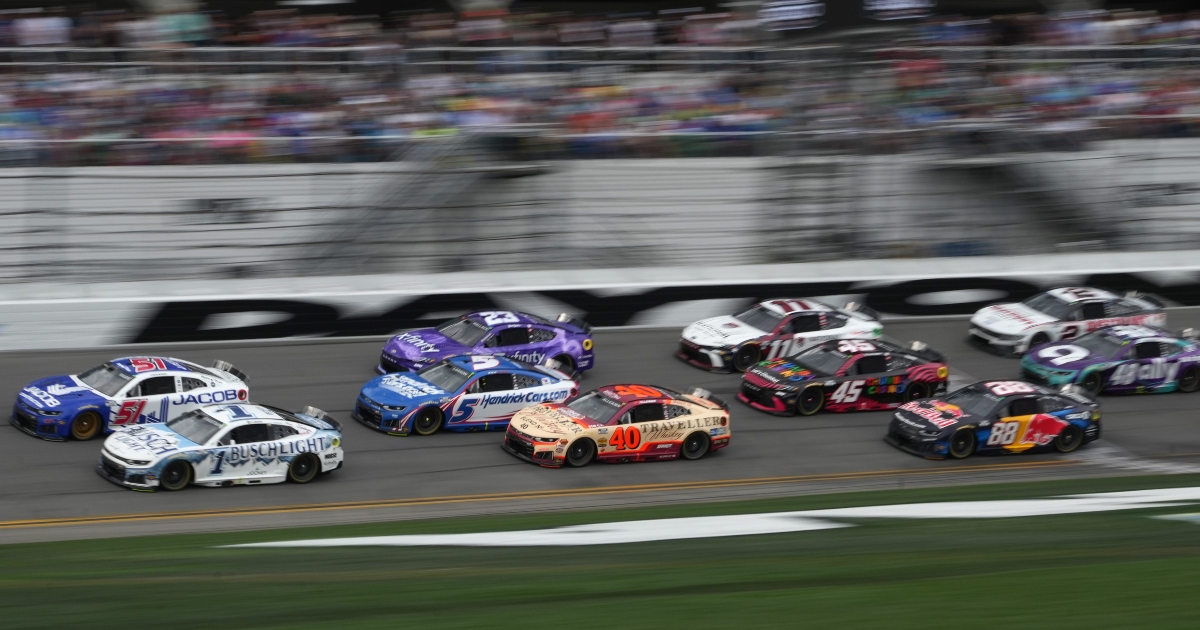
In the wake of the Daytona 500 and amid complaints about the fuel saving that went on in the final stage of the race, two insiders for The Athletic are opening up on the issue. They had some conversations at Daytona that shed light on the problem.
Jeff Gluck revealed that a conversation with Chase Elliott and crew chief Alan Gustafson hit on the crux of the issue for NASCAR these days. No longer is it just three cars employing a fuel-saving strategy and using it to beat out the field.
Now the whole field is doing it. That changes things.
Moreover, Gustafson suggested that you can’t simply put the cat back in the bag. Teams can’t unlearn fuel-saving strategy at this point and, even if the rules change, it’s going to remain a part of racing at this level.
“I just don’t know, I guess I’m not as upset about it because I just don’t know what you would do about it,” Gluck said. “The Gustafson thing, his comment about, ‘You’re just not going to go back,’ what could you possibly do?”
With his co-host on The Teardown podcast, Gluck explored some options. Fellow insider Jordan Bianchi wasn’t quite as convinced that anything could be done.
“There’s not much you can do,” Bianchi said. “Maybe if you give them a little bit more horsepower or increase in the engine, because then it would theoretically burn more fuel and that would create the emphasis on having to make more pit stops, that nature. I don’t know what you can do. It’s a byproduct.
“It’s so much like in this sport, though, that is often over-engineered. No offense to the crew chiefs and the engineers out there, they sometimes take the fun out of things because they figure out, ‘Oh, we can do this or we can do that.’ That’s just part of the sport.”
One suggestion that has been made — outside of altering the cars themselves — is to change the stage breaks. Is there a way to space them out such that fuel saving becomes a non-factor?
“You can never really fully put the genie back in that bottle,” Bianchi said. “How do you change this? I don’t know how you do that. Could you change the stage breaks? Is there a way you can change the stage breaks and maybe have the first or second stage to a point where you have a distance where you have to make one stop? I don’t know. Then what does that do for that last stage and how that is parsed out? I don’t know. But that would be the only thing I can think of.
“This is what it is. It’s like so many other things where you have very, very smart people and they’re looking for every little micro advantage they can. And once they figure out how to do something that gives them an advantage like Alan Gustafson did at Talladega, other crew chiefs are going to quickly jump on board. And it’s just what do you do?”
For Bianchi, there are just too many moving parts to reliably know how things would play out if you alter one or the other. He explained.
“I understand the idea of giving them a bigger engine and maybe increasing speeds and everything like that, but you have to be really mindful of the safety component as well, here,” he said. “There is a hard ceiling on how fast is too fast. It’s a real delicate balancing act and I don’t think there’s a way to do it.”
Gluck also fell pretty close to those lines when it comes to the fuel-saving issue. The bottom line is that now that crews know how beneficial it is to shave time off the last pit stop, they’re going to try to do it.
Fuel saving just happens to be the most optimal way to do that right now. So you see it fairly often.
“The core problem is the same, and that is that everybody wants to take the least amount of fuel on the final stop,” Gluck said. “So it doesn’t matter if you don’t stop for stage breaks because they’re still setting up for the final pit stop. Doesn’t matter if you add a stage. They’re still setting up. No matter what they’re like, ‘When we get to the last pit stop, we’re going to leapfrog people by taking as little fuel as we can.’ That is the strategy.”
For Bianchi, though, the fuel-saving issue isn’t even necessarily a new phenomenon now. We talk about it after a race like the Daytona 500, where it comes into play, but it’s hardly new.
Still, that shouldn’t keep NASCAR from pondering potential solutions. There’s a reason why the issue has been so polarizing.
“Saving fuel is not like some wild thing that just came into being,” Bianchi said. “There’s been Daytona 500s that have been won on fuel mileage and strategy calls. This has always been a part of it to some degree.
“Maybe it’s more prevalent now, but it’s also more prevalent too because we have more access to data. We know everything. We know every lap time, we know everything to the enth degree of how these teams are saving fuel, how much they’re on the throttle. We have access to that data, so this is not something that’s like just new. This has happened for many years before this. It’s just now it’s, like many things, data has shined the light on this and now we’re seeing it play out.”