
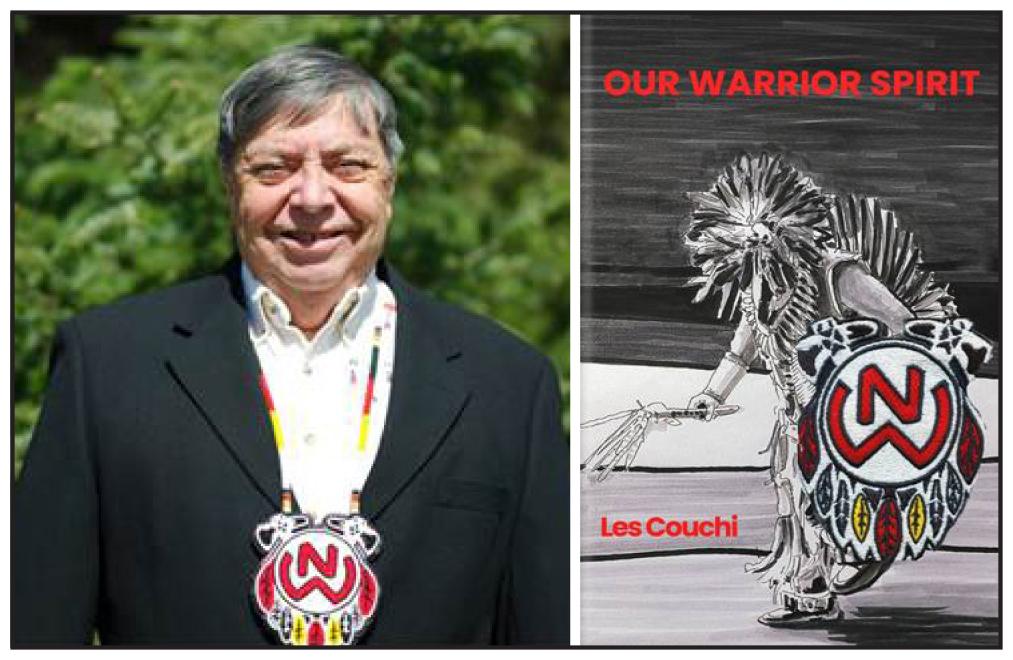
Our Warrior Spirit is writer Les Couchi’s way of paying tribute to the Elders of Nipissing First Nation.
The book came about when discussions were occurring in 2024 on how a $10 billion settlement of the Robinson Huron Treaty annuities litigation would be distributed among 21 First Nations in northeastern Ontario.
A portion of the money received by Nipissing would go into a fund for the community to use and another portion was to be paid directly to individuals.
“A lot of the younger people were asking for an equal share and I thought, they really don’t know what it was really like,” said Couchi, who suggested that the individual portion be calculated on a yearly basis and be distributed according to age.
That is what happened, but Couchi says his suggestion could have been “something that was already on the table.”
“For the most part, I don’t think many of (the young people) were too upset. There were a couple of radicals in every community that wanted that share. But I think most of them did come to realize that that would be a fair way to do it,” he said.
With his portion of the settlement money, Couchi wrote and published Our Warrior Spirit. His wife Mary Lou McKeen and sister-in-law Pearl McKeen helped with research, editing and formatting the book.
“I wanted to pay tribute to all the Elders in our community…(and) I decided that a book might be a way to do it in a permanent way,” he said.
But there is another aspect to the book. As he writes in the introduction of Our Warrior Spirit, “Could the book inspire younger generations and potentially be a “playbook” for other First Nations?”
“Playbook” is an appropriate term as integral to the story Couchi tells about Nipissing First Nation as it is to the impact of the Nipissing Warriors hockey team.
The team, brought together in the 1960s, was comprised of players from the eight communities of the sprawling 23-mile-long reserve. With few people owning vehicles, many didn’t know they had relations on the other side of the reserve, Couchi says.
“So when the team was put together, the communities began to work together,” he said.
The Nipissing Warriors played from 1965 to 1975. Not only were the players, which included Couchi who joined for the 1968-69 season, committed to the team, but the First Nation supported them, turning out to pack the arena and helping to raise funds for jerseys and sticks.
Tragedy struck on New Year’s Day 1967 when Chief Ted Commanda, a driving force in starting the Warriors team, as well as a “rough and tough” player, was shot to death.
Writes Couchi, “Ted Commanda—the man whose vision of community unity-through hockey sportsmanship—was felled by his own people…Changes in our community would be necessary. We would need to deal with addictions, promote language, education and culture, and address the atrocities of the past. Progress would start in earnest with healing and recovery as a major objective.”
Our Warrior Spirit details the challenges presented by “oppressive colonialism,” including “domination by the government, church and police and their unrelenting, pervasive controls over our lives,” poverty, racism, poor education, housing conditions, and intergenerational trauma.
Along with the painful stories of Elders from Nipissing, Couchi also recounts his own story of intergenerational trauma. It wasn’t a story he intended to share, he admits, but reading a book by NHL player and Buffalo Sabres coach Ted Nolan, a member of the Garden River First Nation and someone Couchi had come to know, changed his mind.
“(Nolan) admitted to some things in his book that I thought were very courageous. For someone of his stature to admit that he had these frailties, I said to myself, ‘Why am I so special? Why can’t I do the same thing?’ And so I did. I felt that it would…add to the story (and) to young people or other people who may have experienced what I had, and know that there’s no shame in that. And it’s not your fault. But you have to work your way out of it to be a good citizen,” he said.
Couchi’s father was one of many in Nipissing to attend the Catholic-run Indian residential school in nearby Spanish and returned home “psychologically, physically and emotionally broken.”
“I became an alcoholic when I was 15 because of the abuse I received from my father,” he said. Writing about it was difficult, he added, but “once you get a handle on some of this stuff, then you can understand it. Then you can live with it.”
Couchi entered rehab when he was 21 years old and has been sober since. He is 74.
Our Warrior Spirit also looks at the accomplishments of Nipissing, including the Warrior players who have become leaders in the community.
Couchi is one of those leaders. He worked with youth through Nipissing’s National Native Alcohol and Drug Abuse Program and, at the direction of the youth, started teaching them about their culture.
“Now that Nipissing has revived their culture and we all believe strongly in education, we now have the wherewithal to make a great future for our children. And you can see it. You can envision it,” said Couchi. “We were playing cards with the government, losing all the time. But that’s not happening anymore. I think that there’s a bright future for First Nations to feel good about themselves and to want to get even better.”
Much to Couchi’s surprise and pleasure, Our Warrior Spirit will be used as a textbook for history at the Nbisiing high school on Nipissing First Nation.
Our Warrior Spirit can be purchased online at amazon.ca. It’s also available as an e-book.