
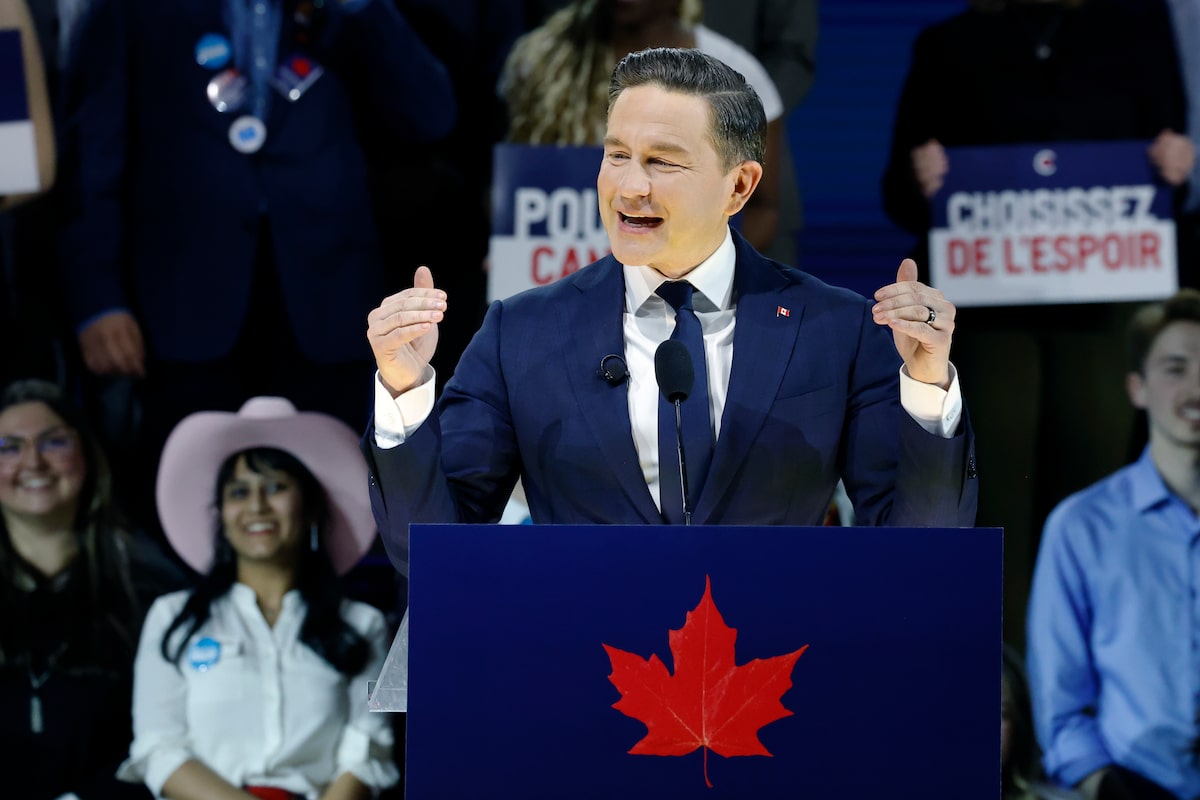
Conservative Party Leader Pierre Poilievre delivers his keynote address at the party’s national convention in Calgary on Jan. 30.Larry MacDougal/The Canadian Press
“What grade would you give Trump for his first year, overall?”
That’s the question the Angus Reid Institute asked 1,612 Canadians, in a poll conducted late last month. Two-thirds of respondents gave U.S. President Donald Trump an F. Another 8 per cent gave him a D. Just 6 per cent gave him an A.
But breaking down the results by party affiliation reveals a very different picture.
Among those who voted Liberal in last year’s federal election, Mr. Trump has almost no fans: 92 per cent gave him an F, and 5 per cent gave him a D. Zero per cent thought he deserved an A or B. The figures for NDP voters are almost the same.
Conservative voters, however, are deeply divided on the issue. Sixteen per cent gave the American head of state an A, with 34 per cent giving him a B, or a C. Only 33 per cent gave him an F.
Opinion: By calling Trumpist ideas ‘Western values,’ we’re handing dictators a gift
Mr. Trump got a failing grade from 97 per cent of Liberals. But 50 per cent of Conservatives gave him a passing grade, with one-in-six giving him the highest mark possible.
For the vast majority of Canadians, Mr. Trump is a unifying figure. When he credits himself for Prime Minister Mark Carney’s election, he’s not lying.
For the Conservative Party, in contrast, Mr. Trump is a source of division. Half of its voters are critical of his performance, according to the Angus Reid survey, while the other half are supportive.
This week’s floor-crossing to the Liberals by Edmonton Riverbend MP Matt Jeneroux is a sign of that division. On the other side of the divide, there’s Bowmanville-Oshawa North MP Jamil Jivani’s freelance trip to Washington D.C.
The Conservative MP said he was trying to help Canada improve relations with the Trump administration (via his old friend, Vice-President JD Vance), but then he gave an interview to MAGA house organ Breitbart News Network, in which he blamed a Canadian “hissy fit,” and not Mr. Trump’s tariffs and threats, for the broken relationship.
Conservative Leader Pierre Poilievre said this week that he doesn’t share those sentiments, and that Mr. Jivani was speaking only for himself. It was, finally, some mild pushback.
But in his major speech to the convention that reconfirmed his leadership last month, as Mr. Poilievre went through the issues facing Canada, he never mentioned Mr. Trump. He avoided the elephant in the room throughout his leadership campaign, because many of his MPs, members and voters have MAGA sympathies – and many do not.
Opinion: Can the U.S. finally just shut up about Canada’s defence spending?
Blame Canada – the Jivani approach – is not going to be a winner with most Canadians, and not because of hissy-fit nationalism. Blaming Canada for the President’s threats and tariffs is just factually wrong.
At the same time, dealing with the biggest issue facing Canada by ignoring it is also never going to be a winner with voters. A party that wants to form government can’t pretend that the thing Canadians are most worried about – and have reason to be worried about – doesn’t exist. Canadians want a government with a plan to tackle the problem, not a strategy to deny its existence.
There is a way for the Conservatives to navigate out of this dead-end.
Mr. Poilievre must clearly and repeatedly draw the distinction between being critical of the Liberal government and being sympathetic to the government’s primary antagonist – Mr. Trump.
Criticizing the Liberal government is normal and necessary. But imagining that the enemy of the adversary must be a friend, and that if the Liberals are wrong then Mr. Trump must be at least somewhat in the right, is dangerous for party and country.
The Liberals have successfully wrapped themselves in the flag, and by playing footsie with MAGA, Conservatives have helped them. Now would be a good time to stop.
Conservative voters, Canadians all, share some of the same concerns as many Americans who voted Republican in the last U.S. election. People worry about inflation, crime, jobs, national defence, an inefficient regulatory state, a mismanaged immigration system and woke novelties.
But the Conservative leader has to make it clear that his Canadian answers will not be Mr. Trump’s American answers.
And when it comes to Mr. Trump’s unilateral declaration of trade war against Canada, his tariffs and threats, and his administration’s insinuations of annexation and domestic interference, Mr. Poilievre must take a backseat to nobody in his defence of our economy and our sovereignty.
The Conservative Leader has to lead. He has to make it clear to his followers that criticizing the Liberals is not in any way a step to becoming an intellectual branch plant of MAGA.
For the party that refers to itself as the party of Confederation, this really shouldn’t be so hard.