
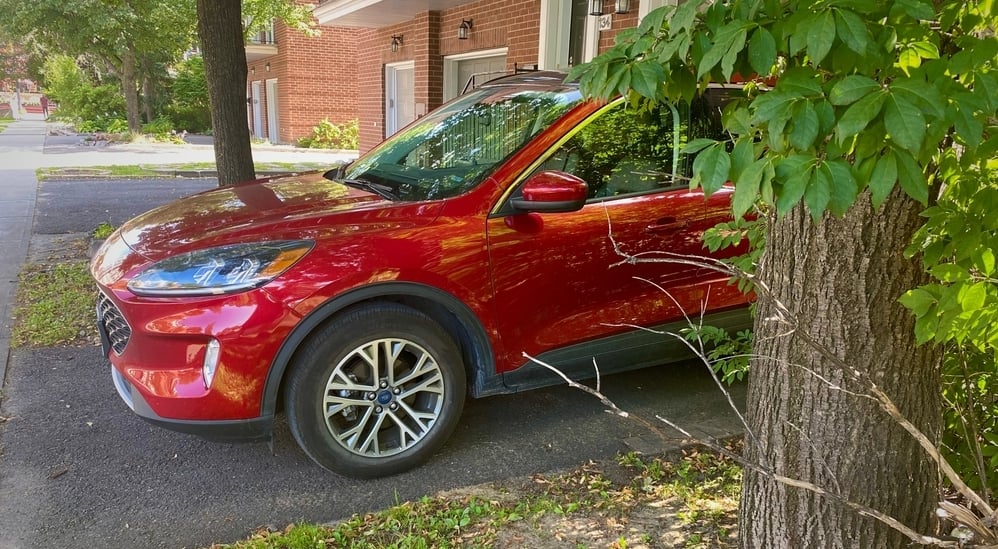
 Red SUV
Calgarian Nadine Harris knew something was wrong when she spotted a shadow moving around in her vehicle. Upon further investigation, she came to the distressing conclusion that someone was trying to break into her SUV — in broad daylight.
On January 12 while working from home, Harris noticed a vehicle pulled up beside hers and backed up a small distance. Harris assumed they were visiting a neighbour, until she recognized a thief manoeuvring around inside her SUV.
Harris rushed outside in a panic, fearing more for the loss of her vehicle than her safety, she later recounted to CBC (1): The thieves fled the scene after breaking one of her vehicle’s windows.
Unfortunately, that was only the tip of the veritable iceberg. Harris took the vehicle to a repair shop to fix the damage — that’s when they found a GPS tracker.
The small, button-shaped device has been removed from her vehicle according to the news outlet, but the discovery resulted in a cascade of other unsettling findings. Harris wondered when the tracker was installed, thinking it was potentially the day before the attempted robbery.
CBC watched a recording from Harris’s neighbours’ security camera from that night and thieves unsuccessfully tried to break into her garage — only to return 12 hours later when she inevitably caught them in the act.
“I was warned to always lock the car, never leave it sitting out on the driveway, people would steal it. But never did I think right in front of my house in broad daylight, or I would be … followed or having a tracker on it and kind of being stalked with it,” Harris told CBC.
Harris’s harrowing experience is a reminder to all Canadians that auto theft is still a real issue, even if it isn’t as ubiquitous as previous years.
Back in 2023, Canada was in the midst of an “auto theft crisis” according to the Insurance Bureau of Canada (IBC), with insurance claims for stolen vehicles topping $1.5 billion. In fact, auto theft claim costs skyrocketed 254% between 2018 and 2023 (2).
To help combat the issue, the RCMP integrated the stolen vehicle information database with Interpol in February of 2024 to help track Canadian stolen vehicles around the globe (3). The results were startling. Interpol found that more than 1,500 stolen vehicles were detected from February to May of 2024, with the agency noting that, worldwide, Canada ranked among the top 10 countries for stolen vehicles out of 137.
Story continues
To help stop the car theft epidemic across Canada, government initiatives such as the National Action Plan on Combatting Auto Theft (4) were put forward, with funding being allocated to border agencies to take custody of stolen vehicles before they got overseas.
So far, these initiatives seem to be making a material dent. In H1 2025, a study from national non-profit Équité Association showed vehicle thefts are down 19.1% compared to the same period in 2024, with 23,094 stolen vehicles (5).
According to the report, Ontario and Quebec saw declines of over 20%, but are still the areas most prevalent with car thieves. Atlantic Canada saw the smallest drop of 9%, with only 910 vehicles stolen.
Read more: Canadians spent $183B on dining and clothes in 2024. Prioritize these 4 critical investments instead and watch your net worth skyrocket
While GPS trackers remain a common method used bad actors, there are other ways they can get inside your vehicle quickly. Staff Sgt. Kerry Smith of the Calgary Police told CBC how a “hot trend in auto thefts” is thieves reprogramming key fobs to gain entrance.
With keyless driving becoming more widespread in the Canadian auto market, car thieves are taking advantage of vulnerabilities inherent in technology. The vice president of investigative services at the Équité Association, Bryan Gast, told Global News that thieves can use cheap tools to “intercept radio signals” between a vehicle and its key fob to start it, unbeknownst to the owner (6).
Gast also mentioned that once a thief enters, they can reprogram a vehicle’s key fob through its diagnostic port, which is normally used to monitor data points like mileage, emissions, and speed.
There are a variety of ways to fall victim to a car theft, but do you have any fallback if it were to happen?
According to the IBC, theft and attempted theft are considered a “specified peril,” which is an additional form of coverage that is not mandatory (7). However, it’s wise to review your specific policy to confirm what is and is not covered in the event of theft.
If your car is stolen or damaged in the process an attempted theft and you have the correct coverage, your insurance company generally pays out the actual cash value of the vehicle, which is based on the vehicle’s condition, mileage and age (8).
Although Canada is making strides in combatting auto theft, stories like Harris’s remind us that it can still happen to anyone. Here are practical and simple ways you can protect your vehicle (9).
Install a kill switch. Putting a switch in your vehicle that manually disables electricity to your ignition or fuel system can make it much harder for bad actor to start your car in a hurry. They cost around $100 or less, and many are easy to install without a professional (10).
Upgrade anti-theft defences. While not eye-catching, additional anti-theft devices such as a steering wheel lock or a diagnostic port cover can dissuade thieves. Both of these options cost $150 or less and don’t require any professional assistance to install.
Protect your key fob. These devices are an easy to manipulate with technology, so protecting them properly is paramount. A common method to prevent any remote tampering is to place them in a signal-blocking container known as a Faraday Box. These routinely sell for $20 to $100 online.
While no solution is foolproof, layering multiple deterrents can significantly reduce your risk.
We rely only on vetted sources and credible third-party reporting. For details, see our editorial ethics and guidelines.
CBC News (1); IBC (2, 7); Interpol (3); Public Safety Canada (4); Équité Association (5); Global News (6); Intact Insurance (8); Waterloo Regional Police (9); Driving (10)
This article provides information only and should not be construed as advice. It is provided without warranty of any kind.