
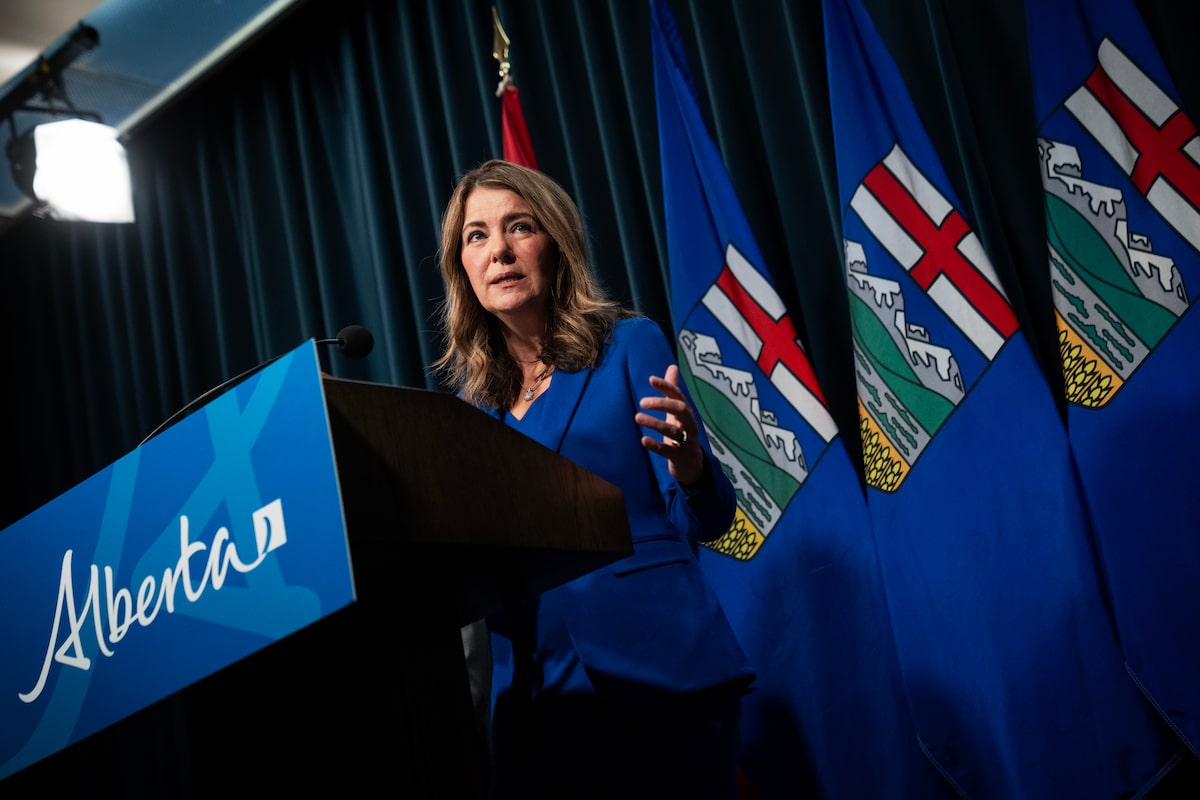
Premier Danielle Smith plans to ask Albertans if they would support a law restricting provincially funded health care, education and other social services to Canadian citizens, permanent residents and people with an Alberta-approved immigration status.Todd Korol/The Canadian Press
The Alberta Premier’s bid for more provincial control over immigration, and announcement of a referendum, is setting the table for negotiations with Ottawa, including over funding to support asylum seekers and other temporary residents, immigration experts say.
On Friday, Alberta Premier Danielle Smith spelled out details of the immigration proposals she plans to put to a provincial referendum in October.
They include asking Albertans whether the province should take increased control over immigration, prioritizing economic migration.
She also plans to ask Albertans if they would support a law restricting provincially funded health care, education and other social services to Canadian citizens, permanent residents and people with an Alberta-approved immigration status.
Alberta Premier defends fall referendum plans
Albertans would be asked if temporary residents should have to wait 12 months to qualify for provincially funded social support, and should have to pay toward health care and education.
The proposals to exert more control over economic migration to the province are in line with those in Quebec.
“What we’re looking at is a model very similar to what Quebec has had since 1991 with their Quebec Canada accord, where they have total control over their economic migrants,” Ms. Smith said at a press conference Friday.
Richard Kurland, a Vancouver-based immigration lawyer and policy analyst, said for Alberta, and other provinces, the issue of more power over immigration has been a source of tension with Ottawa for some time.
He said the Alberta Premier’s announcement of a referendum on immigration was as much a bid for more power over which newcomers come to the province, as a bid for more cash from the federal government.
Ottawa in the past few years has given large sums to Quebec to help house asylum seekers after the provincial government publicly aired its grievances over the cost of supporting refugee claimants.
“The bigger picture is setting the table for negotiation. That is what is really going on now,” Mr. Kurland said. “Alberta will make noise about the cost of health care for asylum seekers and temporary residents and Ottawa will turn on the spigot. It’s a play for more money.”
Premier Danielle Smith says in a televised address that her government is putting nine questions to a provincewide referendum on Oct. 19, including proposals to restrict social services from some immigrants. Smith says she’s not afraid of direct democracy and trusts the judgment of Albertans. (Feb. 19, 2026)
The Canadian Press
Toronto-based immigration lawyer Randy Hahn said a lot of the powers Ms. Smith wants are within the purview of the federal government.
“You could say this is a negotiating tactic. It’s an example where a province is responding to how federal immigration policy has an impact on their own arrangements and costs they incur,” he said.
Under the Constitution, provincial and federal governments share responsibility for immigration. A province can make its own law on immigration so long as it not “repugnant” to any federal Act of Parliament.
Under the federal Immigration and Refugee Protection Act, the Immigration Minister can enter into agreements with provincial governments, so long as they do not limit federal powers on who is admissible to the country.
On Friday, a spokesperson for Saskatchewan Premier Scott Moe restated a demand, previously made in 2022, that the province be given powers over immigration similar to Quebec’s.
Amid a wave of Canada-wide unity, Alberta separatists push back
Both Alberta and Saskatchewan have also been asking Ottawa to increase the numbers of immigrants they can nominate for permanent residence.
Jill McAlister-Lane, the Saskatchewan government’s executive director of communications, said Saskatchewan’s demand for similar authority over immigration as Quebec is still on the table with Ottawa.
The 1991 accord between the federal government and Quebec grants the latter more far-reaching powers over immigration than any province.
It gave Quebec exclusive responsibility for selecting economic immigrants in the province. Quebec can also set the criteria for choosing them and can advise Ottawa on the number of immigrants it wants.
The federal government sets annual target levels for the numbers of temporary and permanent residents it wants to admit to Canada. In November, it cut the number of temporary residents it plans to admit, slashing in half the number of international students over the next three years.
Gabriel Brunet, a spokesperson for Intergovernmental Affairs Minister Dominic LeBlanc, said: “We strongly believe that Albertans and all Canadians are best served when we work together, including with the unprecedented measures we have taken to bring control back to the immigration system and our shared action to build our economic advantages as an energy superpower.”
He said there had been progress in reducing asylum claims, new temporary foreign workers and international students. A bill to tighten the rules on asylum claims is being considered in Parliament.
Ottawa shakes up immigration system to bring in military recruits
Ms. Smith expressed consternation about the rising numbers of asylum seekers who have come to Alberta, criticizing the federal government for failing to control their numbers.
Asylum claims, according to IRCC figures quoted by Ms. Smith, have been increasing in Alberta from 1,995 in 2021 to 10,050 in 2024 and 7,125 until the end of November, 2025.
Ms. Smith said she wants to restrict access of asylum seekers and other temporary residents to provincially funded health care.
“If people who are coming here for temporary reasons, then they should make sure that they have proper insurance,” she said.
Far fewer asylum claims are made in Alberta than in Ontario and Quebec. In December, 2025, there were 620 asylum claims in Alberta, according to IRCC figures, with 3,590 in Ontario and 2,315 in Quebec.
Figures from IRCC show the number of asylum seekers who came to Canada reduced by slightly more than a third in 2025 compared with 2024.