
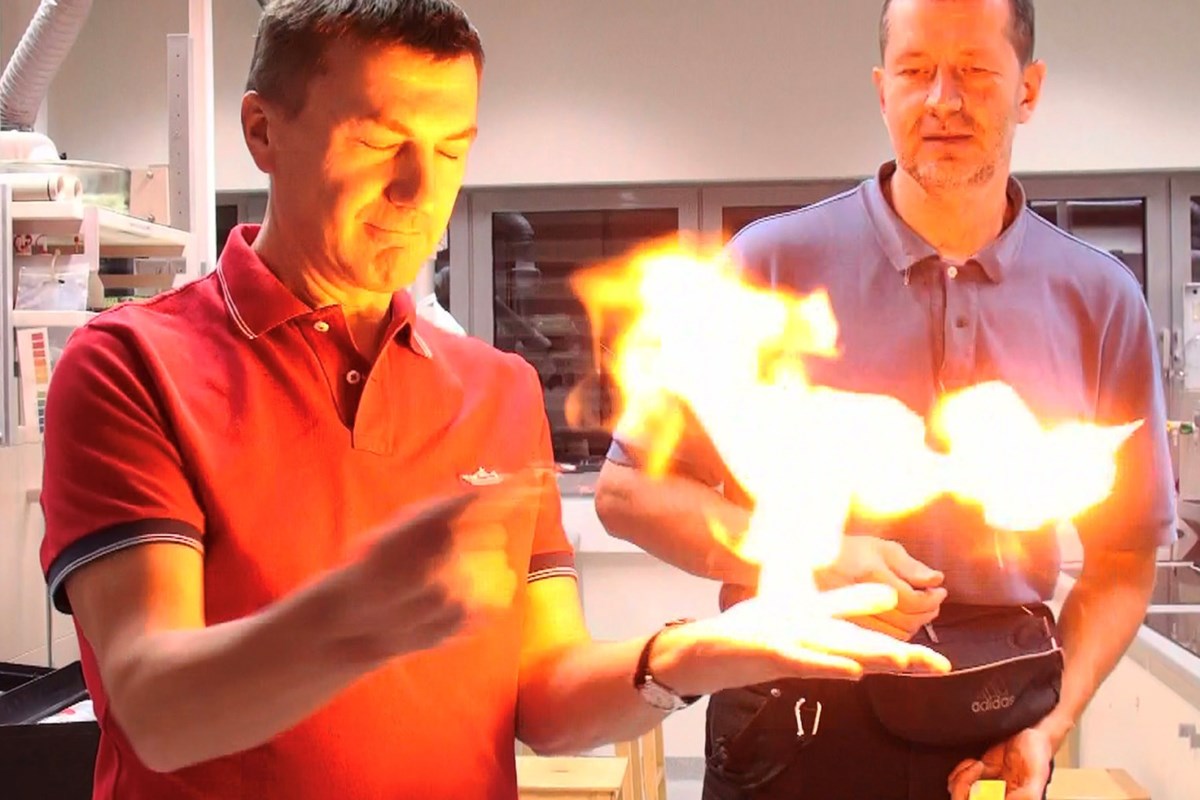
Prime Minister Mark Carney announced plans this past week to build a new facility to make nitrocellulose, the principal ingredient in gunpowder
Buried in a 58-page defence industrial strategy released this week by Prime Minister Mark Carney were brief references to a planned manufacturing plant with potential to provide a boost to northern Ontario’s struggling pulp and paper sector.
Most media reports paid little or no attention to the high priority the strategy places on building a Canadian production facility to make nitrocellulose – traditionally a key ingredient in making ping-pong balls.
But nitrocellulose has many uses beyond table tennis.
Also known as guncotton, flash paper, flash cotton, cellulose nitrate, flash string or pyroxylin, nitrocellulose is made using wood pulp.
It’s a naturally occurring polymer that’s 12.5 percent nitrogen and dries to a fluffy white material.
In the 19th century it was used to produce rayon and other early man-made fibres.
It’s a popular ingredient in nail polishes and the lacquers used to finish guitars.
Of particular interest now to the Canadian government, nitrocellulose is highly flammable and is the principal ingredient of modern gunpowder as well as solid rocket propellants and explosives.
This past Tuesday, the defence industry strategy released by Carney announced creation of a new Canadian Defence Industry Resilience (CDIR) program, with a nitrocellulose plant as an urgent priority.
“The new CDIR will provide targeted support to Canadian businesses to increase their production capacity for defence-related goods, equipment, services and materials,” the strategy document stated.
“Its initial area of focus will be supporting Canadian businesses to expand their defence production capacity for ammunition and explosives, including components and materials.
“One key component of modern munitions is nitrocellulose, a propellant used in a wide variety of firearms and artillery.
“A priority under the CDIR will be to establish a Canadian nitrocellulose production capability, with production to start in 2029.”
The new plant could be built anywhere in Canada, but the main source of the cellulose used to make nitrocellulose is wood pulp, which is widely available in northern Ontario.
Last summer, Ward 5 Coun. Corey Gardi and Ward 3 Coun. Ron Zagordo convinced Sault Ste. Marie city council to look into the feasibility of attracting “a Canadian defence/munitions production facility or facilities.”
“Locating a defence production facility in Sault Ste. Marie could significantly boost the local economy, create jobs and diversify the industrial base of northern Ontario, aligning with both the federal and provincial governments’ goals for regional development,” said a resolution approved by city council.
A report prepared in August 2025 by National Bank of Canada strongly made the case for Canadian nitrocellulose production.
“Nitrocellulose, or guncotton, is the propellant base for 155 mm artillery shells – munitions Canada already produces with domestic expertise and is scaling up to supply to allies,” the report said.
“Yet despite being one of the world’s largest wood-pulp producers, Canada makes no nitrocellulose, leaving our assembly lines exposed to foreign inputs that are increasingly in short supply.
“With Ottawa’s pledge to raise defence spending to five per cent of GDP by 2035, and a new support package for a forestry sector hit again by U.S. tariffs, the opportunity is clear: convert pulp into propellant and turn a trade-pressured industry into a cornerstone of national and allied defence.”
“Nitrocellulose is indispensable in the manufacture of smokeless gunpowder, explosives, films, coatings, textiles, adhesives, and pharmaceuticals.”
“Despite ranking among the world’s top five pulp producers, and producing some of the highest-quality dissolving pulp globally, Canada manufactures no nitrocellulose at all. Instead, we export raw pulp abroad while importing finished nitrocellulose back – a glaring vulnerability at a time when allied demand is surging and supply chains are fragile.”
“Few countries have both the resource base and industrial know-how to close this gap. Canada does – and it should act,” the bank report recommended.