
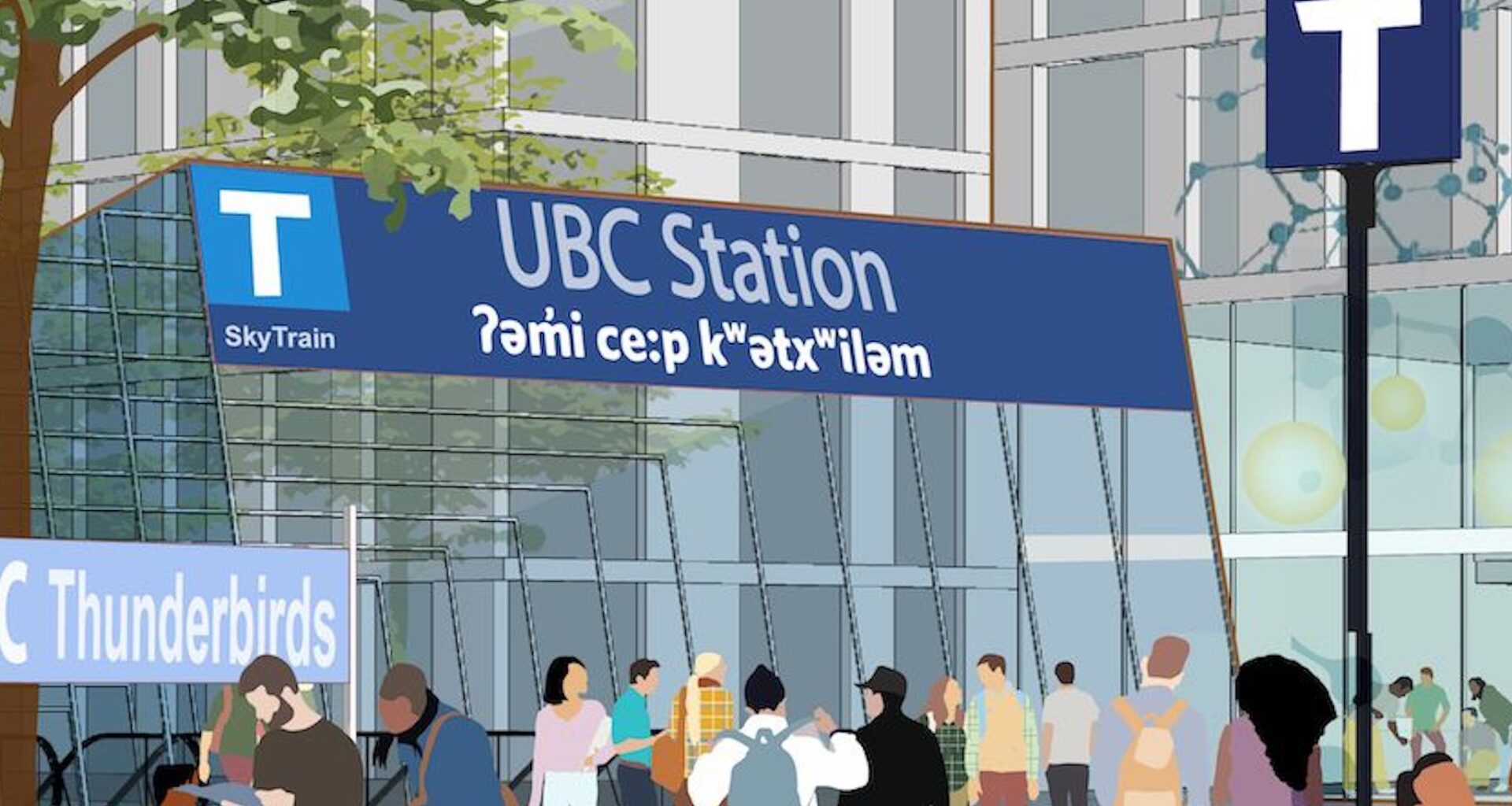
Federal Minister of Housing Gregor Robertson says he will continue to press for extending SkyTrain’s Millennium Line to the University of British Columbia (UBC), arguing the long-discussed project should remain a near-term priority as governments weigh major public transit investments across Metro Vancouver.
Speaking Friday to the Greater Vancouver Board of Trade, Robertson — who served as Vancouver’s mayor from 2008 to 2018 — acknowledged disappointment that the current Broadway Subway project was not approved to run all the way to UBC in a single phase.
“As a local here and as someone who worked hard on getting the Broadway Subway component, I was obviously disappointed when we didn’t have support across the region to go right to UBC in one shot,” said Robertson.
“That was what we were looking for from a Vancouver perspective, and I think it serves the region best.”
Robertson played a crucial role in pushing the Broadway Subway project forward throughout his mayoral tenure, including convincing TransLink’s Mayor’s Council to prioritize the Broadway Subway and lobbying the provincial government.
But with both regional and provincial politics at play, the Mayors’ Council did not agree to build the line to UBC in one go, instead deciding to extend the Millennium Line’s western terminus only as far as Arbutus Street, at least on an interim basis. At the time, in the 2010s, the Mayors’ Council also demanded that the Surrey Newton-Guildford LRT project be placed on equal footing with the Broadway Subway in terms of having roughly the same implementation timelines. That LRT project was later cancelled, with its funding redirected to the Expo Line’s Surrey-Langley SkyTrain extension.
The current subway project will extend SkyTrain west along Broadway to Arbutus Street, leaving the final leg to UBC for a future phase. The UBC extension has been a persistent topic in regional public transit discourse, given the university’s status as one of the province’s largest employment and education hubs and a major destination for daily commuters.
Robertson said the next steps will require coordination among multiple partners, including the Government of British Columbia, TransLink, the City of Vancouver, UBC, and local First Nations. He also emphasized that the provincial government will play a critical role in any future funding decision.
“There’s a number of big priorities,” he said, pointing to projects such as the George Massey Tunnel replacement, which he characterized as a “big, huge one,” as well as public transit needs on the North Shore, and growing pressure in the Fraser Valley. “Transit, the mayors, the province — I think everyone’s looking at what’s the list of priorities and how much capital do we have to allocate.”
While acknowledging those competing demands, Robertson said he wants to see available funding directed toward projects that can move quickly from planning to construction.
“I’m going to be just pushing for, let’s move the capital that we have right now where we can invest and get things built,” he said, adding he hopes the UBC extension will be included as part of a near-term solution.
Robertson said he plans to keep working with all partners to advance the project, noting that extending rapid transit to UBC remains a key goal for Vancouver and the broader region.
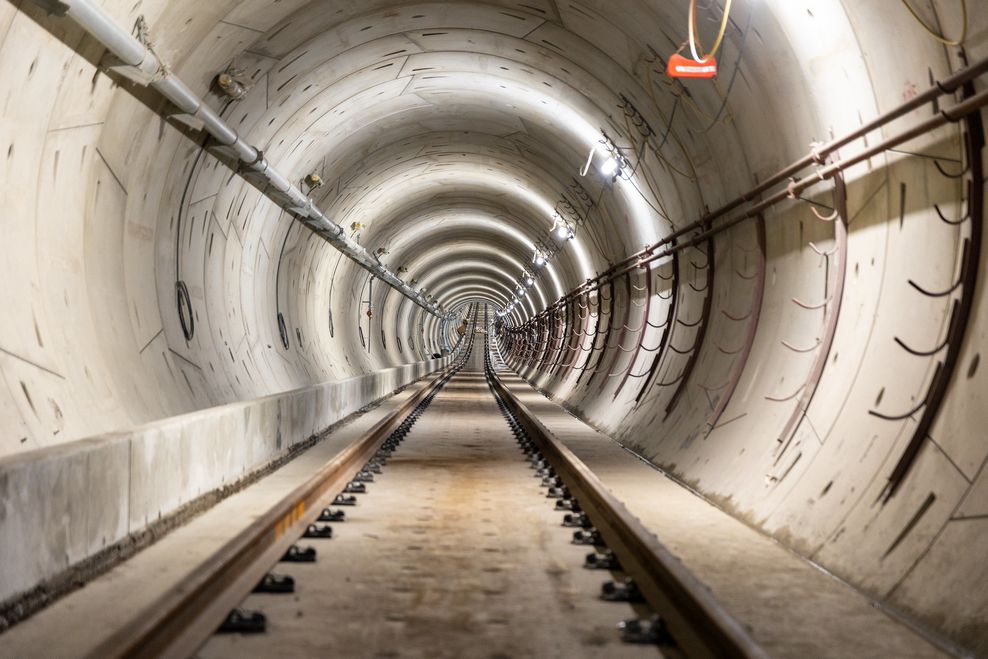
November 2025 construction progress on the tunnel for Broadway Subway. (Government of BC)
The federal housing minister also addressed criticism over Prime Minister Mark Carney’s decision to reduce the 10-year Canada Public Transit Fund (CPTF) beginning in 2026 from the $30 billion allocated by Justin Trudeau’s previous administration to $25 billion — an overall reduction of $5 billion over 10 years, falling from $3 billion per year to $2.5 billion per year specifically for public transit.
There are also concerns that the CPTF has partly diluted into Carney’s new 10-year, $51-billion Building Communities Strong Fund (BCSF) announced in November 2025, which enables a much wider range of infrastructural expenses, including housing, healthcare, schools, community centres, utilities, roads, bridges, and public transit.
The intent of the CPTF was to provide predictable, stable, significant long-term funding towards the capital costs of building new and improved public transit infrastructure across the country.
But major portions of the CPTF were also deemed to be too complex and arduous, requiring a time-intensive application and in-depth planning processes necessitating coordination between an urban region’s public transit authorities and municipal, regional, and provincial governments. This includes developing regional housing plans and transit-oriented development policies. On these aspects, TransLink and Metro Vancouver cities come far ahead of their counterparts in other parts of the country due to the B.C. government’s legislation on these matters, which have required B.C. municipal governments to adopt such strategies over the last few years.
“The [CPTF] money has not flowed. There were real challenges with gearing up and getting the money flowing out to transit for use of transit. We do a fantastic job on the ground, but the process and the way that that fund was set up has been very difficult for the transit authorities. So money has not been flowing, which is problematic,” said Robertson.
“What I’m bringing forward with my colleagues is we’re streamlining the funding in the Canada Public Transit Fund. We’re going to move it faster.”
Robertson clarified that over the next 10 years, there is $25 billion dedicated completely to public transit from the CPTF, and a separate $51 billion from the BCSF, which could be directed to public transit among the wide range of permitted uses.
“Overall, it’s about being more flexible, being more responsive, moving that investment a lot faster. We have to change the speed or the pace of government and investing right now. We have to move faster,” added Robertson.
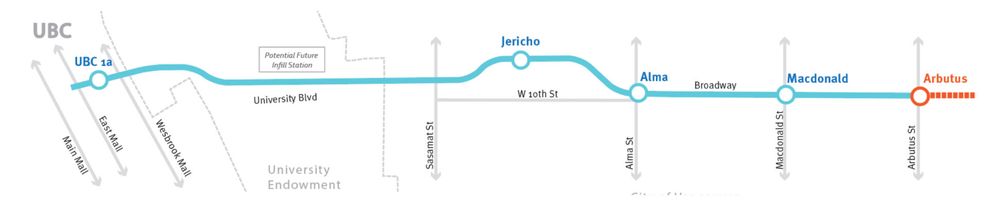
TransLink’s recommended route and station locations for UBC SkyTrain, April 2022. (TransLink)
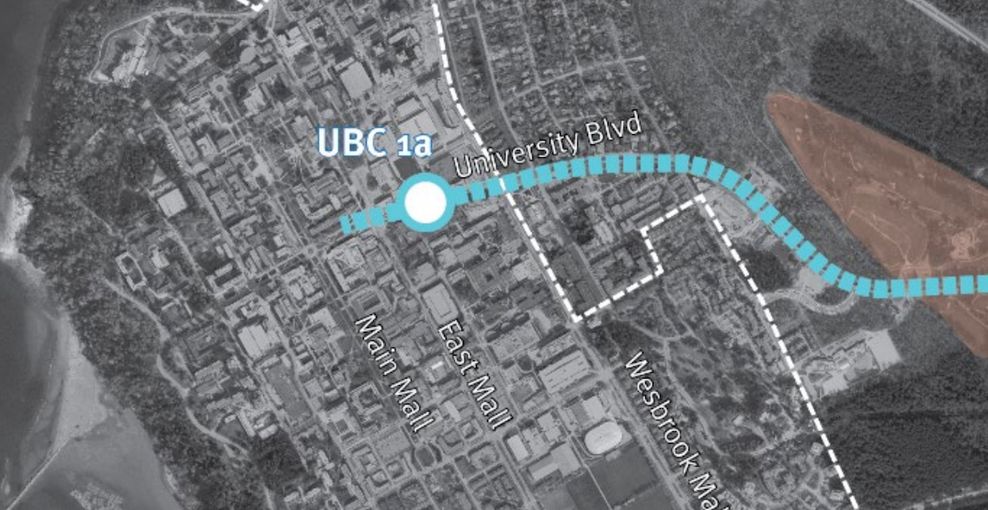
Terminus station location for the UBC SkyTrain extension of the Millennium Line, April 2022. (TransLink)
The $2.95-billion, six-km-long, six-station Millennium Line extension reaching the new Arbutus Station will reach completion and open in Fall 2027. The remaining journey to the UBC campus will be performed by a truncated 99 B-Line route from Arbutus Station, which will become one of the SkyTrain network’s busiest stations overnight when the subway opens.
The remaining SkyTrain route from Arbutus to UBC is roughly seven km, with potential station locations at Macdonald Street, Alma Street, Jericho Lands, and the vicinity of the intersection of East Mall and University Boulevard.
The provincial government is currently leading the detailed design and technical planning of the UBC SkyTrain, which is anchored by the business case work. This current work carries a cost of about $40 million, with $14 million provided by the federal government.
This includes conducting geotechnical test boring in 2024 along the entire route at 100-metre intervals to extract soil samples.
As of September 2025, a significant portion of the business case has been finished, with the provincial government indicating at the time they were working on the financial framework and needed about another year.
TransLink’s Mayors’ Council’s 10-year plan calls for the construction of the UBC SkyTrain extension in the early 2030s.
But with the provincial government’s current financial challenges and competing priorities, they are looking to reduce taxpayer-supported debt, which also includes slowing down the pace of starting new major infrastructure projects.