
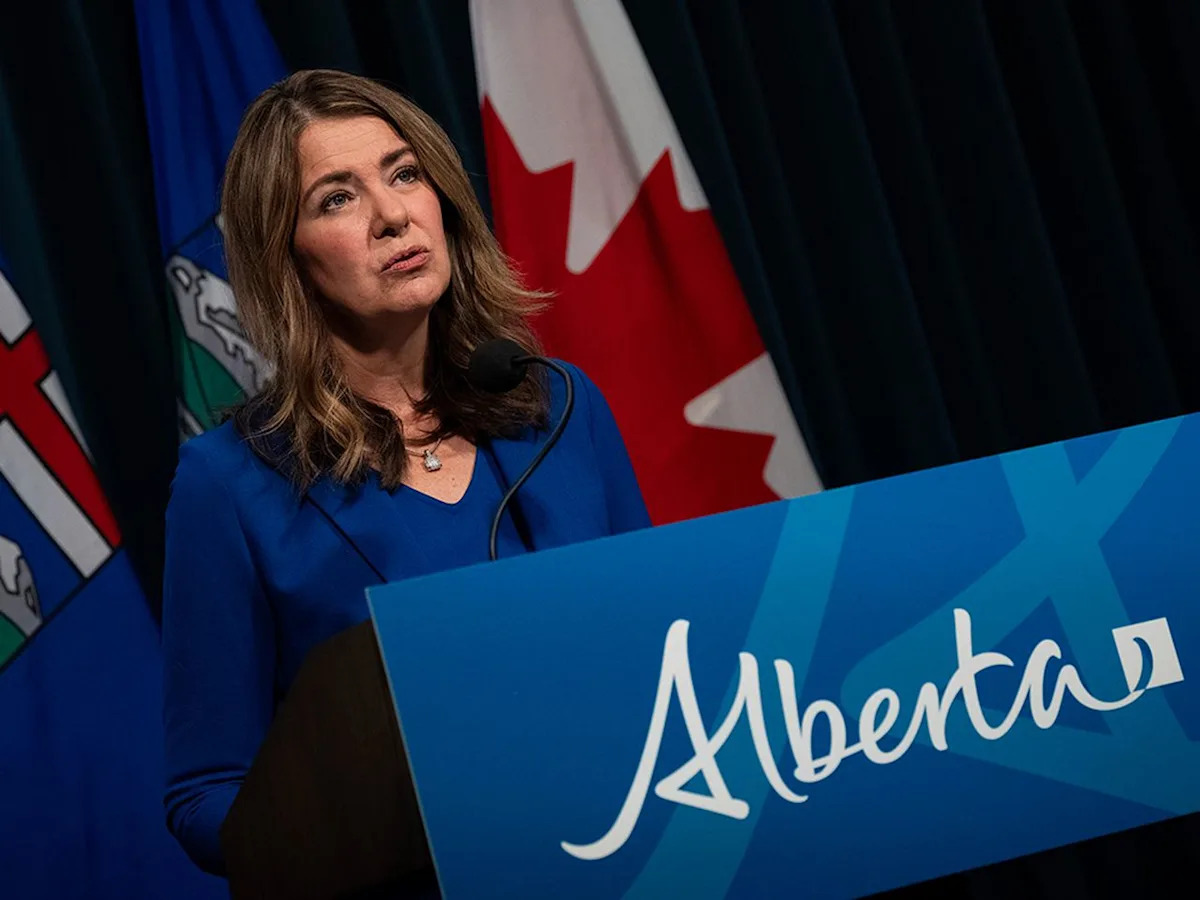
Ottawa sees Alberta Premier Danielle Smith as the enemy, much as her predecessor, Peter Lougheed, was in federal crosshairs decades ago, says political insider Norman Spector. And, he adds, Ottawa is “working hard to destroy her, with much more support in Alberta than in the ‘70s, rather than working with her to address Alberta’s concerns.”
In a televised address Thursday evening, Smith changed up the game, in effect, giving Albertans an alternative to the pro-separatist vs. status quo referendum question expected to be put to Albertans in October. She’s given Albertans a third, less radical option, Norman observes, “in effect, she’s divided the vote of Albertans who are dissatisfied with the status quo.”
In the provincial referendum she announced on Thursday, scheduled for Oct. 19, Albertans will be asked yes/no questions about provincial immigration, and collaboration with like-minded provinces to amend the Constitution to give more powers to provinces.
“She put meat on the bones of her oft-stated position: a sovereign Alberta in a united Canada,” Norman tells me. “It will be interesting to see if this lessens the criticism of her being a separatist, whether Carney and other provinces take up her proposals and agree to restart constitutional negotiations and whether Ottawa enters into negotiations toward an immigration agreement with Alberta.”
Smith was facing growing pressure to denounce Alberta independence proponents — from the NDP opposition and well-organized pro-federalist campaigns in the province, and from other premiers. B.C. Premier David Eby demanded Smith condemn as “treasonous” meetings by Alberta separatists with Trump administration officials, and Ontario Premier Doug Ford publicly called on Smith to take a stand against the separatists. Smith’s defiant response: “I’m not going to demonize or marginalize a million of my fellow citizens when they’ve got legitimate grievances.”
How does Norman interpret Smith’s tabling of a third, less radical option? She’s adopted former Quebec premier Robert Bourassa’s approach — that led to more traditional federal-provincial negotiations like we saw at Meech and Charlottetown — “rather than the knife-to-the-throat strategy that (Stephane) Dion’s father recommended as the only way to bring about change,” Norman asserts.
He’s not optimistic this approach will be any more successful for Alberta now than it was for Quebec in 1986. Will Ottawa and the other provinces cooperate, he asks. “They did at the beginning of Meech, but other provinces and First Nations added items and it failed in the end in the Charlottetown referendum.”
“It’s very hard to amend the Constitution,” he says, emphatically.
I’ve interviewed Norman a few times to talk about what happens behind closed doors in federal-provincial relations in Canada. He was part of Ontario’s delegation at the 1979 First Ministers Conference, and part of B.C.’s delegation at the same meetings in 1981, before moving to Ottawa in 1986 to mediate federal-provincial relations during the Canada-U.S. free trade negotiations. After that, he was Brian Mulroney’s chief of staff.
We had also connected, earlier in the week, to talk about what’s unfolding in Alberta; Norman observes that Smith is getting pummelled, “mainly for political reasons and ideological reasons, both internally and externally.” Whereas over 40 years ago, he recalls, Lougheed could go toe-to-toe with Ottawa and speak for Alberta, with little opposition from Albertans.
“I’m seeing quite a bit of what I saw in Toronto in the ‘70s happening now,” Norman shares, “particularly in media and in Ford’s position.” He can’t resist taking a jab at Ford, suggesting the Ontario premier is “more bellicose and much less sophisticated than Bill Davis.”
Lougheed was vilified for the same reasons as Smith, Norman asserts, but there are differences. “Canada has changed and Alberta has changed, and he (Lougheed) was able to fight PET (Pierre Elliott Trudeau) to a draw.”
In their heyday, B.C. premier Bill Bennett and Lougheed “admired each other and worked well together,” he elaborates. As well, Saskatchewan premier Allan Blakeney was not an enemy and the NDP in Alberta was basically non-existent.
“Another thing that’s different,” Norman explains, “is that Smith has been under attack across the board.” She’s challenged the Canadian consensus in multiple ways, and become a target, he observes. “Policy-wise, she’s a bigger threat than Lougheed, but in her mannerisms,” he observes, “she’s not more provocative.”
And to my great alarm, he adds, “Not sure how much the gender thing matters, but it’s hard to dismiss it.”
What’s critically different now is Trump, who is watching and perhaps waiting
Smith’s in a tight spot; we agree. Nearly three months after the much-vaunted signing of an energy MOU between Ottawa and Alberta, no significant progress on a new private-sector bitumen export pipeline to Asian markets has been reported. Last week, Enbridge’s CEO announced the company will not lead or fund a West Coast pipeline venture.
With that in mind, before Smith’s speech I had asked Norman: “What’s your advice to the Alberta premier?”
“I’d advise her to address the province, state her position clearly and point to the (pipeline) MOU as her way of addressing Albertans’ concerns,” he responds. And, tell Albertans she’ll report back — one week before any separation referendum (which has yet to be triggered via petition) — on the results achieved as a result of the MOU.
Norman’s recommending hardball; dial up the pressure on Ottawa and the rest of Canada. “She has to make it starker,” Norman asserts, hint more strongly of the consequences, but never use the “s” word. “What’s critically different now,” Norman ominously cautions, “is Trump, who is watching and perhaps waiting.”
Smith had initially used the knife-at-the-throat strategy employed by Quebec in decades past, Norman observes. “It has worked fairly well in forcing change in Ottawa,” he suggests, “and I can understand why a premier of Alberta is looking at Quebec not just because of equalization!”
Canadians resented Quebec employing that strategy, Norman acknowledges, but Quebecers were united and Ontario fearful about Quebec leaving, and took it seriously. “Trump, in my opinion,” he cautions, “is why we should be just as concerned about Alberta leaving.”
“Carney is ragging the puck with Trump, and I suspect he’ll go to the polls before July and try to preempt Smith with the same move,” Norman warns. “Carney has an open road paved by Trump,” he asserts, “and Canadians need to understand the threat.”
And if he were advising Carney? “I’d advise him to take the concerns of Alberta seriously and make sure that the MOU does not turn out to be a nothingburger and, with never-say-never Trump watching and perhaps waiting, to forget about an election now, however tempting that might be.”
But, Norman observes, “there’s no knife in what she’s now proposing.”
Smith has turned down the heat, taken the pressure off Carney, and the wind out of the sails of the secessionists, Norman observes, and in doing so, has reduced the risk of Trump jumping in. Yet, he observes, “it remains to be seen what cooperation with Ottawa produces on the pipeline front.”
“I should say one last thing: If Carney doesn’t take the MOU seriously and really screws Alberta, (Smith) still has the option of making a different speech a week before Albertans vote in the referendum.”