
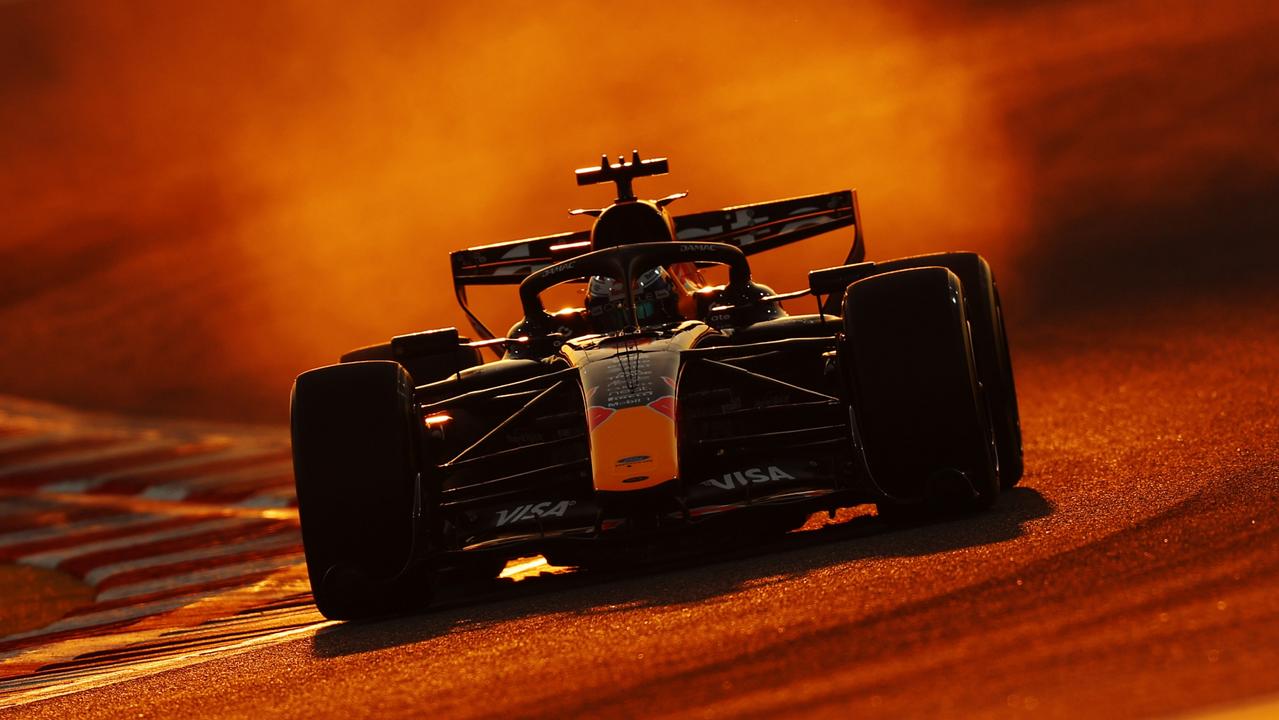
Formula 1 CEO Stefano Domenicali has called for calm amid criticism from drivers and scepticism among teams of the sport’s new regulations.
F1 has all-new rules for both chassis and engines in 2026 in the biggest regulatory shake-up in generations.
The rules have been built around the new power unit, which retains its basic turbo-hybrid V6 architecture but with electrical energy boosted to 350 kilowatts, almost matching the 400 kilowatts produced by the internal combustion engine.

Fox Sports, available on Kayo Sports, is the only place to watch every practice, qualifying session and race in the 2026 FIA Formula One World Championship™ LIVE in 4K. New to Kayo? Join now and get your first month for just $1.
Though the engine is extremely powerful when operating at full capacity, at most tracks the cars can’t regenerate enough electrical energy in the braking zones to avoid running out of charge various times around the lap.
The chassis rules have included active aerodynamics in response, with a low-drag straight-line mode introduced to try to reduce the hybrid motor’s workload, though in practice it boosts output by only a matter of seconds.
Drivers have had to adapt to new styles of driving, including aggressive lifting and coasting as well as the unusual use of lower gears to keep up the revs to charge the battery.
The cars also automatically ‘super clip’ power from the internal combustion engine to redirect it to the battery at various points around the track.
It’s led to all four of the world champions on the grid criticising the regulations in some way, though Max Verstappen’s implication they could lead him to quit F1 is far removed from Lewis Hamilton simply describing the rules as too complicated.
Some teams are also calling for last-minute rule changes to alter the way the cars behave, though limited unanimity among the constructors strongly suggests a healthy dose of self-interest at play.
With barely a week until first practice at the season-opening Australian Grand Prix in Melbourne, Domenicali says drivers, teams and fans shouldn’t fear change, and he’s called for calm ahead of the start of competition.
“I don’t feel this anxiety,” he said, per Autosport. “We need to stay calm because when there is something happening with new regulations there’s always the doubt that everything is wrong.
“I don’t understand what all this panicking is that’s going around, because there will be incredible racing, there will be a lot of action, and that’s why, as I said, prudence is always part of my style.
“In any case, if something is not as we would [want it], I think that the credibility of the sport is we can sit down with responsible people, the technical people and the FIA, to find solutions.
“I want to reassure the fans that this is an incredible spectacle, because I was just on the track to see outside with a fan’s eye. I didn’t see any difference whether it was speed, sound.
“Of course the most sophisticated fans will understand the different sounds in a certain situation, but I guarantee that the 99.9 per cent of the fans will not feel that, because it’s impossible.
“Therefore I want to be positive in that respect, and as I said, if something has to be rectified, there will be the time and the measure that we can do together as a system to react.”
MORE FORMULA 1
Where Piastri’s McLaren stands ahead of Melbourne — and the sport’s clear crisis team
Mercedes boss unloads over bitter F1 feud… and immediately regrets joke
Doohan’s F1 dreams remain… as shock ‘option’ emerges
Jack Miller: 2026 Starts Now | 07:52
‘YOU KNOW MAX HAS A WAY OF SAYING SOMETHING…’
Domenicali also played down some of the criticisms from the drivers.
Verstappen described the hybrid-centric formula as “Formula E on steroids”, while Fernando Alonso quipped that super clipping made his car so much slower at some parts of the circuit that even the Aston Martin chef could drive it.
Norris was initially positive about the rules, though he has since described them as “certainly not the purest form of racing”. Hamilton opined that the rules were so “ridiculously complex” that “you need a degree to fully understand it all”.
The Italian CEO said opinions had already shifted over the three weeks of testing and that the drivers were constructive behind closed doors.
“I had a meeting with all the drivers here, and everyone understands it’s different, but there is a very big wish of being constructive,” he said.
“You know Max has a way of saying something that could be sometimes interpreted in a certain way. I guarantee to you that Max loves and cares about Formula 1 more than anyone else. He has a way of putting the point that he wants to say in a certain way, but we had a very constructive meeting.
“We’ll have a very constructive meeting also with the federation and the teams to highlight what his points of view are of what he believes needs to be done to keep the driving style at the centre without changing the approach.
“By the way, the comments of the first day are already different from the comments of the third day of driving. This will evolve. I’m pretty sure that when we’re going to sit down together in the middle of the year or at the end of the year, you will see a different picture.”
Feeney visibly distressed after victory | 01:39
RULE CHANGES BEING PREPARED DESPITE ASSURANCES
Despite Domenicali’s optimism, the FIA and the teams are already preparing contingency plans if the opening rounds of the season see their worst fears realised.
Australia is expected to be among the most difficult circuits for the hybrid motor, as is Saudi Arabia, the fifth round of the championship. Japan, round 3, will also require significant compromises.
Several possible solutions have been floated to avoid some of the more extreme energy management required.
One is to allow the cars to regenerate more energy through super clipping.
Currently the car can automatically divert power from the internal combustion engine to the hybrid motor to charge the battery at certain parts of the track. Despite the hybrid motor being 350 kilowatts, it’s limited to 250 kilowatts in reverse, when it’s harvesting power rather than deploying.
One idea is to boost that limit to the full 350 kilowatts, making super clipping more productive. That would make cars slower at certain parts of the track but in exchange for more power elsewhere.
Reducing the maximum power output from 350 kilowatts down to anywhere as low as 200 kilowatts is another idea. That would effectively make the battery last longer, though this would also come at the expense of less power overall — for example, by neutering the currently very impressive acceleration speeds.
Though both options would affect power — whether at only certain parts of the track or the overall maximum output — theoretically lap times would remain just as fast. The difference would be that drivers can drive the car in a more natural way. There would be less lifting and coasting — lifting off the throttle for a period of time at the end of straights before hitting the brakes — and less of a requirement for novel gear selections and other driving tricks currently practised to keep the battery full.
It would also make preparing for qualifying laps less delicate, with drivers currently needing to balance tyre warm-up with starting the lap at 100 per cent charge.
Both options, including both options together, were trialled during the final Bahrain test with the approval of the FIA.
“I can really assure you that in the F1 Commission there has been an open discussion to put on the table possible solutions to address this [lack of energy] issue,” Domenicali said.
“There’s going to be a meeting before the start of the season to avoid over-reaction, because it’s pretty clear we need to avoid over-reaction.
“We just stepped into a new journey, so that’s why we need to stay calm.
“If there is something that is useful and can be implemented straight away, I’ve seen a very open approach by the FIA and also the teams showing the same kind of approach to eventually solve this kind of issues that are on the table to be solved and fixed.”
Broc Feeney wins third Supercars race | 02:57
DOES IT MATTER ANYWAY?
Domenicali, as F1 CEO, is naturally preaching calm, but he also rightly argues that there was considerable consternation over the 2014 rules early that season, almost all of which was found to be misplaced once racing got underway.
The then F1 CEO, Bernie Eccelstone, along with then Ferrari president Luca Montezemolo, famously called for a crisis meeting about the apparent dearth in on-track action and spectacle on the Sunday of the Bahrain Grand Prix, shortly before Hamilton and Nico Rosberg’s memorable race-long duel left both executives with considerable egg on their faces.
The engine formula lasted 12 years without being considered a particular hindrance.
It’s also worth remembering that Formula 1’s fan base has grown significantly in the last five years. New fans will have no particular affinity for the previous naturally aspirated V8 era, and even fewer will have experienced a V10 or V12 car in the flesh.
Hybrid engines have become very much part of Formula 1’s DNA.
“I am pretty confident this will evolve in a situation that, at the end of the year, no-one will remember what we are talking about today,” Domenicali said, per the BBC.
“With all respect to all these technicalities we are taking about, it is something in the inner business of F1. [For] our 900 million fans, it is not in their business.
“What has to be protected is having great racing, great overtaking opportunities, great challenge to the drivers to show they are best. If these points are not taken, we need to intervene and restart immediately.
“The cars are really beautiful, the sound is very nice, and if you go around the track [in Bahrain], it seems that there is the car like it was last year, and that’s very important for the one that are very specific technical details to understand.
“Don’t be worried about the energy management. We’re going to solve that — if we need to solve it, by the way.”
He added that the outcome of the Australian Grand Prix and the subsequent early races shouldn’t be taken on their own given the newness of the rules, with development both technically and in understanding likely to change the game quickly.
“There is a build-up to an incredible season where a lot of people have different opinions, but as always, when we start the first race in Australia, we’re going see the truth for that race [only], with the possibility that we can see different situations from track to track that will give different situations to understand,” he said, per Racer.
“I wouldn’t make a final conclusion after the Australian race at all, whatever it would be, because it would be very, very premature — believe me on that.”
The boss insisted that concerns over the new rules would dissipate once the lights go out in Australia.
“Everyone will be focused on winning the race, and that’s the focus that has to be remembered,” he said, per Racer. “The winner will always be the fastest or luckiest. Nothing will be different from the past in that respect.”