
Breadcrumb Trail Links
The Backyard Astronomer: A lunar eclipse is completely safe to observe and enjoy as the full Worm Moon slowly turns a darker orange
Published Feb 22, 2026 • Last updated 23 hours ago • 2 minute read
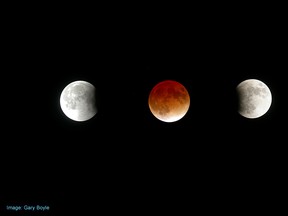 An example of lunar eclipse. Photo by SuppliedArticle content
Throughout the weeks and months, we see the sun by day and the moon by night. But a few times each year, they line up along with Earth to produce spectacular solar and lunar eclipses. We do not see an eclipse each month because of the Moon’s slight tilt in its orbit around the Earth.
Advertisement 2
This advertisement has not loaded yet, but your article continues below.
Article content
Sometimes the bright full moon appears above Earth’s shadow projected in space, while in other months it is located below the shadow. When the alignment is just right, the Moon slips into this cone of darkness.
Article content
Recommended Videos
Article content
This celestial dance will unfold in the early morning hours of March 3. The eclipse will be seen in its entirety from the Pacific and Mountain time zones, whereas farther east, the moon will set before the entire show is over.
In Sudbury (Eastern Standard Time), the eclipse begins at 4:50 a.m. The mid-eclipse will be at 6:33 a.m., and the moonset will be at 6:39 a.m.
A lunar eclipse is completely safe to observe and enjoy as the full Worm Moon slowly turns a darker orange as sunlight bends through our atmosphere, like a red sunset. This is in stark contrast to the Feb. 17 annular solar eclipse, where special eclipse glasses were needed. Fear not, only the penguins would have seen it over Antarctica.
Advertisement 3
This advertisement has not loaded yet, but your article continues below.
Article content
While the eclipse is underway and on any clear night for that matter, check out the brilliant planet Jupiter high in the sky that sets around 4 a.m. Then there is Orion the Hunter and other brighter winter constellations. Today’s cellphone apps will help guide you through the starry shapes.
The path of totality for the next solar eclipse occurs on Aug. 12, stretching from Greenland down through Spain, best viewed during ocean cruises. The sun will be covered for a few minutes, depending on where you are. On the night of Aug. 27 into the morning of the 28th, North America will witness a partial lunar eclipse. During mid-eclipse, 96 per cent of the moon will be immersed in the Earth’s shadow.
Known as The Backyard Astronomer, Gary Boyle is an astronomy educator, guest speaker and previous monthly columnist for the Royal Astronomical Society of Canada, as well as past president of the Ottawa Centre of the RASC. He has been interviewed on numerous Canadian and US radio stations as well as in newspaper articles. In recognition of his public outreach in astronomy, the International Astronomical Union has honoured him with the naming of Asteroid (22406) Garyboyle. Follow him on Facebook and his website: www.wondersofastronomy.com.
Article content
Share this article in your social network