
Russian archaeologists revisited a mummified woman originally found in 1994 to discover that she received a first-of-its-kind jaw surgery, illuminating how sophisticated the Iron Age Pazyryk culture was in the field of surgery, as their extreme living conditions made it necessary.
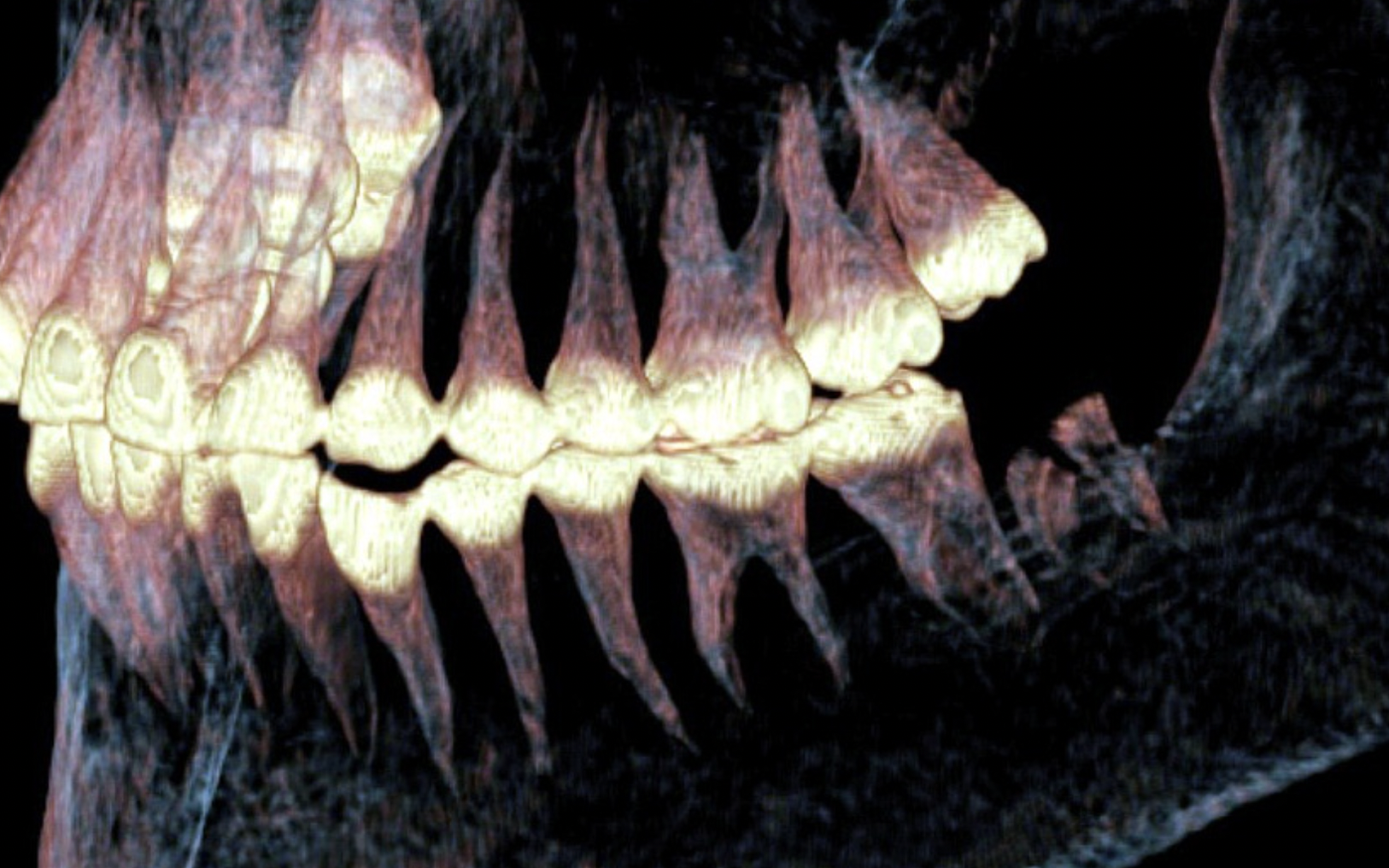
Over 2,500 years ago, researchers believe that a 25- to 30-year-old woman most likely fell off a horse, as the Pazyryk were a nomadic culture, and suffered terrible injury to her jaw, as the CT scans revealed. However, they showed much more, the signs of elastic used to stabilize the jaw, according to a translated statement by Novosibirsk State University.
According to Dr. Andrey Letyagin, a radiologist at the Siberian Branch of the Russian Academy of Sciences, “It is possible that we have discovered evidence of such a surgical procedure for the first time.” Penetrating not only the injury but also the complex surgical intervention, researchers revealed a fascinating slice of surgical history, as the Pazyryk (and Egyptians) demonstrated superb skill, shaped by adversity.
Back in 1994, archaeologists at the Russian Academy of Sciences uncovered a woman who, it would turn out, possessed a groundbreaking jaw. Laid to rest with a wig, on a wooden cot, in a cemetery on the Ukok Plateau, her grave lacked artifacts, suggesting she was of a lower socio-economic class.
As only part of her head was mummified, her case was overlooked, but a recent team “wanted to learn as much as possible about her,” Natalia Polosmak said in a statement. All that was left was her skull. Gizmodo continues that the results of the CT scans astonished researchers because her right TMJ, near the ear, had been destroyed.
According to a statement, a working knowledge of surgical procedures would have been necessary, as the Pazyryk lived in harsh conditions that threatened their lives. “If they had…not used surgical techniques, how would they have survived…?” However, researchers knew little about the surgeries they could perform until now, though their needlework would suggest hands already prepared for surgery.
Given the injury, she wouldn’t have been able to eat or speak. Without surgery, however, according to researchers, she would have died. Her skull would incurred permanent damage, as it would have been distorted or depressed on the right side, as per the press release, which affected her appearance.
A society that took care of its own
Before the invention of anesthetics, however, or, as far as we know, researchers found thin canals had been drilled along with a ligament structure, converging at a right angle. Most likely, researchers stated in a press release, that she had to keep her mouth open during the procedure, which was carried out in two stages. The holes in the bone had been drilled “very smoothly,” and bone tissue subsequently grew around the holes.
An elastic material, made of horsehair or animal tendon, held the articular surfaces together, allowing the woman to miraculously move her jaw, but she could not chew on the right side. That put significant pressure on her left side, so the teeth were severely damaged, with notable inflammation.
Though her burial exemplified nothing extraordinary, as a woman with no status, the surgery demonstrates that the Pazyryk took care to tend to the sick and injured in their society, regardless of their station, Gizmodo reported. They were all laid to rest in a wooden coffin, which was a valuable material in this society.
“We don’t know what her personal value to society consisted of,” Polosmak said to Gizmodo. But, “in this society, everyone was valued in life, simply, for their existence and honored after death.”