
The general consensus around gravel tyres is that wider is faster. Professional riders like Dylan Johnson have been banging this drum for a few years now, and nearly every pro bike we saw at The Traka last year had the limits of clearance pushed to the point that paint was definitely going to be removed should things get muddy, which they did.
This has been somewhat fuelled by our own studies last year into road tyre width, where we concluded that wider road tyres were faster for nearly everyone, even going up to 40mm slicks.
Much of these studies, ours and others’, have been based purely around rolling resistance data, taken either from a rolling resistance rig, or by our preferred method of a pedalling efficiency rig, which we will come to in the methods section shortly.
The issue with taking only rolling resistance data is that it doesn’t account for the fact that wider tyres present a greater frontal area to the wind, and as such, should be less aerodynamic.
Image 1 of 13
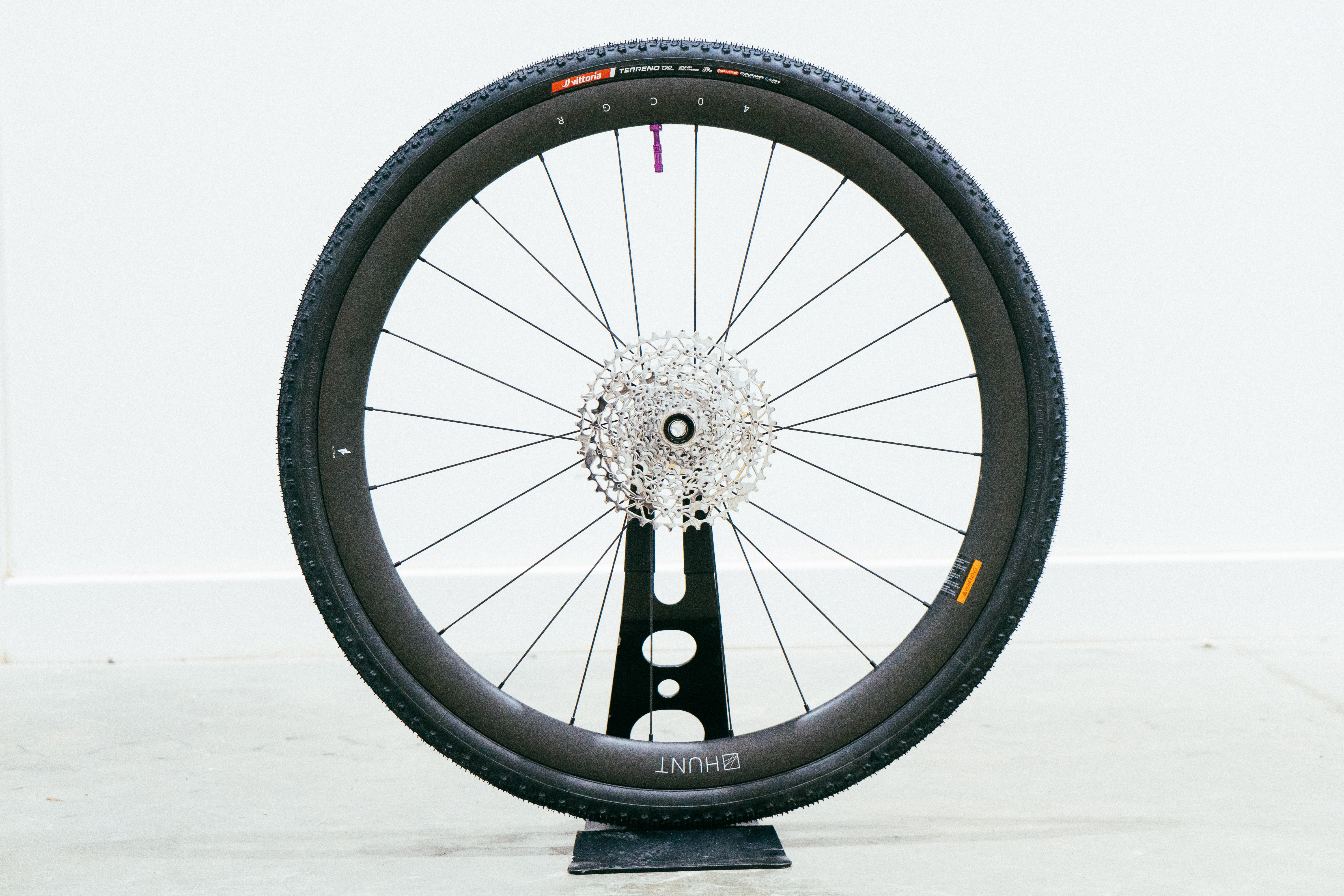 Hunt, 38mm(Image credit: Will Jones)
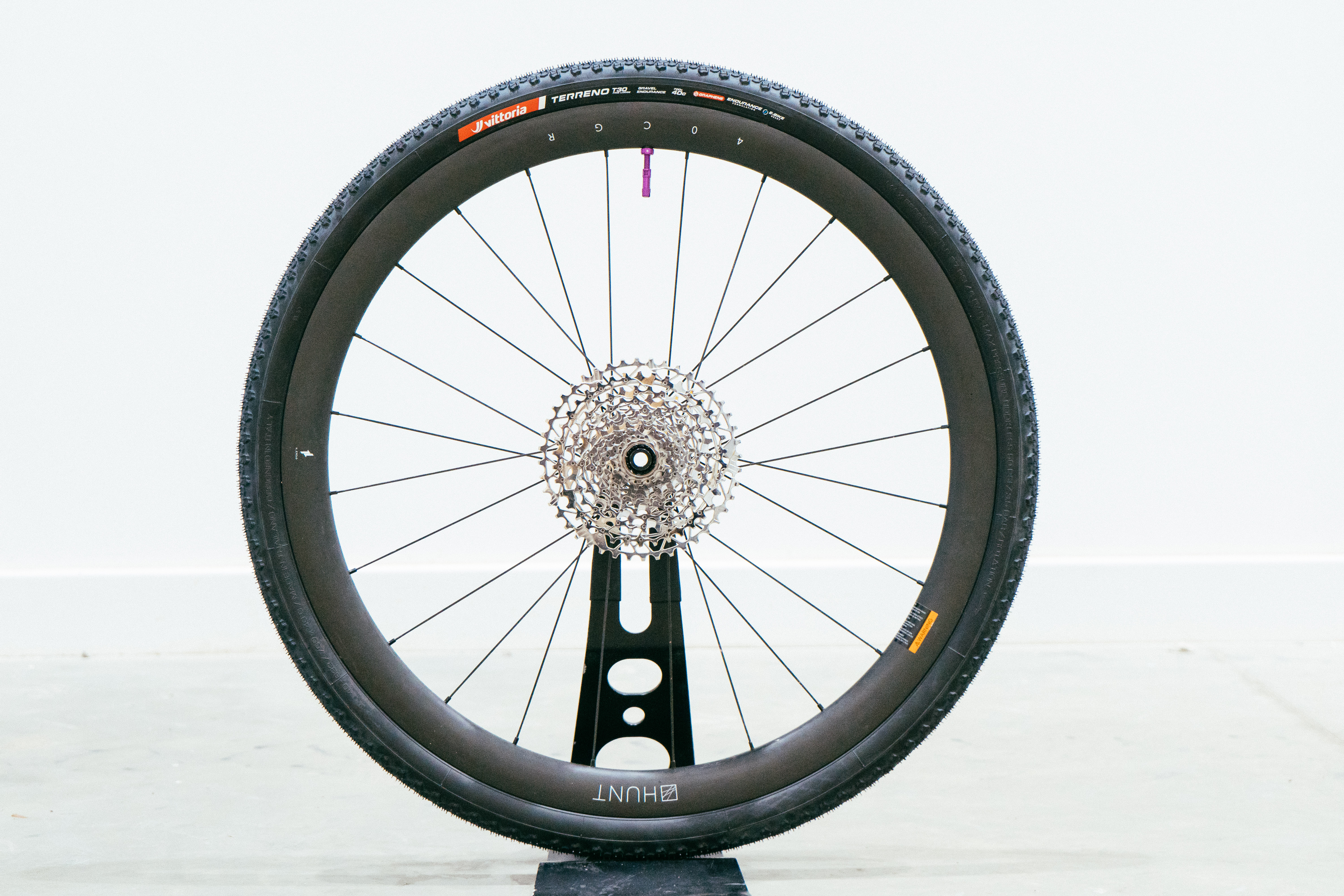 Hunt, 40mm(Image credit: Will Jones)
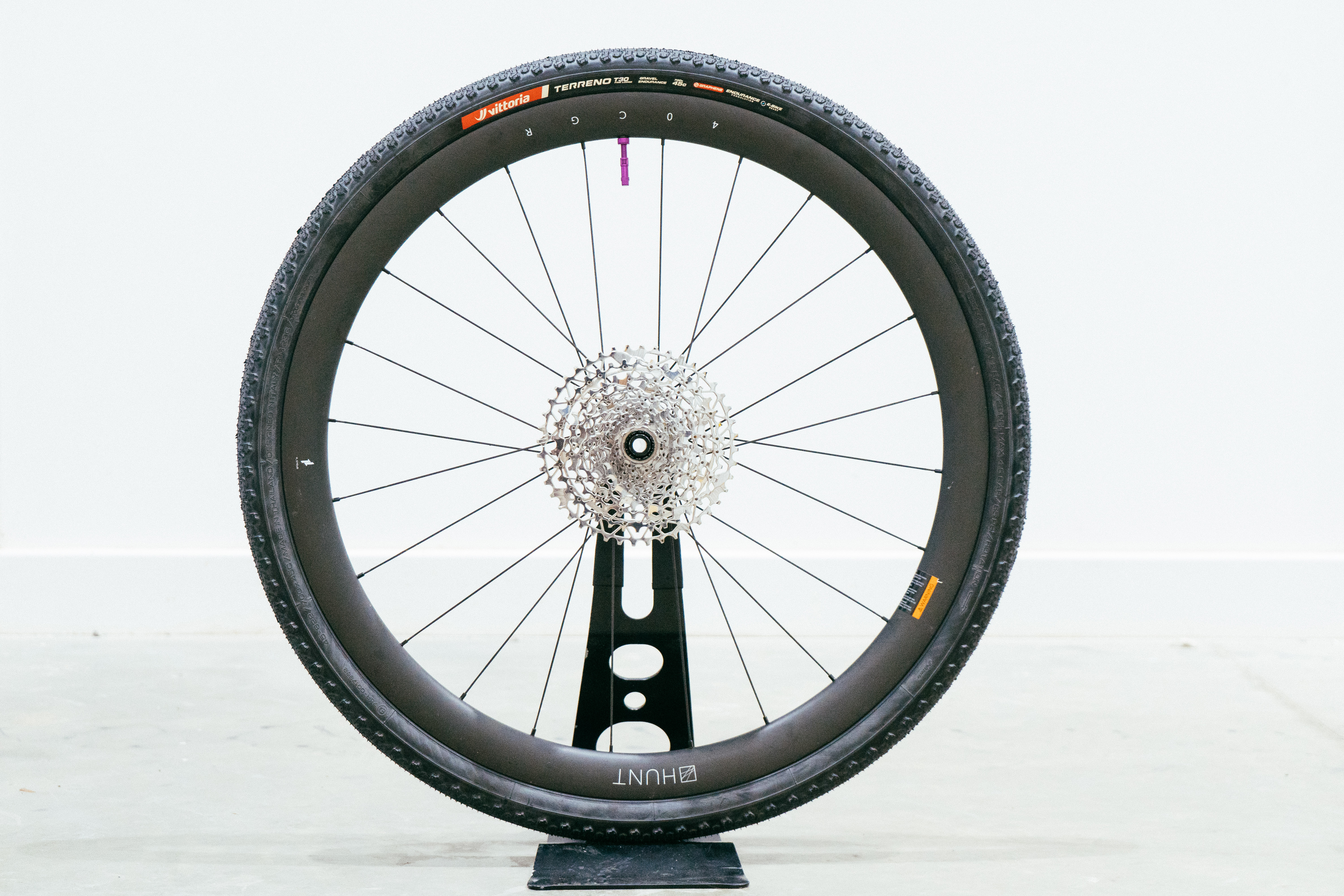 Hunt, 45mm (Image credit: Will Jones)
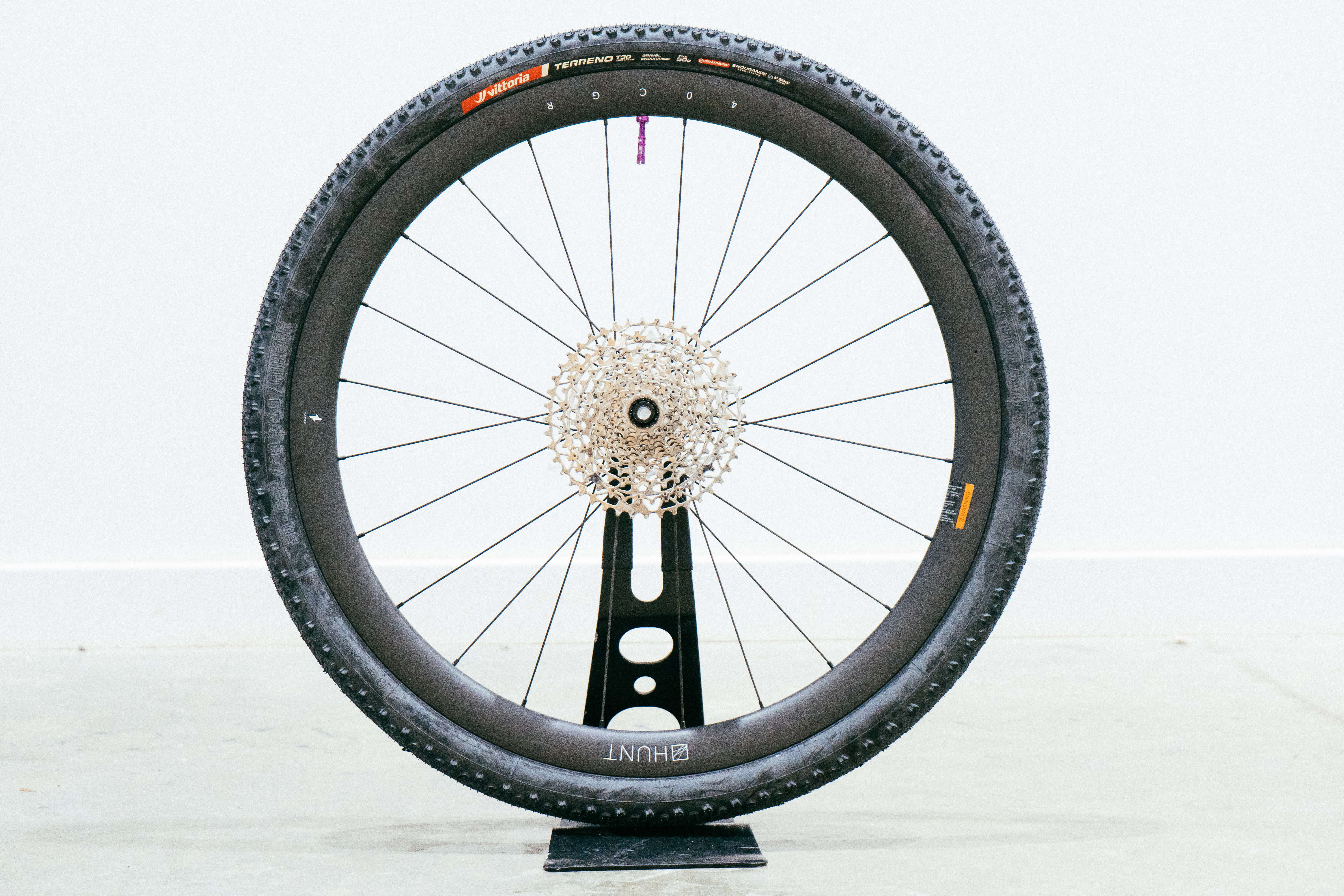 Hunt, 50mm(Image credit: Will Jones)
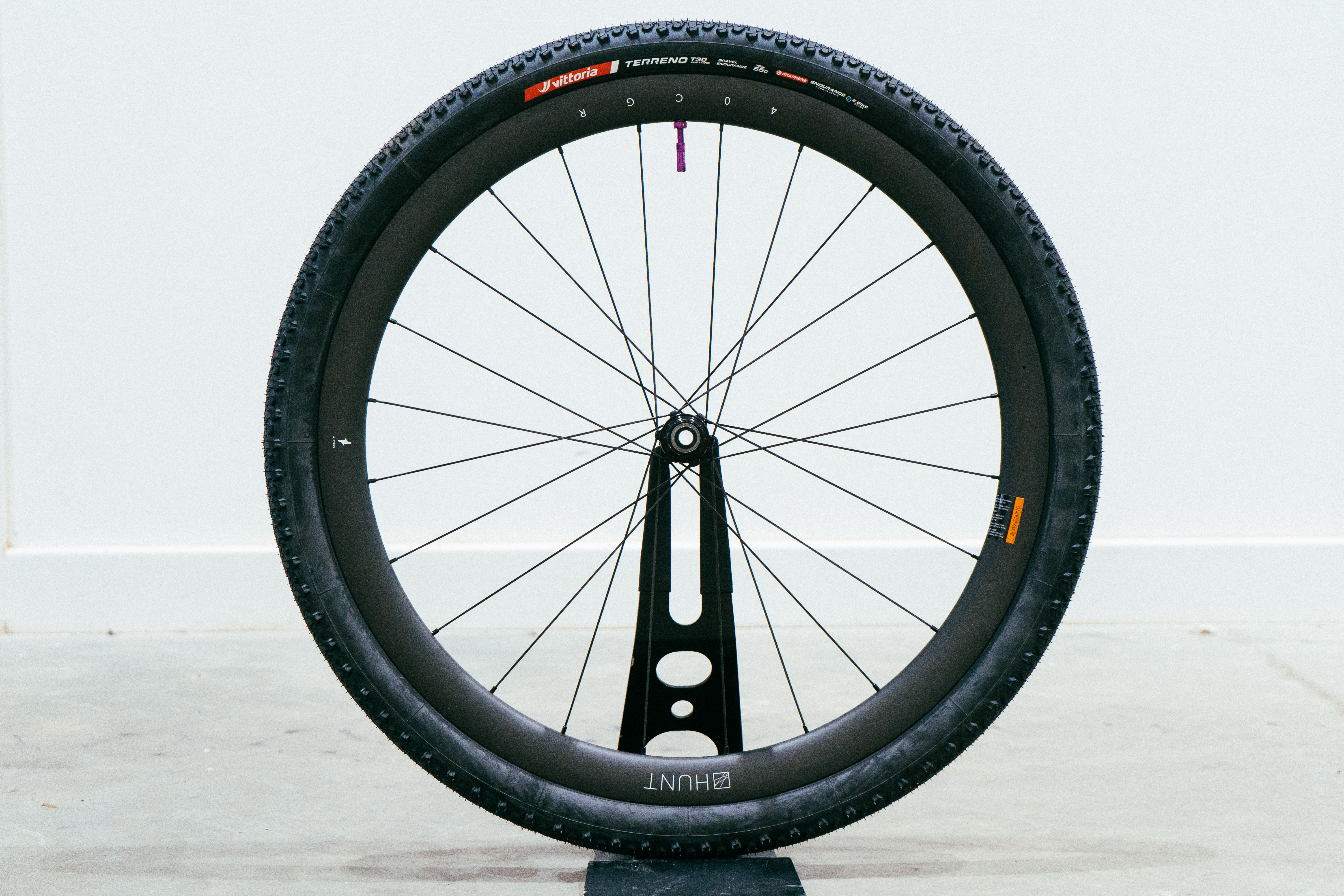 Hunt, 55mm(Image credit: Will Jones)
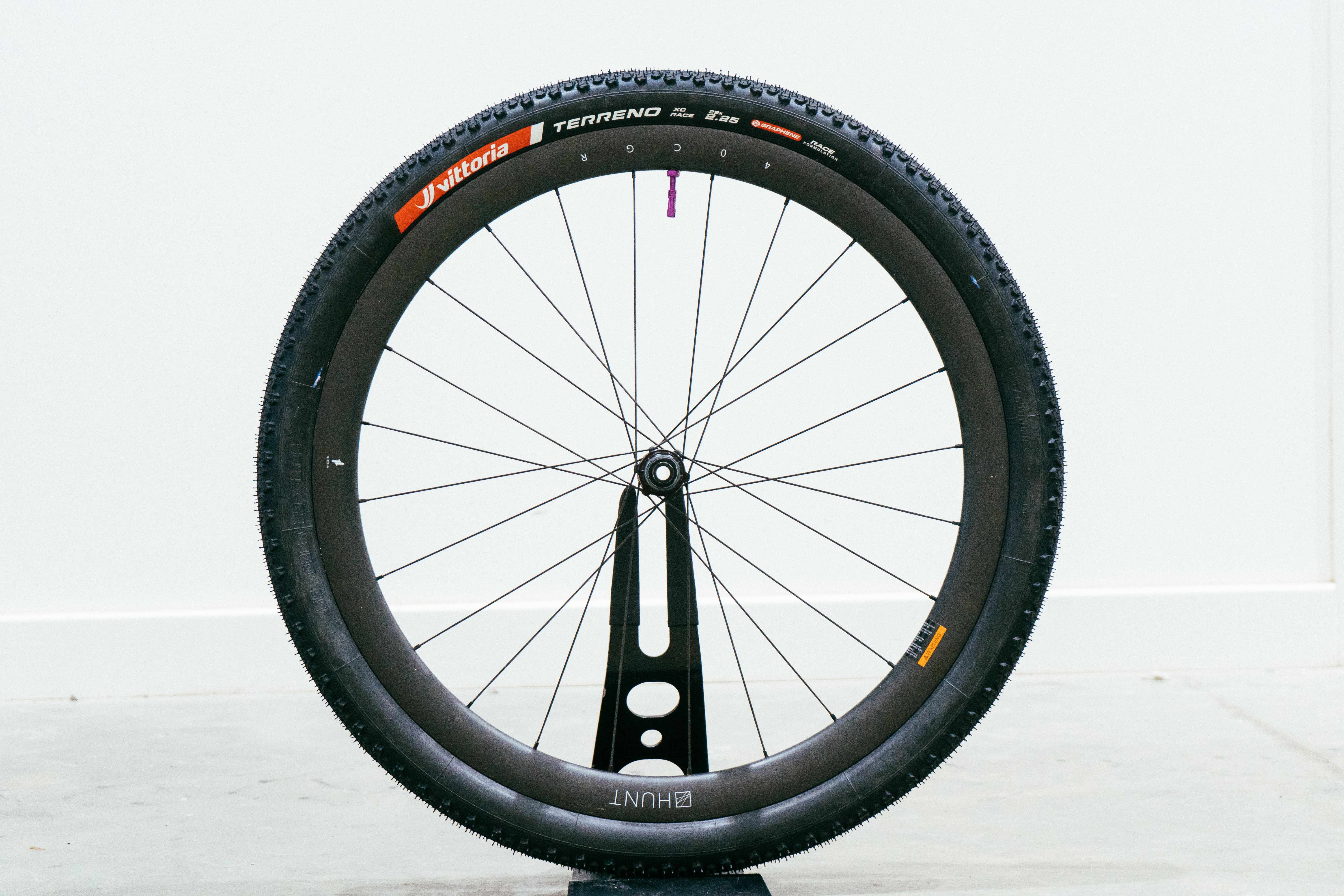 Hunt, 2.25″(Image credit: Will Jones)
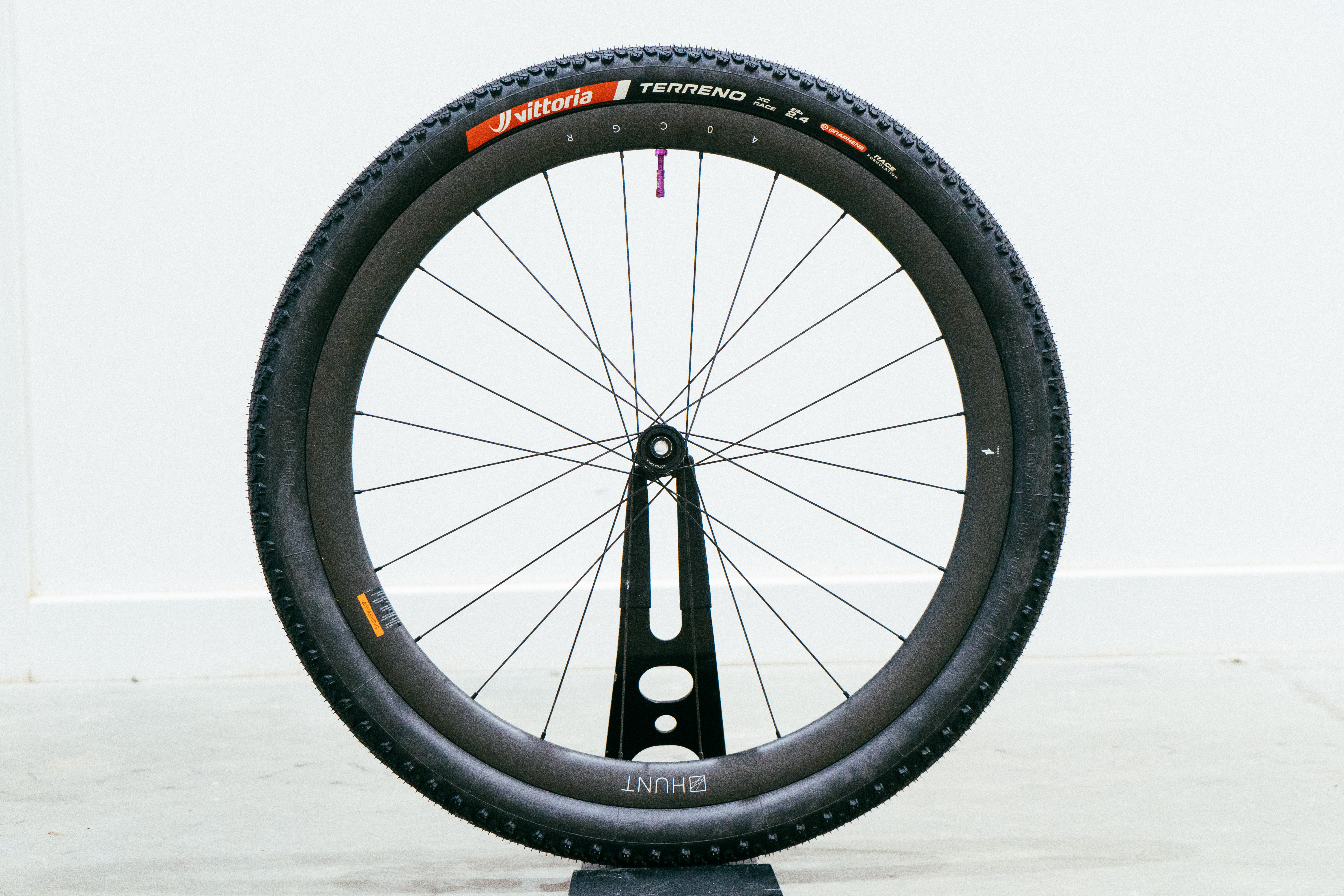 Hunt, 2.4″(Image credit: Will Jones)
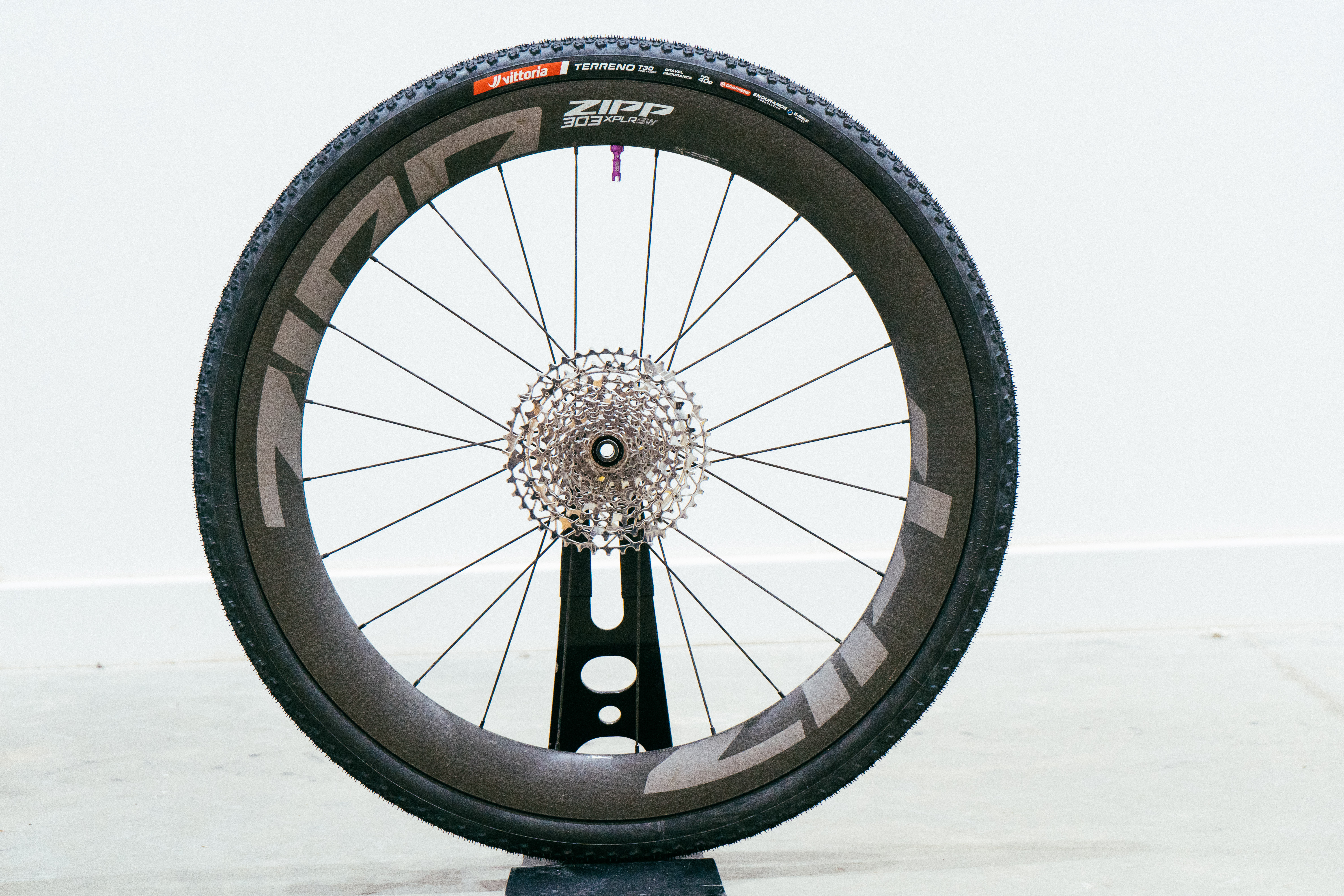 Zipp, 40mm(Image credit: Will Jones)
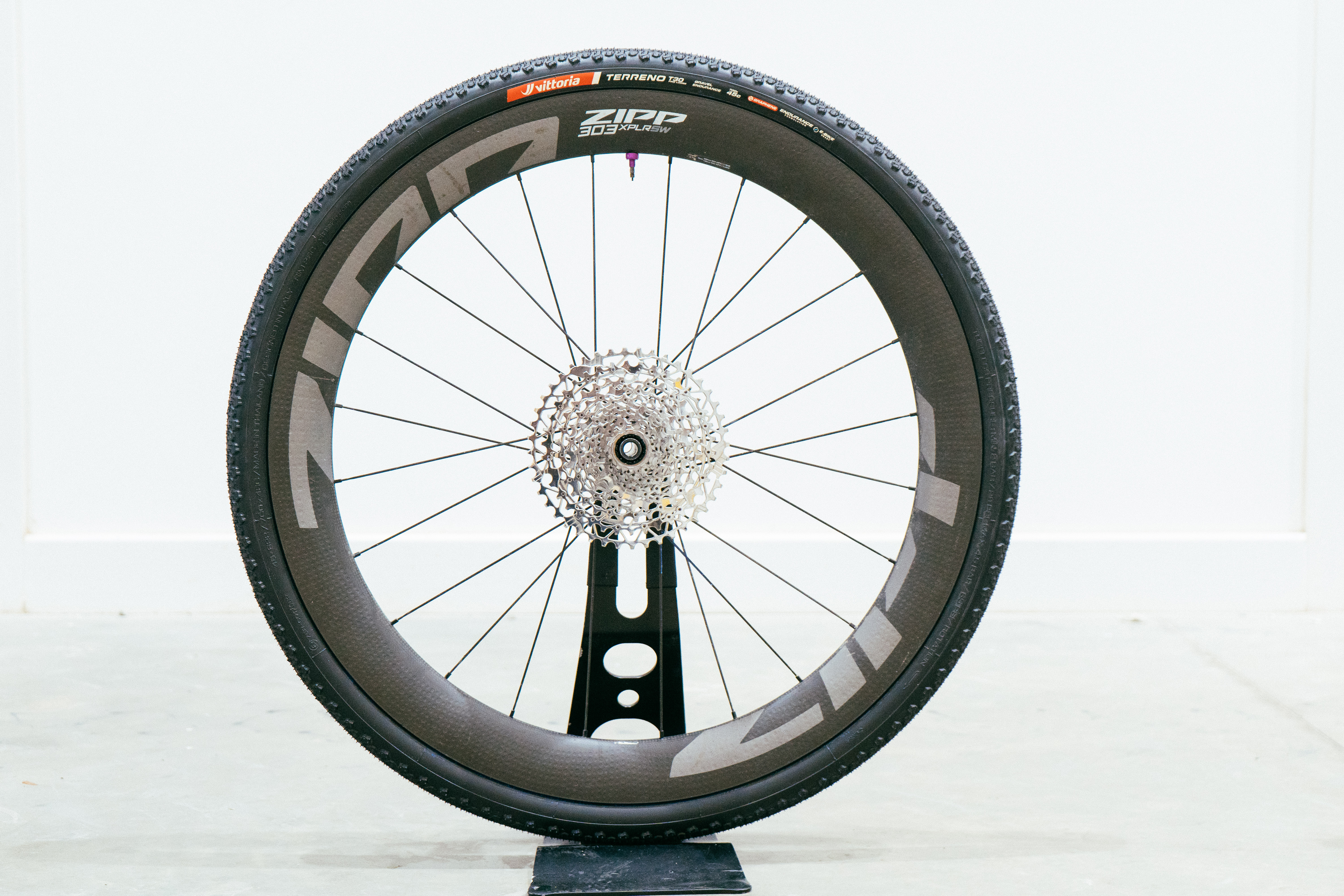 Zipp, 45mm(Image credit: Will Jones)
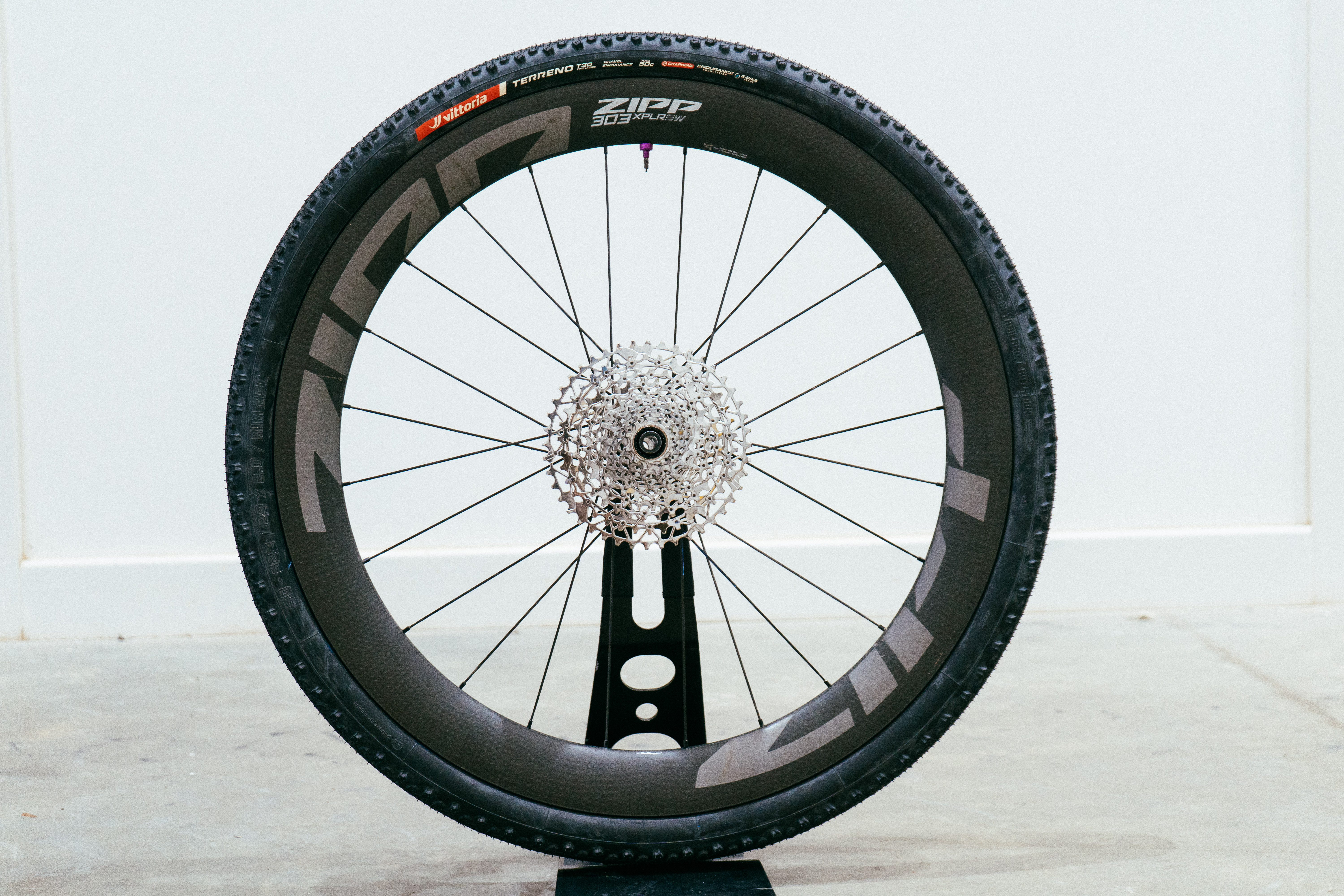 Zipp, 50mm(Image credit: Will Jones)
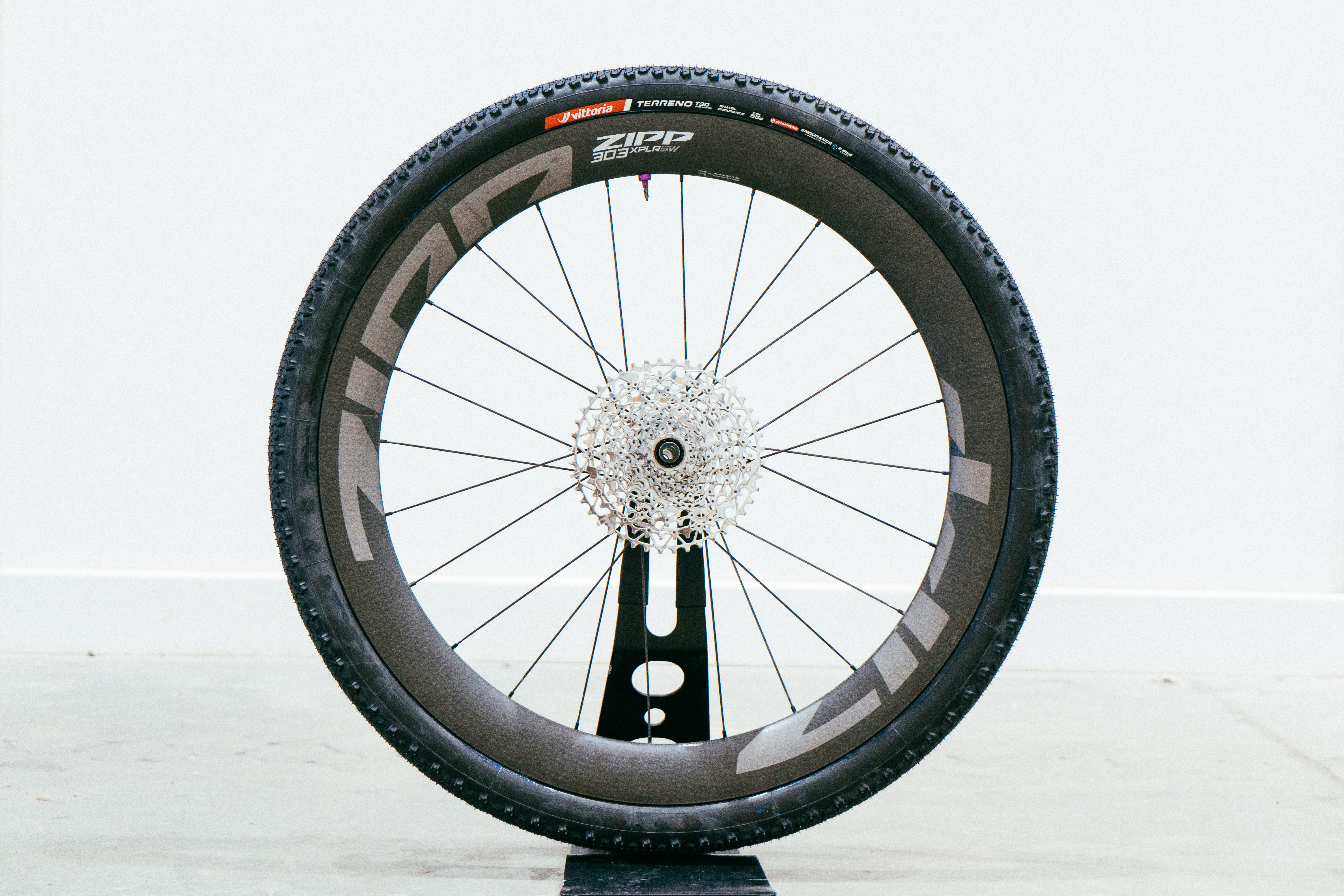 Zipp, 55mm(Image credit: Will Jones)
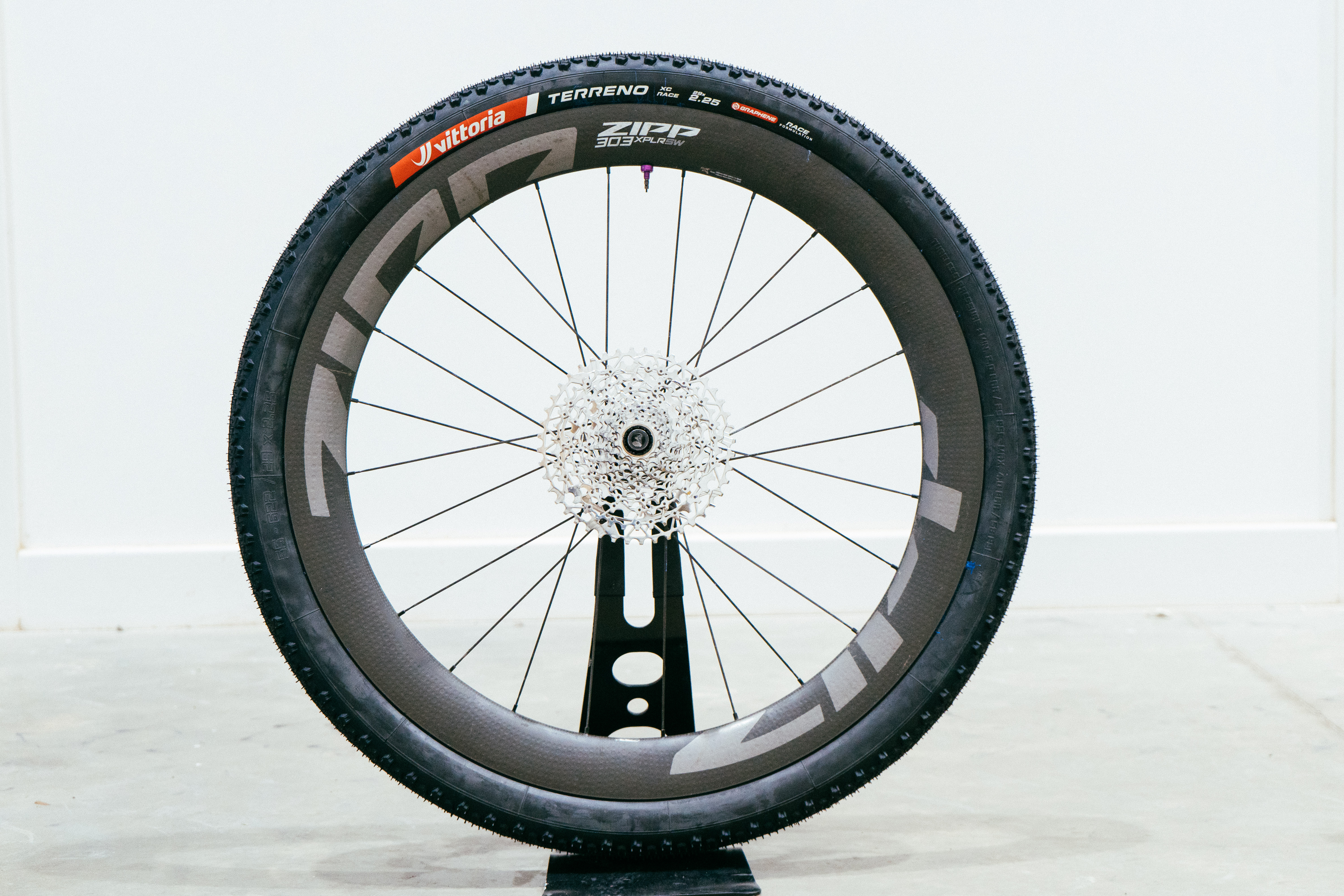 Zipp, 2.25″(Image credit: Will Jones)
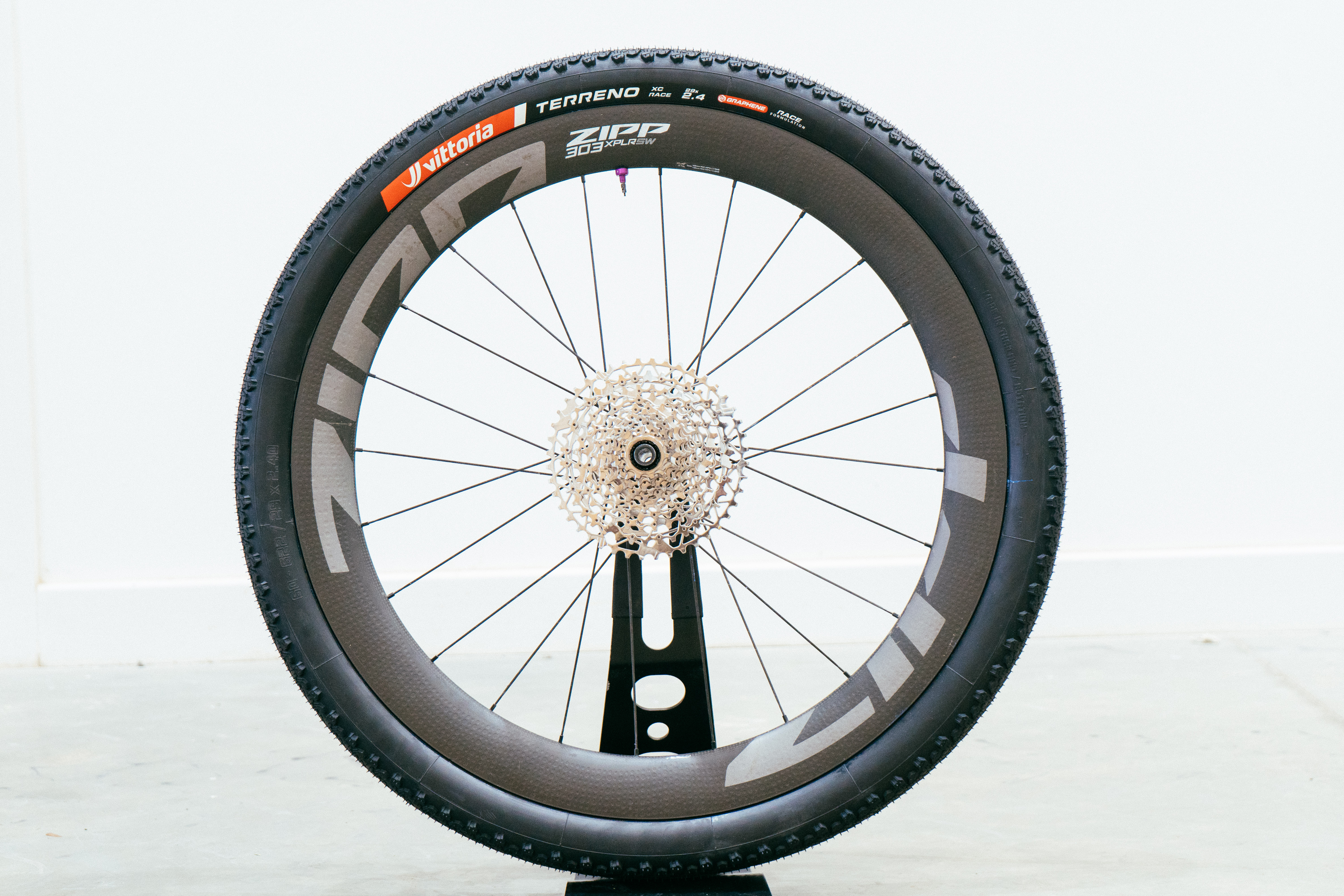 Zipp, 2.4″(Image credit: Will Jones)The tyres
To test a full-width sweep with as many other variables remaining consistent throughout, we selected the Vittoria Terreno Dry as the model of choice. It comes in widths as skinny as 31c, and as wide as 2.4” (61mm), with plenty of options in between. Given that this test is about gravel tyres, we discounted anything below 37mm wide, both for time efficiency and because realistically most of you reading this probably aren’t considering fitting 35mm tyres to your gravel bikes.
To throw a slight spanner in the works, Vittoria refreshed the Terreno range, replacing named models with a T-Score system, meaning the ‘Terreno Dry’ became the ‘T-30’ model, and some widths were re-labelled to reflect their as-fitted size better.
I’ll get into the testing methodology shortly, but for the aero testing, you’ll see slightly different sidewall colours. We ran the aero testing bike-only, and as we were only concerned with the tyre shapes from a data perspective, the casing type didn’t matter.
For the rolling resistance portion of this investigation, we did standardise the casings as best we could. The majority of the suite, from 37mm to 55mm, were constructed using Vittoria’s ‘Gravel Endurance’ casing, while the 2.25” (57mm) and 2.4”(61mm) were constructed using the ‘XC Race’ casing. The extremely low profile nature of the central knobs also serves to reduce the ‘drum effect’ on the rolling resistance rig, whereby tyre knobs are pressed into the carcass and cause the tyre to deform more than it would on actual surfaces, artificially inflating the rolling resistance figures.
From an outside perspective, the tyres appeared visually the same in construction, and I was assured by Vittoria’s UK distributor that they were ‘as near as dammit’ the same, though, as we will see in the data, it appears this was probably not the case. In an ideal world, we would have tested the ‘XC Trail’ casing as well, but sadly, we are not blessed with infinite time and resources on this front. Regardless, the data these tyres produced is certainly enlightening.
We also tested a few extra variables to ensure what we were measuring was down to just the tyre width. While in the wind tunnel, we also ran a series of tyres with increasing knobbly-ness to see if heavily treaded tyres are slower aerodynamically.
Present on the day
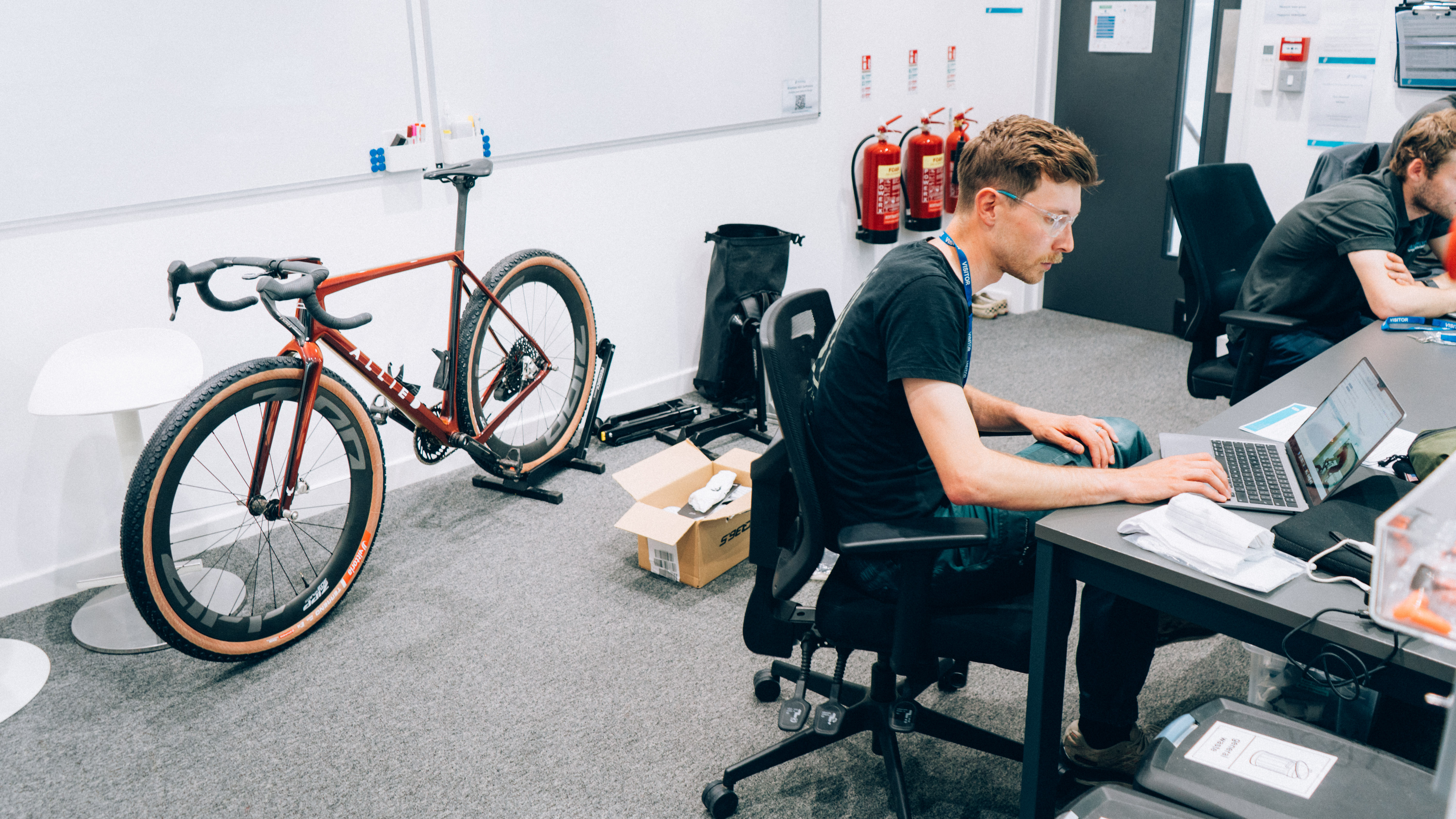
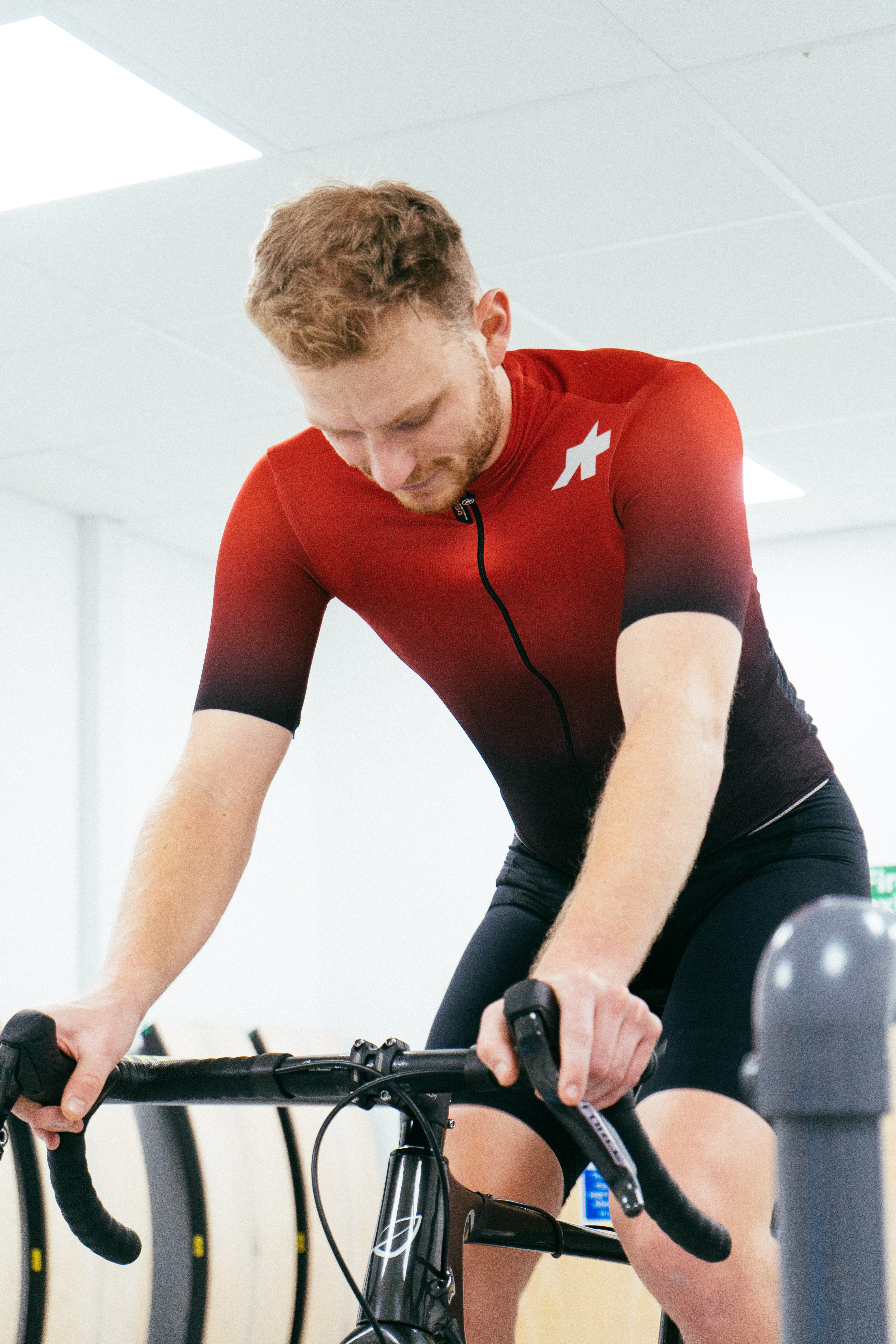
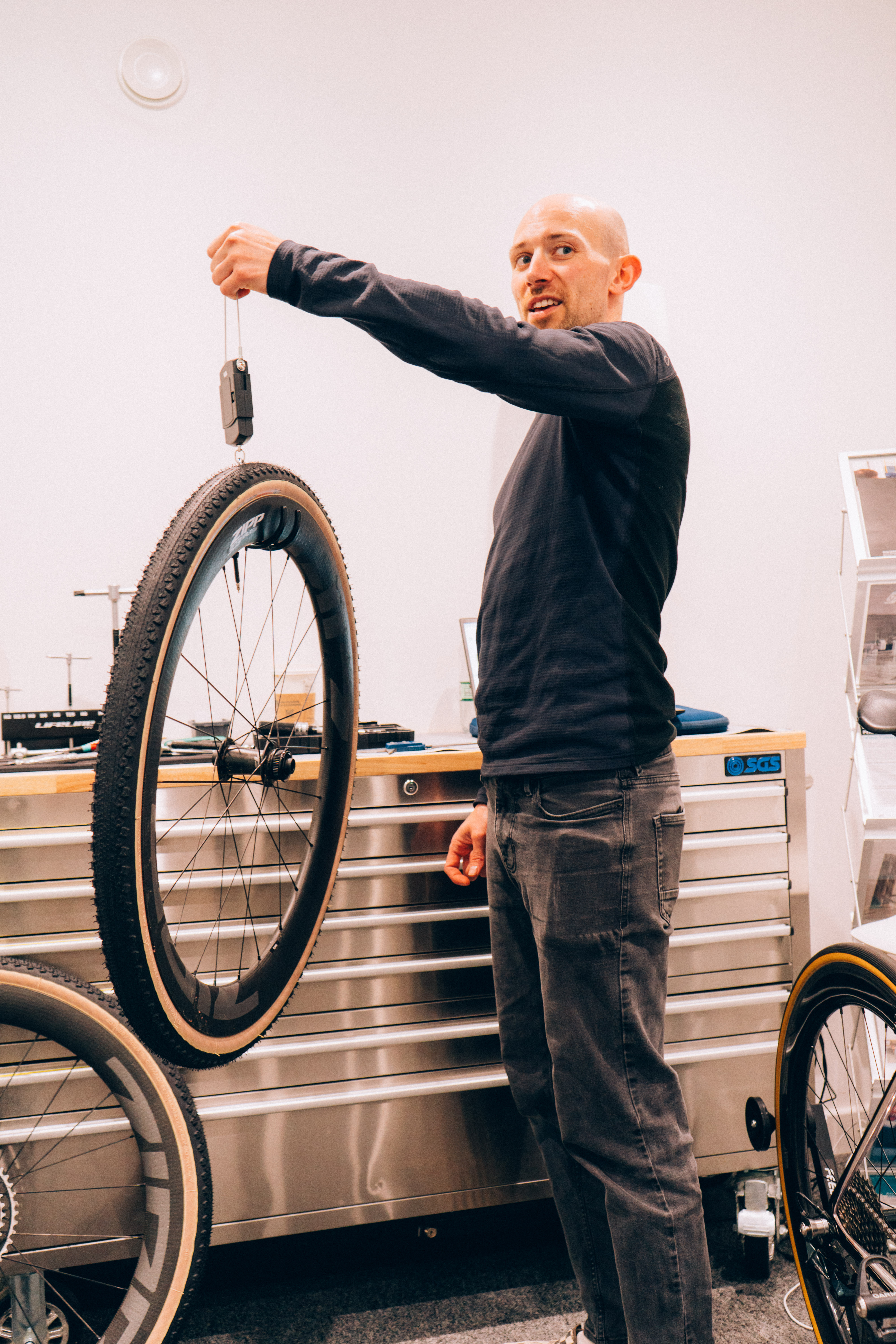
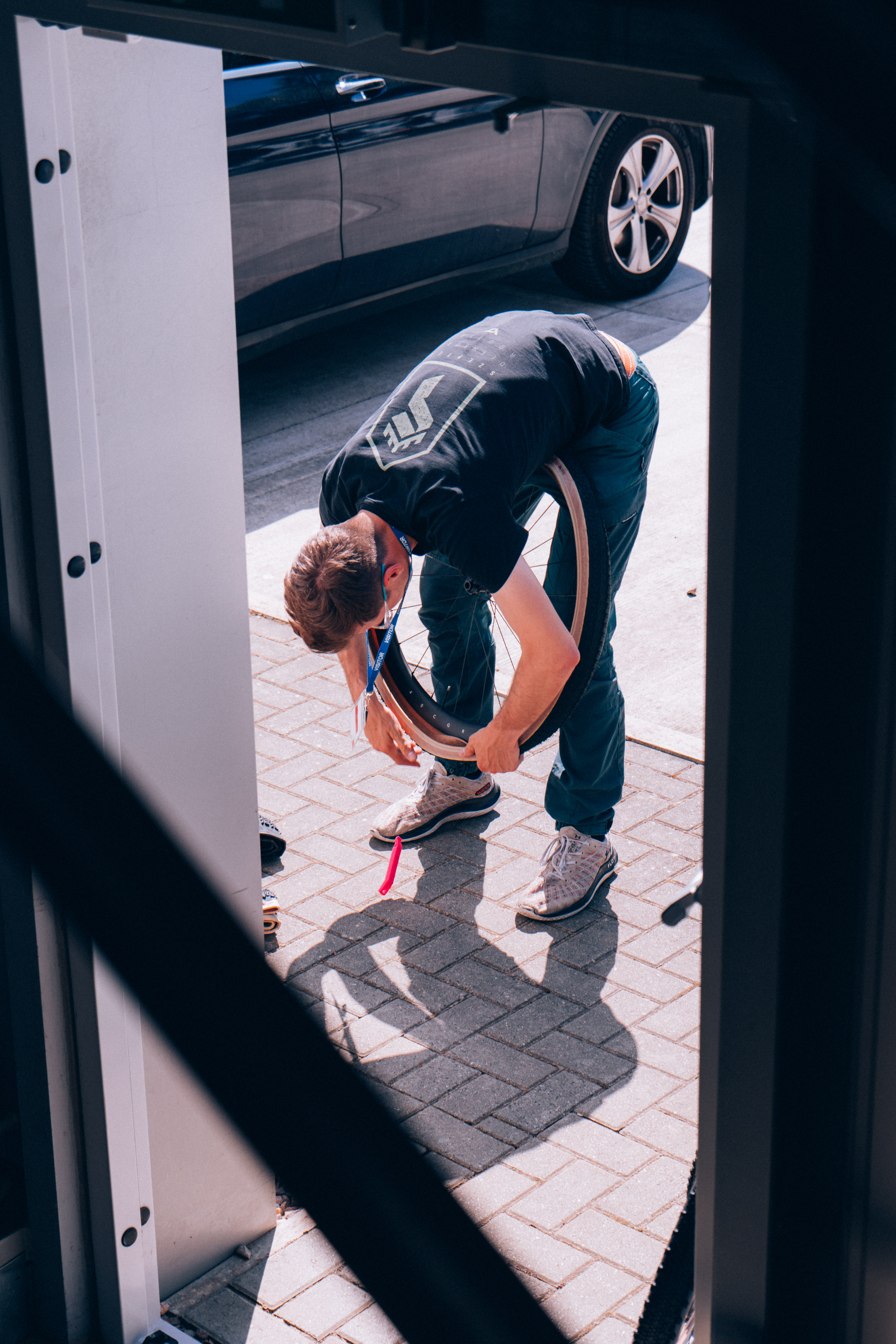
Jamie Williams – Video manager, and willing pedalling efficiency rig riderJosh Croxton – Associate Editor and leader of our aero testingTom Wieckowski – Tech Writer, ex mechanic, making sure everything was measured and standardised properlyEd Westrop – Videographer, making sure we get loads of lovely 4K footageWill Jones (me) – Senior Tech Writer, on photo and content duty, as well as tyre changing, general dogsbody, and running the rolling resistance part of the testingThe SSE staff – Always helpful, and without them ‘driving’ the machines we’d be scuppered

(Image credit: Will Jones)
How we testedWind tunnel
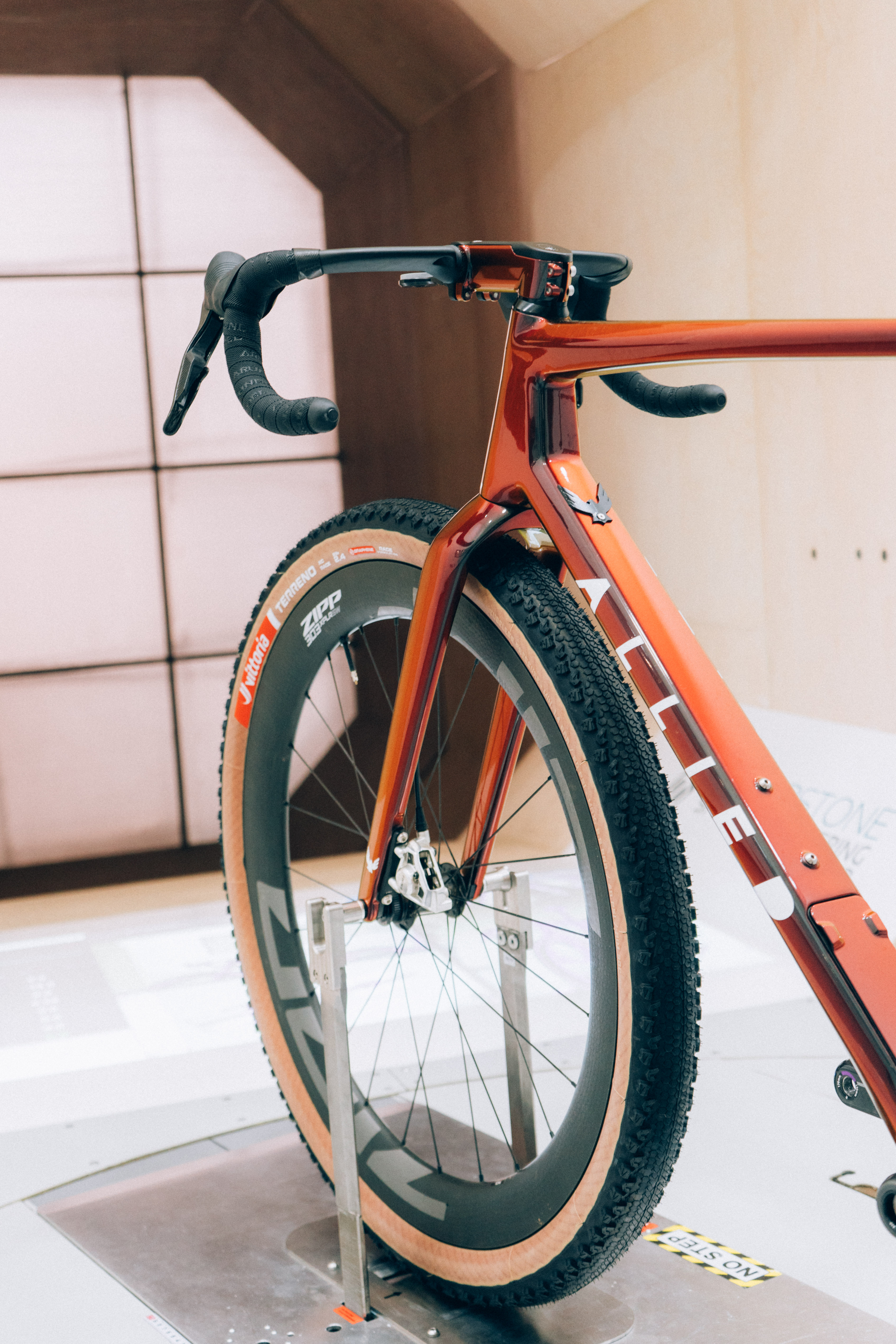
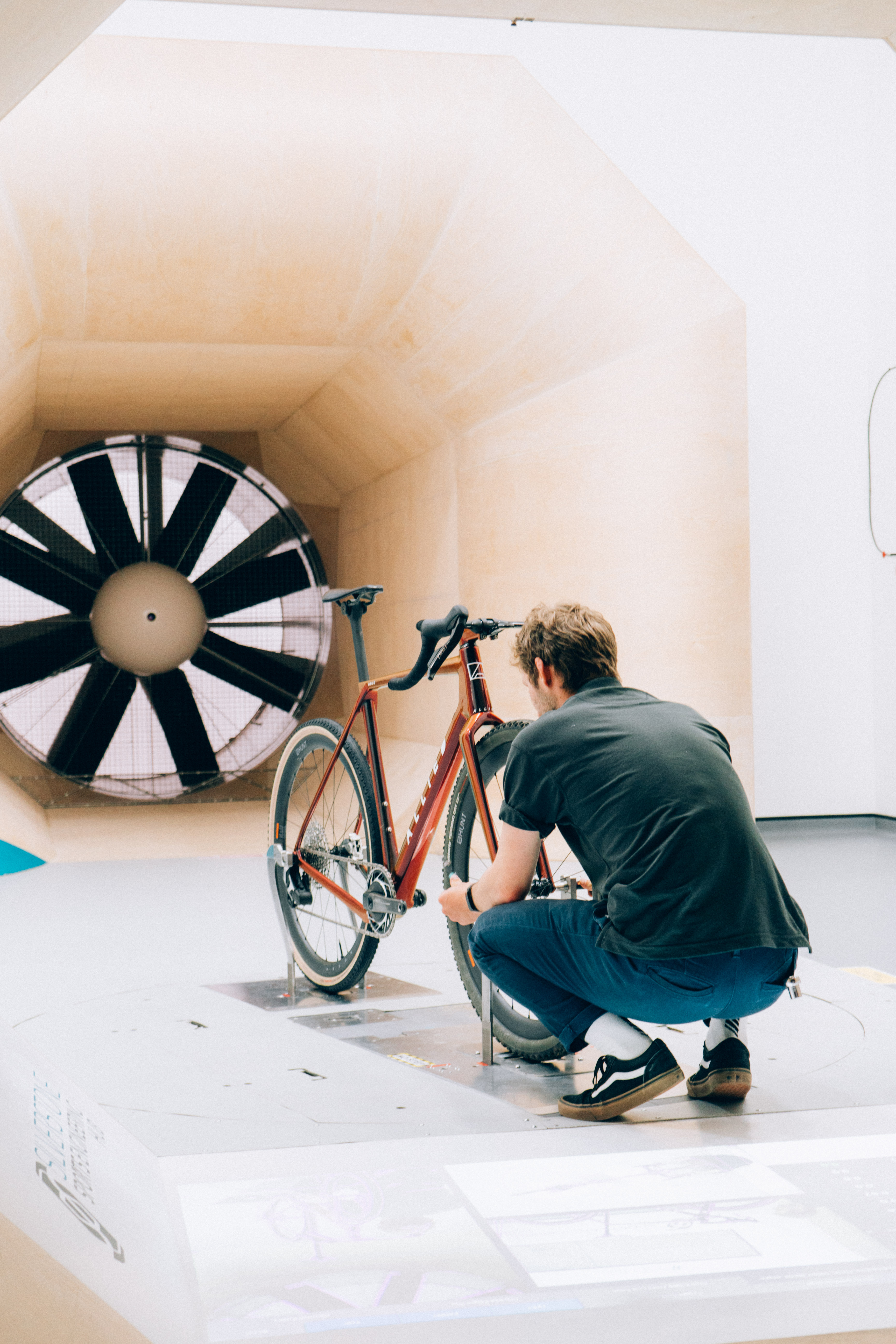
Unlike our wind tunnel bike tests, we opted to run our tyre sweep as a bike-only test. This was partially down to time constraints, as we had spent the morning teasing out the differences between aero socks, amongst other things, and partially to produce the ‘cleanest’ possible data, without the noise that adding a rider imparts. Bikes cannot ride themselves, but as we were only changing the tyres each time, this seemed the ideal option.
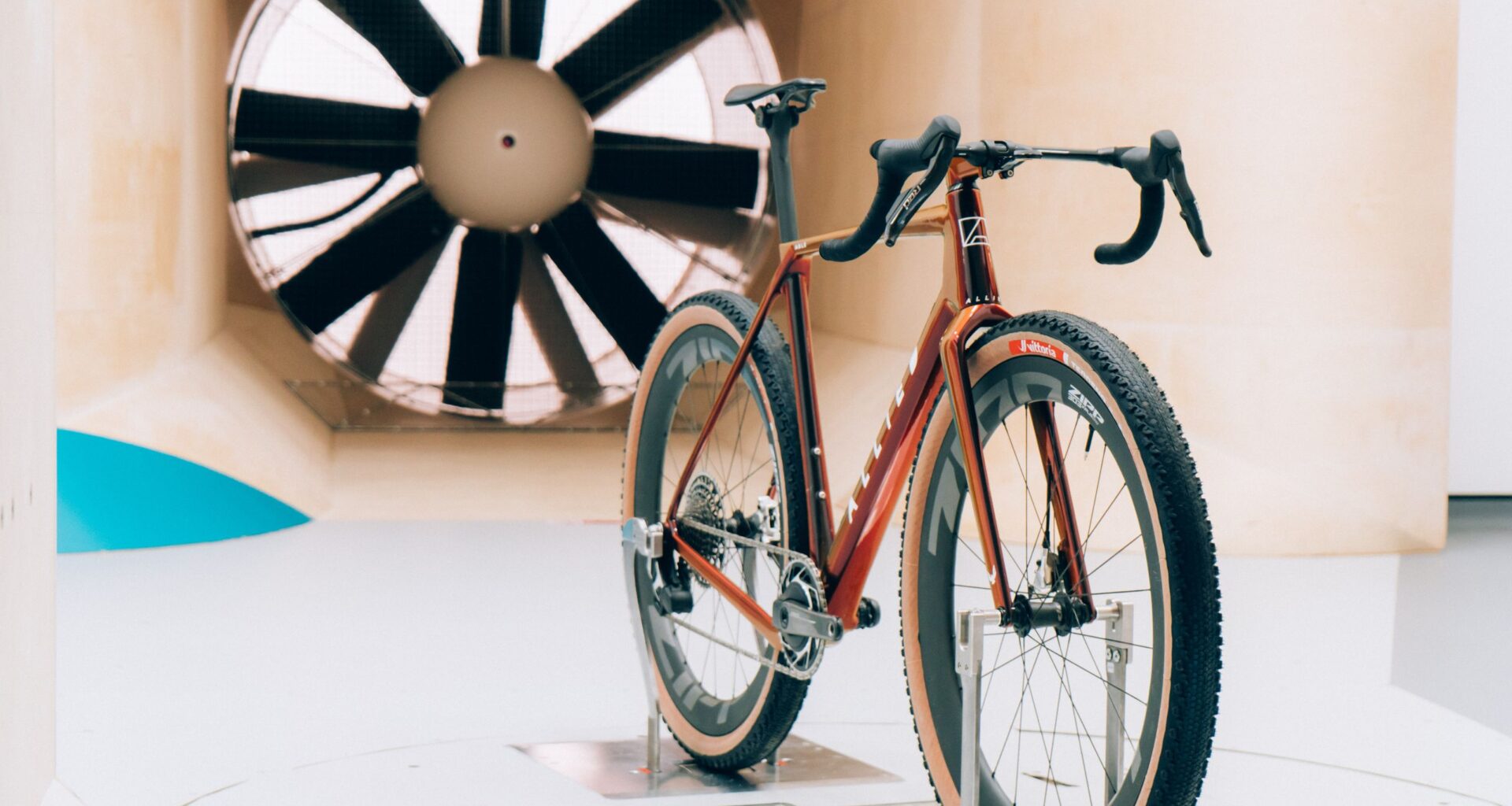
We ran our standard protocol, which will be familiar to many of you by now. A full sweep of yaw angles (the angle at which the wind hits the bike) from -15º to +15º in 5º increments. The cranks were run without pedals and fixed in place throughout to ensure they didn’t have any impact on proceedings. The tunnel was ‘tared’, like pressing ‘zero’ on your kitchen scales, before every run also. Our test bike, an Allied Able, naturally remained unchanged throughout the day in all respects.
Unlike our road bike tests, where we run the tunnel at 40km/h, we opted for 35km/h in this case. While this is an extremely punchy pace for an amateur gravel ride, it represents the pro gravel race speeds, and crucially, is fast enough that differences should be measurable. Aero differences increase the faster you go, and so at slower speeds they will diminish, but at this point we assume that if you’re worrying about how aero your gravel tyres are, you’re at least considering racing on them.
We tested each pair of tyres on two sets of wheels: a set of Zipp 303 XPLR NSWs, with their extremely wide internal 32mm width, and a set of Hunt 40 CGRs, with a more ‘normal’ 25mm internal rim. This should allow us to see if having a wider rim offsets the greater frontal area of a wider tyre by offering up a smoother wheel-tyre interface to the wind.
Tyre pressures were standardised, based on SRAM’s online tyre pressure calculator, as this is what many of you would probably do in the real world, and what we use as a first port of call when setting our own pressures, and it is scalable.
To ascertain a confidence margin, we repeated the 38mm size at the start and end of the day, using the variability of the results to inform us. The difference between the two runs was 0.28 watts.
(Image credit: Will Jones)
Pedalling efficiency rig
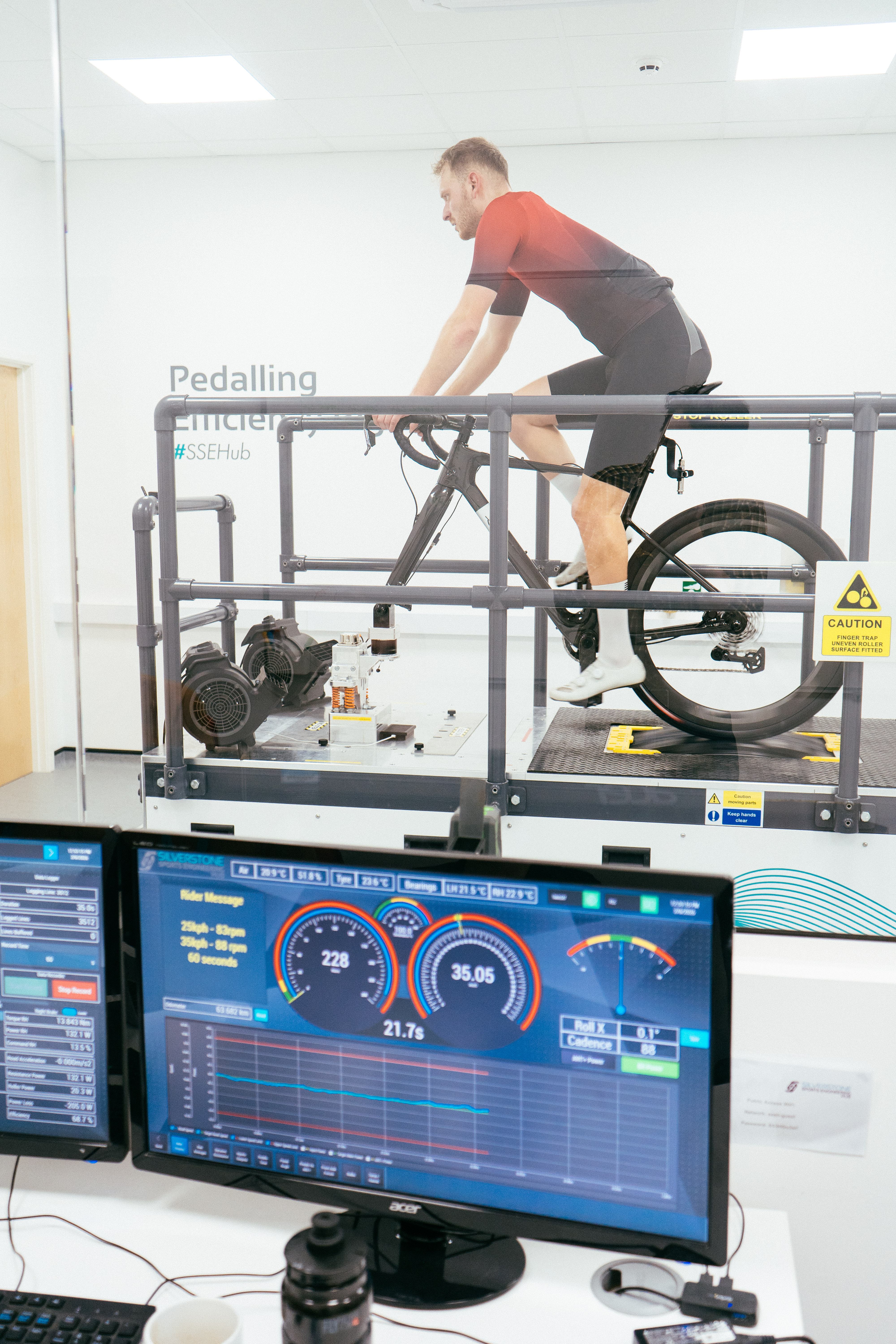
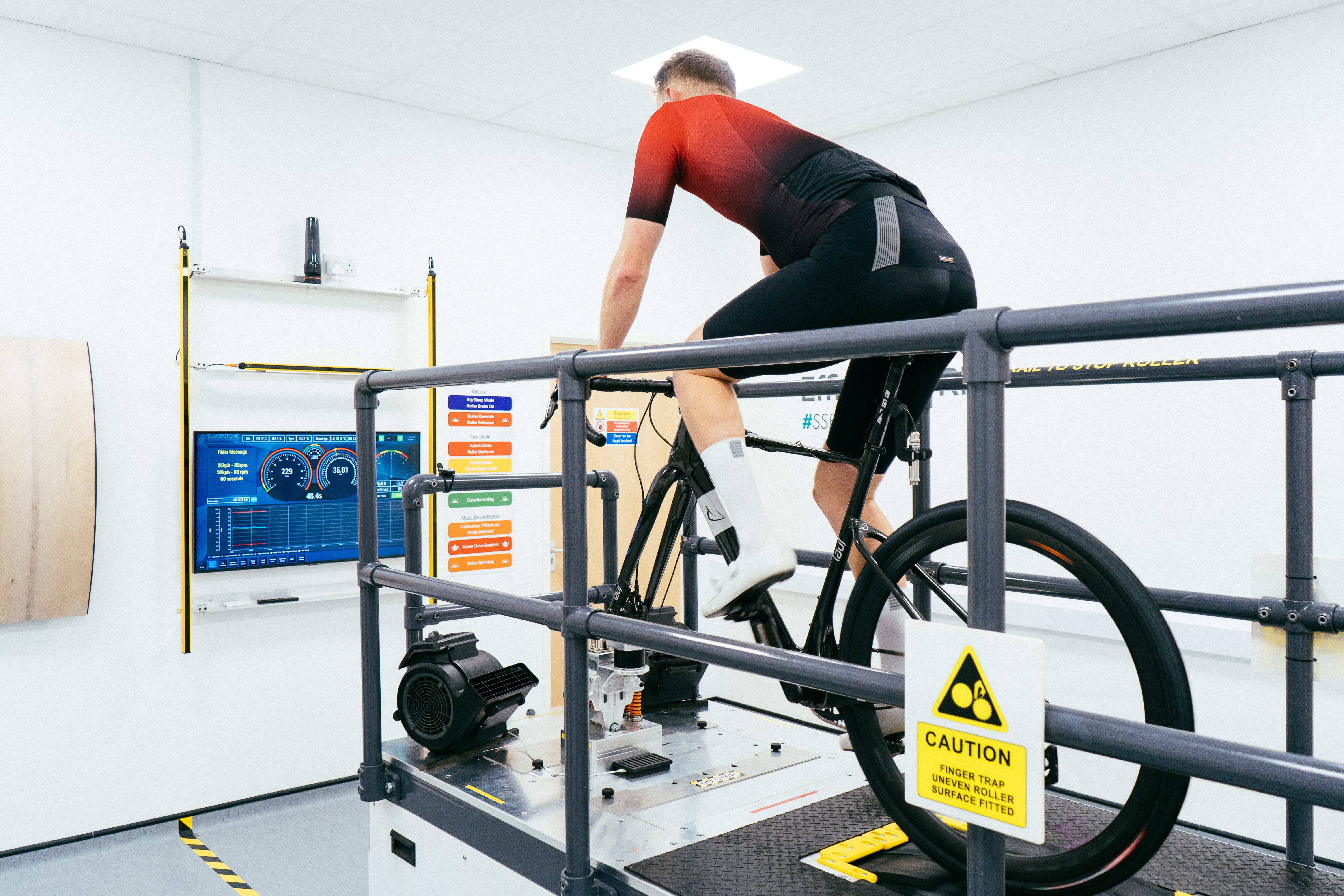
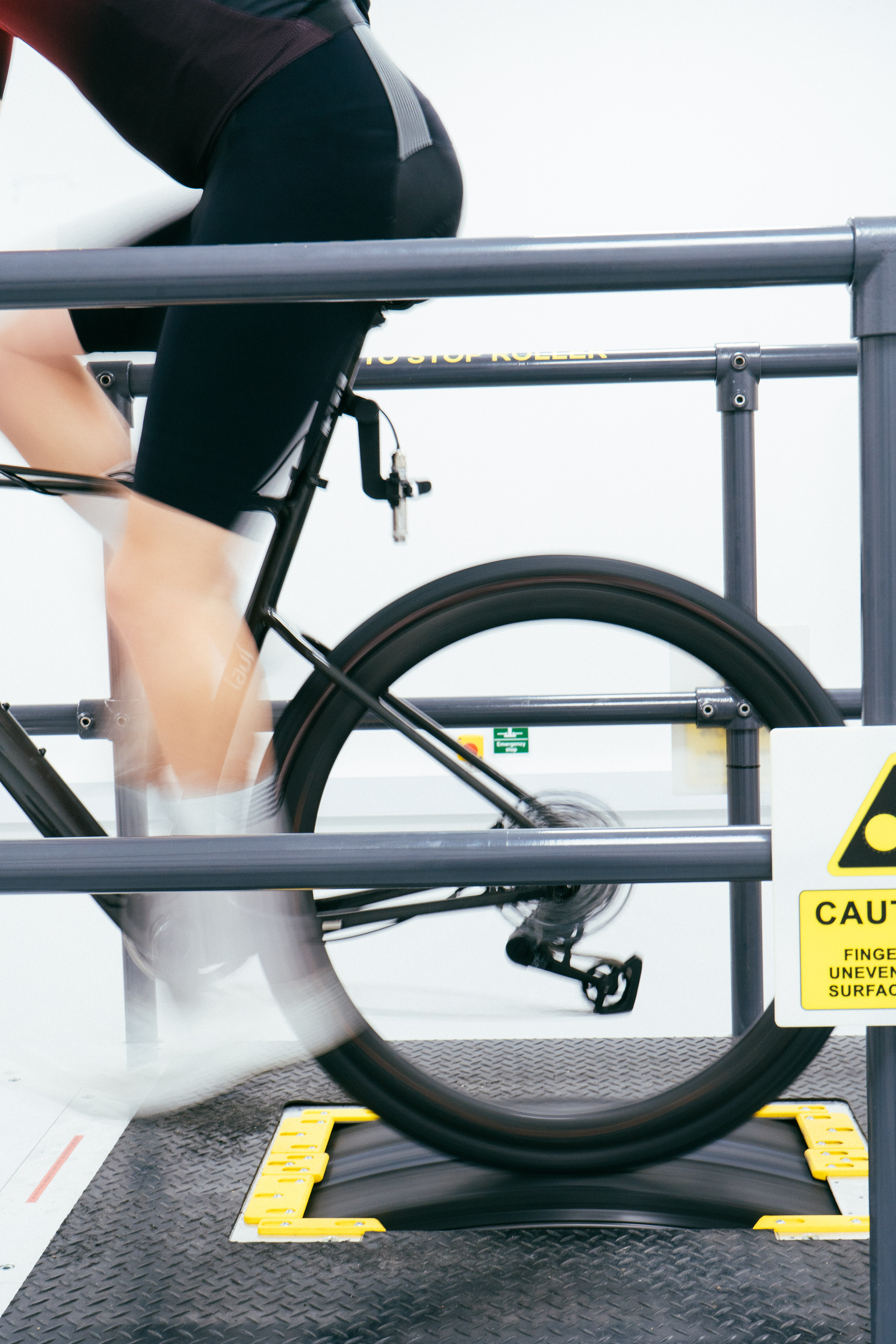
Our previous rolling resistance investigations have focused on swapping various models of tyres on a single surface, or investigating the impact of increasing road tyre size on one or two surfaces. The pedalling efficiency rig (PER) at Silverstone has three simulated surfaces on its drum: smooth tarmac, closely packed cobbles known as ‘setts’ (the closest analogy to general gravel we have), and large, widely spaced cobbles that simulate extremely rough terrain.
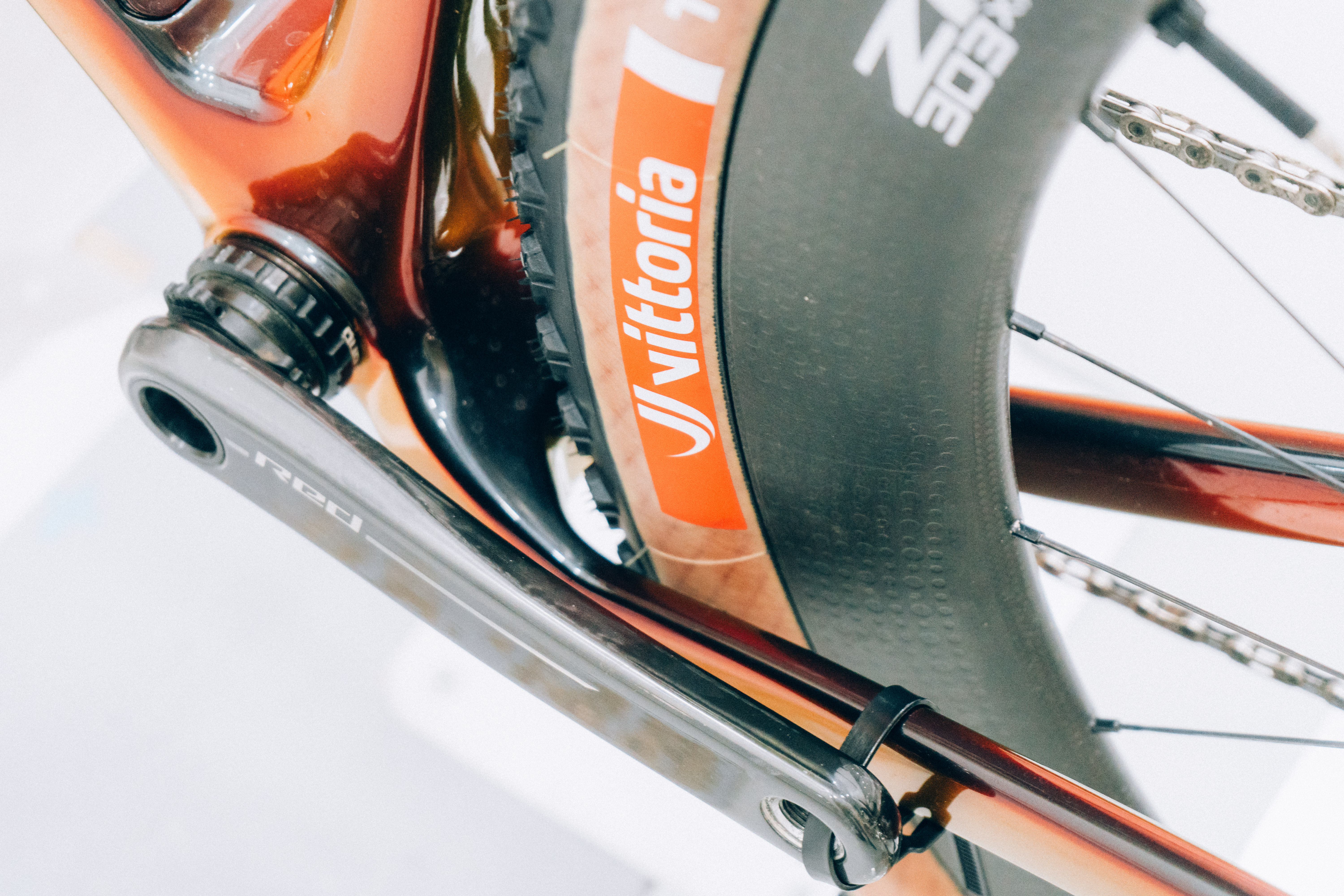
The test bike – a Lauf Seigla with a rigid fork in this case, though the difference in bike doesn’t impact the tyres as we are no longer concerned with aerodynamics here – is mounted to a fork jig, and the rear wheel only is tested on the drum. This means the rolling resistance data is for a single wheel only, and so any result needs to be multiplied by 1.818 to account for the slight bias of weight distribution towards the rear wheel.
We used brand new cassettes across the wheelsets, and the bike was fresh from the factory with a brand new chain to avoid any mucky drivetrains throwing the results off. The chain was coated in the original factory grease, which we accept isn’t necessarily the most efficient setup, but as it remains constant, and we are only interested in the wattage differences between tyre sizes rather than absolute resistance values, it bears no impact on the final results.
It’s a simple power in (measured by a set of Body Rocket pedals that measure 1,000 times a second) versus power out at the drum measurement, and gives data immediately, allowing us to perform any repeats should anomalies arise, which they did on a small number of occasions.
We ran a full suite of tyre sizes on both wheel options (Hunt and Zipp), before swapping to a new surface, repeating the 38mm size at the start and end of each surface session to produce an error margin for each, taking the largest figure as our actual error margin (as the others could be falling within the larger error margin). This figure is 1.33 watts, slightly higher than that of the tunnel data, but down to the fact that Jamie, our Video Manager, was on the bike pedalling to a pair of speeds – 25km/h and 35km/h – so there is some human variability added into the mix.
Each speed is a 60-second run. We ran a second, slower speed simply to add more data, despite not testing the aerodynamic properties at this slower speed. Rolling resistance is a linear relationship, and so should simply scale. Two speeds, three surfaces, and a large suite of widths mean we needed 42 runs, not accounting for any repeats. We didn’t run the Zipp rims with the 38mm tyre, even though we tested this setup in the wind tunnel. It is narrower than the recommended safe minimum for these rims, and we didn’t want to risk blowing sealant all over some extremely expensive equipment and not being allowed to come back.
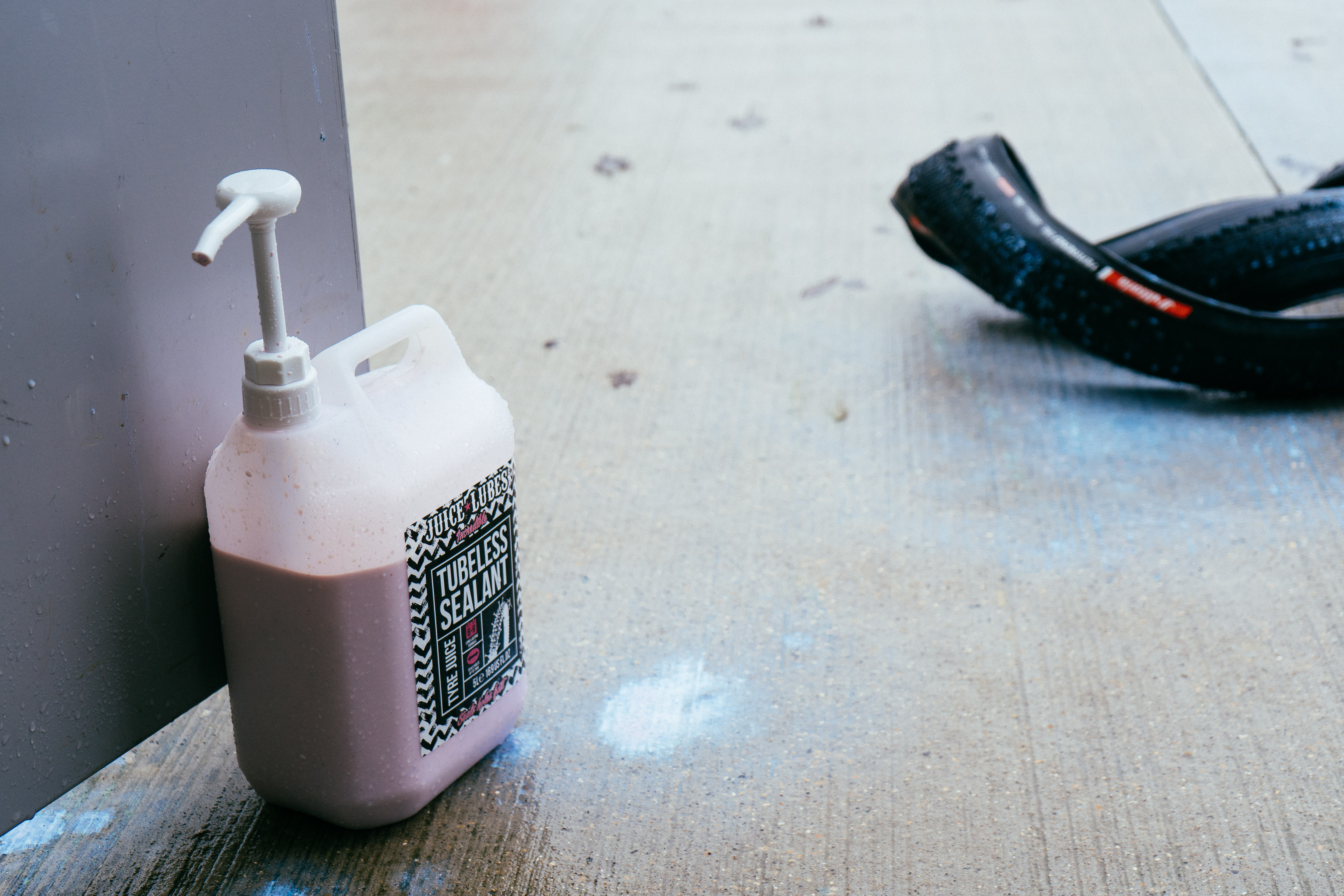
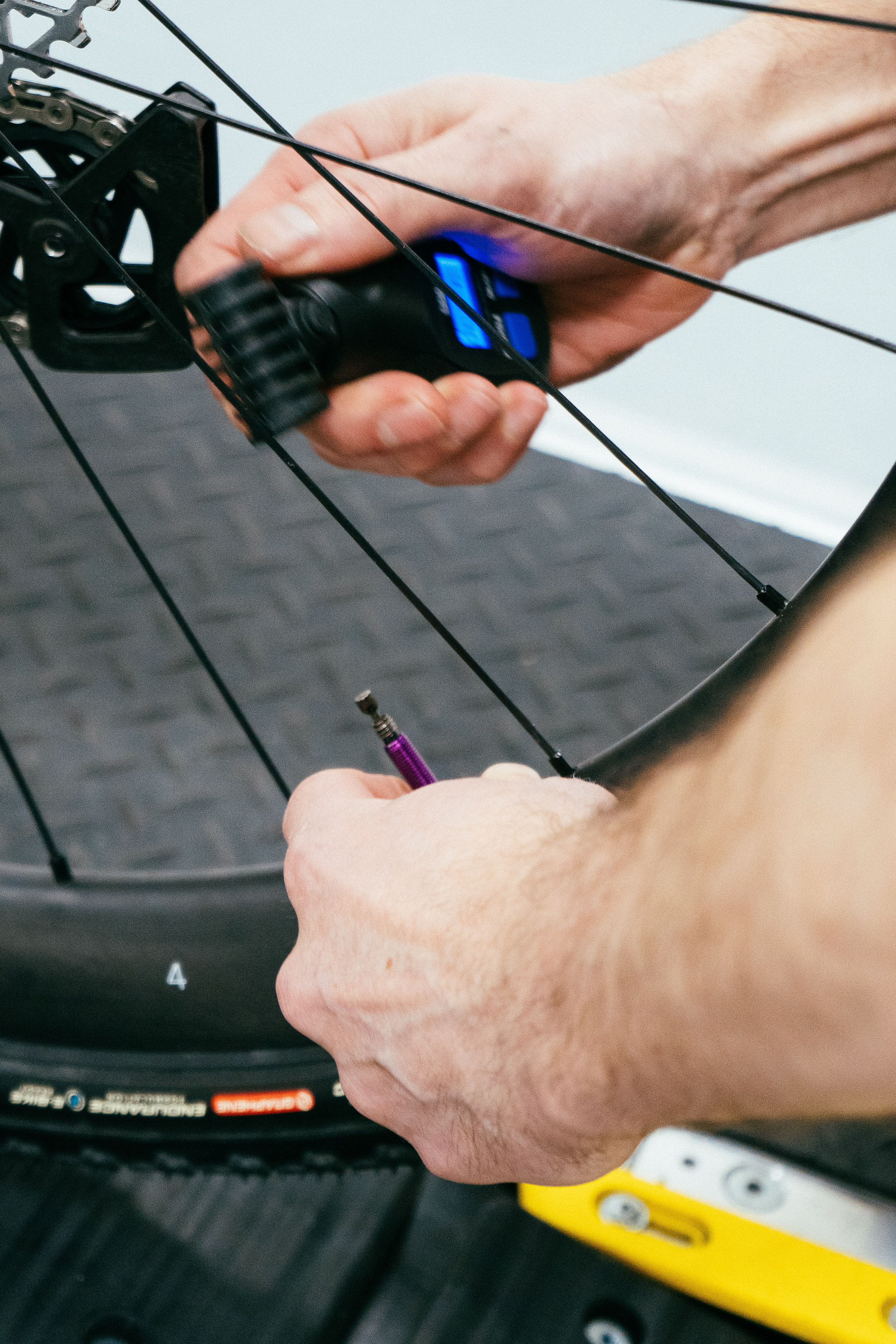
Each tyre size was run tubeless, with an identical 30ml of Juice Lubes sealant in it, with identical Juice Lubes valves (in Cyclingnews purple). We could have scaled the sealant with size, but in our experience, this is about the minimum needed to help seal a tyre, and keeps the sealant variable consistent throughout. Pressures were checked before each run to make sure they were holding air. The tyres were also monitored for temperature throughout the test, given a warm-up period before starting measurement, and were kept in my house the day before the test to keep them at room temperature as much as possible in the run-up.
We also measured Jamie’s weight constantly and kept him ‘topped up’ with fluid so that it remained constant as he sweated his way through close to 100km of riding on a static bike.
At the end of the day, primarily out of curiosity and a surfeit of free time, we ran what we thought of as the most standard setup at point of sale – a Hunt rim, shod with a 45mm tyre – on the setts surface at a sweep of pressures from 50PSI down to 10PSI, in 10PSI decrements, to ascertain whether pressure has a greater impact on rolling resistance than it does on the road. Our previous testing shows that it matters very little what pressure you run on the road as long as you are within a pretty healthy window, either side of your ideal pressure.
(Image credit: Will Jones)
Additional disclaimers and caveats
As ever, we are not trying to claim this is the last word in tyre data. Our results are based on two days of testing, on a single tyre model (or models, if you account for the casing differences). There is always scope for more study.
It’s also worth bearing in mind that these results are designed to show comparative differences between different tyre widths, and are not designed to pass judgment on whether the wheels or bikes we used to test the tyres are fast or otherwise in their own right.
There is more to tyre performance than simply reducing your total retarding forces to as small a number as possible. They are your only contact with the ground on which you ride, and there are myriad other factors that could be equally as important, if not more important, to your overall performance, be that in a race or just out riding.
Grip is always key, as is puncture resistance, mud-shedding ability, and how easy the tyre is to set up on a rim and how easily it is to seat and seal using a sealant of your choosing. Remember to consider these things in the round, as well as price. If you’re not getting your tyres from a sponsor, then they can be a big outlay for what is effectively a consumable good.
Finally, our aero data has been weighted to reflect the yaw angles experienced at the speeds at which we tested. The faster you ride, the more time you spend with a yaw angle closer to zero degrees. As we are testing at slower speeds than we do for road bikes the data has been weighted, using a protocol outlined in Nathan Barry’s 2018 paper, A New Method for Analysing the Effect of Environmental Wind on Real World Aerodynamic Performance in Cycling, to weight wider yaw angles very slightly more heavily to try and ensure the data is as real world applicable as possible.
All the data below is subject to the respective confidence margins outlined above. It will be clarified and repeated where necessary to avoid any confusion or overstated accuracy.
(Image credit: Will Jones)
Sponsor declaration
None of this test is sponsored in any way. The equipment we used was all provided free of charge by the brands (Lauf, Allied, Vittoria, Hunt, Zipp, Juice Lubes), and naturally, they are getting some airtime, but have not paid to be included in any way. Even if they had, as we aren’t directly comparing brands against each other, it wouldn’t have added any impropriety, but it bears saying nonetheless.
We paid the standard rate for both the wind tunnel and the PER, which is only possible thanks to you, our readers, continuing to support our testing endeavours through your subscriptions.
(Image credit: Will Jones)
ResultsAerodynamic losses
Given the aero data is, while slightly more complex in its maths, the simpler of the two in terms of the actual volume of bulk data, let’s start here.
The yaw weighted wattage differences for each tyre size are as follows, starting with the Hunt wheels, then the Zipps:
As we are not comparing bikes with riders, where the actual wattage or CdA figure is actually applicable, I have reduced the data to a comparative wattage versus the fastest, which in both cases is the smallest size.
The numbers are pretty similar, with the Zipp setup being marginally faster in almost all cases, except at the 2” (51mm) size. This is more easily seen when graphed:
We assumed that the Hunt wheel would perhaps be faster at lower widths, due to the internal and external rim width better matching the smaller tyres, diverging from the Zipp and becoming slower the further up the size range you go, but things are basically the same throughout. As these are wattages versus the narrowest (fastest) size, we can say that, as the Hunt is showing slightly higher numbers throughout, the differences in aerodynamic performance are slightly greater, likely due to the wheel-tyre interface, than they are with the Zipp wheels, but the differences between the two setups are pretty marginal.
The differences between the tyre sizes themselves, however, are larger, with six and a half watts lost by swapping to a 2.4” tyre from a 38mm. This is quite an extreme swap, and likely not something many people will be doing if they have a bike that can take such enormous tyres.
A more reasonable scenario would be someone who has purchased a gravel bike that came with stock 47mm tyres, swapping them out for 2.25” models, which would create a 4-watt aero drag penalty at 35km/h. If, however, you are riding slower than 35km/h, then this will be smaller.
That contextualises the aero losses, which I think can be best summed up as measurable, but perhaps only large enough to warrant worrying about if you are riding gravel competitively.
(Image credit: Will Jones)
Rolling resistance losses
There’s a lot more data to get into here, given that we have three surfaces to cover. In this case, I am presenting the power losses for each tyre as they came out of the PER for both speeds (25km/h and 35km/h). As well as a wattage differential versus the fastest tyre in the suite of widths – the largest option, in almost every case, for every speed – before scaling that figure by 1.818 to create a total system rolling resistance penalty versus the fastest setup.
We will start with tarmac, then setts (which is the closest gravel analogue), then cobbles.
What is curious is that, in all cases and on all surfaces, the rolling resistance increases with width until you hit the MTB tyres (2.25” and 2.4” models – 57mm and 61mm). This certainly came as a surprise, as we had initially assumed there would be a decrease in rolling resistance with increasing width, especially on rougher surfaces.
Staring at number tables isn’t overly helpful to visualise things, though, so I’ve graphed everything for you in a couple of ways. Firstly, as the data is presented in the tables, with the power losses being compared to the fastest option, you’ll see the largest tyre sizes having a ‘zero’ power loss.
In order to better mesh together the aero and rolling resistance data, I have also graphed them with power losses versus the smallest size. In these graphs, you’ll see the same shape, but anything above the horizontal axis is slower, and anything below it is faster than the smallest tyre (38c for the Hunt rims, 40c for the Zipps).
There is a slight gap in the data in one of the tables above, and therefore in one of the graphs. When testing the Zipp wheels on tarmac with a 55c tyre, we noticed a clear random power spike that threw that run totally off, and as such, we repeated it, but neglected to repeat it for both speeds, leaving a blank in the 25km/h data. Given the glut of data elsewhere, this doesn’t really impact our ability to tease out trends or conclusions, but it needed explaining nonetheless.
What can we glean from this data, then? Well, on the face of it, it looks like MTB tyres are fast, purely from a rolling resistance standpoint. The differences in tyre performance are of a greater magnitude than those created by aero differences, with swings reaching 43 watts between the fastest and slowest in the most extreme scenario (Zipp, setts, 35km/h), well above our margin of error, and clearly enough to surpass any aero penalty. Unsurprisingly, given the linear nature of rolling resistance losses, the differences are slightly greater between tyres at the higher speed.
Before we dive into conclusions, let’s combine the two datasets into something easily digestible.
(Image credit: Will Jones)
Combined data
As I mentioned at the start, Vittoria’s tyre labelling changed between the first and second parts of these tests, which was slightly inconvenient, but nevertheless it’s possible to effectively match the old tyres to the new ones. Naturally, this dataset only considers 35km/h speeds, as that’s the only speed we tested in the tunnel. In the following tables, the data is presented with the rolling resistance width, then the equivalent label width from our wind tunnel suite, then the individual losses, before combining the two into a single figure for each size. I’ve left gaps for the tyres we didn’t test in the wind tunnel just to show where they are.
With the datasets combined, we can see that for the gravel tyres, discounting the larger MTB sizes, it’s almost always faster to go as narrow as possible, purely in combined retarding forces terms – we’re not able to pass comment on rider fatigue as a factor here, or grip. The one exception is on really rough ground, where the tyres seem to get faster the wider they go, with a small blip for the 51mm size. This flies in the face of what has become the received wisdom, but obviously that’s not the whole story, as the widest tyres, those with MTB casings, are significantly faster, even when you account for the additional aerodynamic drag they create.
Most interesting is the comparison between the smallest and largest sizes, versus two very closely spaced options. If we take the ‘setts’ surface, as the closest gravel analogy, going from a 38mm to a 51mm tyre with a Hunt rim is losing you 11.7 watts, but going from a 51mm to a 57mm is a little over 20 watts faster, just by swapping to MTB sizes. We don’t have aero data for a 55mm tyre, but looking at the trends insofar as wider tyres are slower in aero terms and, for gravel tyres at least, slower as they get wider too, this difference could well be even greater when you go from a 55 to a 57mm, which is effectively the same size tyre.
It’s clear from the data that, at least in the case of our test suite, MTB tyres are faster than gravel tyres, even accounting for the additional aero drag. Given their high volume, they can be made more supple, at least that’s the theory, given a lower risk of pinch flatting. It’s quite amazing, really, to see that a 2.4” tyre is faster than a 38mm tyre on the road, something that would have basically been unconscionable five years ago.
What does this mean for gravel bike design, and more importantly, for your tyre choices right now? I’ll dig into those broader questions in the conclusions, but before we get there, we have a couple of side quests to tick off regarding pressure and tread.
(Image credit: Will Jones)
The effect of pressure
Because we had the time to do so, we thought we might as well run a mini study into how much can be won or lost by optimising one’s tyre pressure for gravel. In order to do this, we ran what we thought of as the most ‘standard’ gravel setup, a Hunt rim with 45c T30 tyre on the ‘setts’ surface at 35km/h, at pressures from 50PSI (slightly over the recommended allowance) down to 10PSI, in 10PSI increments. The data is as follows:
For the tyre setup in question, our test pressure, as given by SRAM’s online calculator, was 30.2PSI. I’ve highlighted the 30PSI to serve as a reference point, and it’s interesting to see that it wasn’t the fastest option, losing 8 watts to the 40PSI setup, which is about double the aero differentials we found between a 47mm and a 2.25” option. Somewhat hearteningly, as it fits our previous study, the differences in rolling resistance between 30PSI and 50PSI, which is a huge range for a 45mm tyre, were only 8 watts, with 50PSI being a single watt slower than that for 40PSI, which is within our margin of error.
If you’re not chasing every watt, then as long as you’re in the right zone, you’re going to be OK, broadly speaking, but from this data alone, it may pay to run your tyres a little harder than you think; if you ignore any handling and grip implications this may have.
Things clearly fall off a cliff when you lose air, though, with wattage penalties approaching triple figures in the very unfortunate hypothetical scenario that you double-flat and it seals at 10psi for each tyre. Taking a more realistic scenario of a single-wheel puncture that seals after losing 20PSI, you’re going to incur a penalty of 13.5 watts.
It should go without saying that this is a very small dataset. Further study with multiple tyre models is needed to say conclusively if running herder tyres that an online calculator suggests is a good idea, and again, there are more than just wattage considerations at play to consider.
The effect of tyre tread
Image 1 of 3
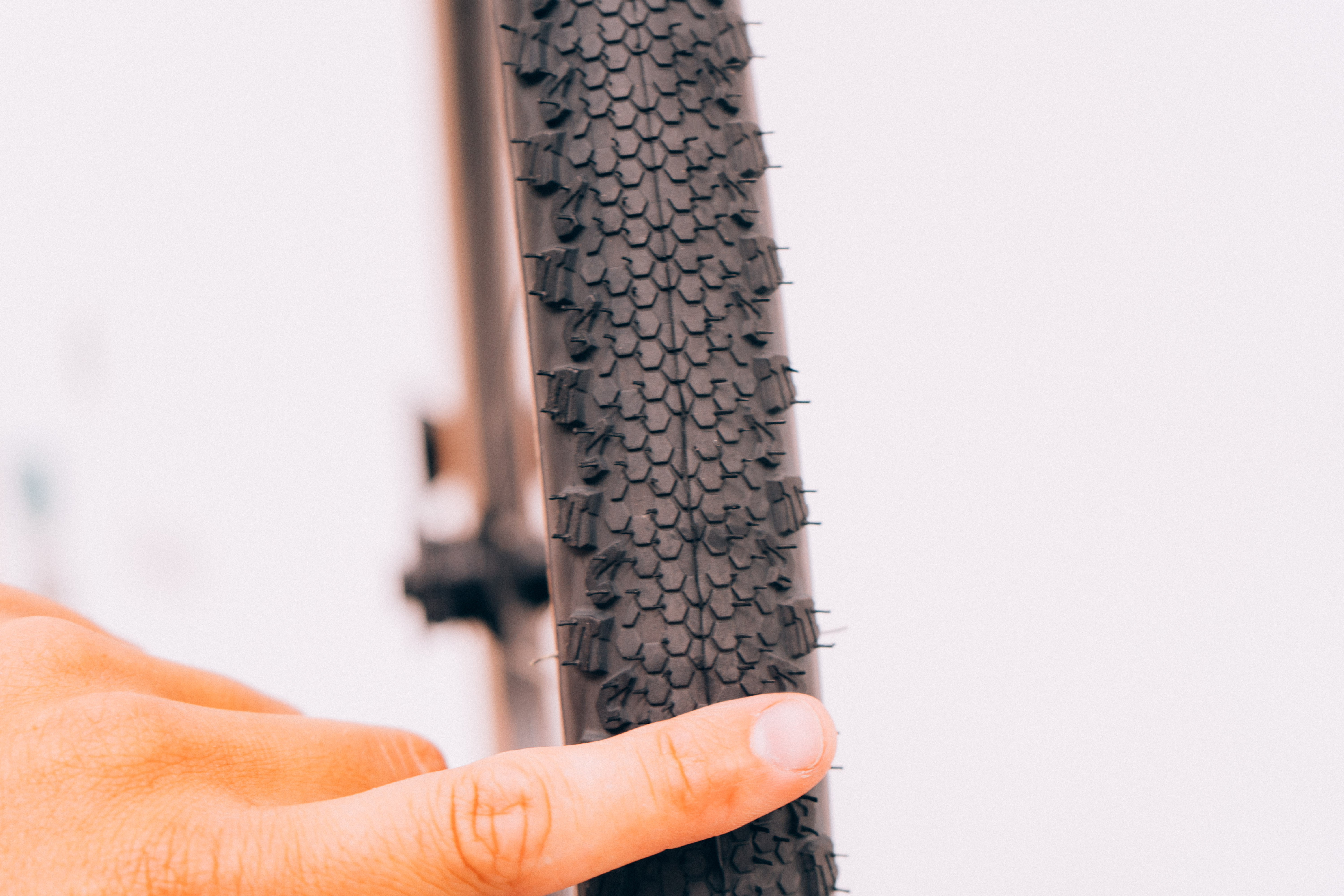 Terreno Dry/T30(Image credit: Will Jones)
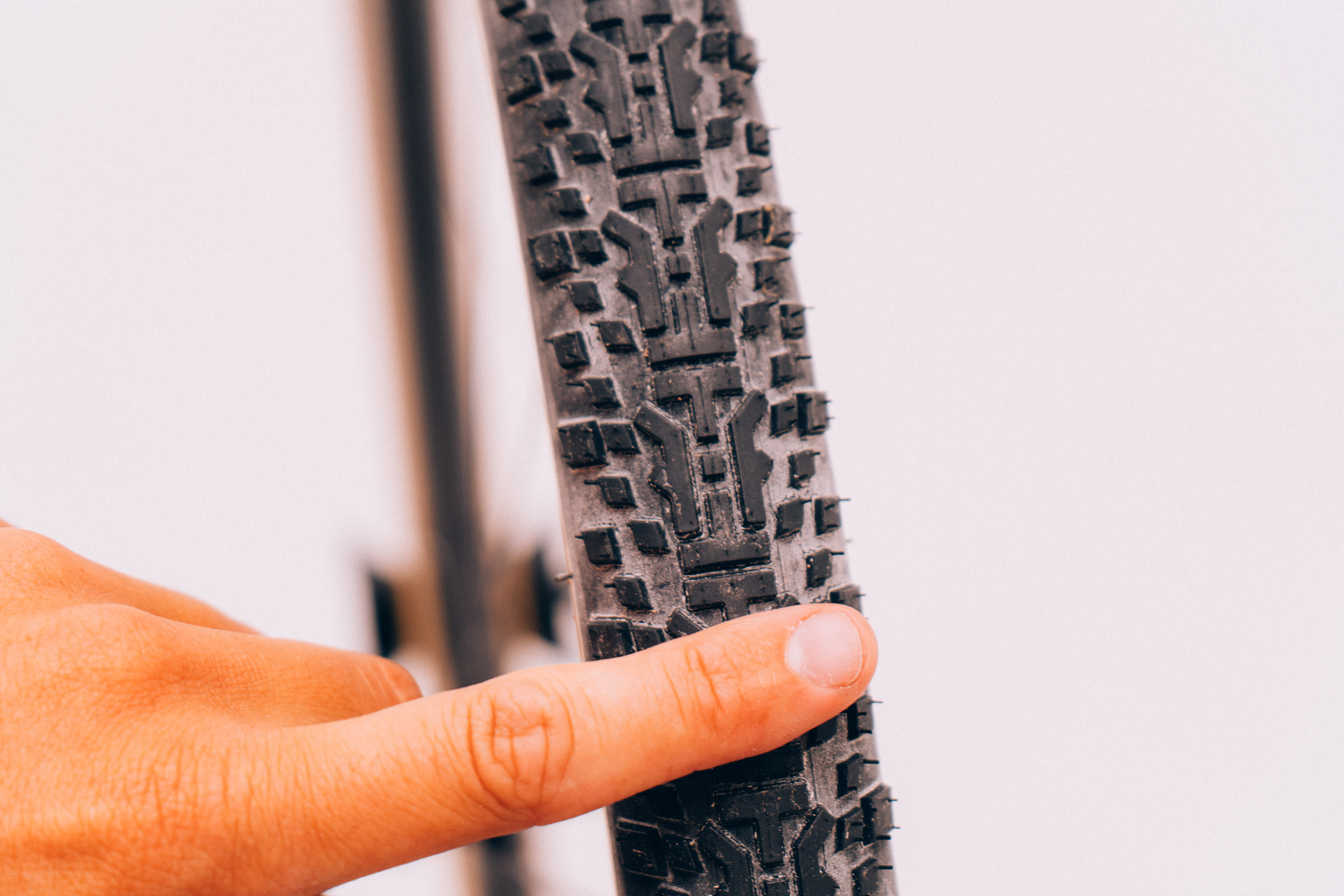 Gravelking X1(Image credit: Will Jones)
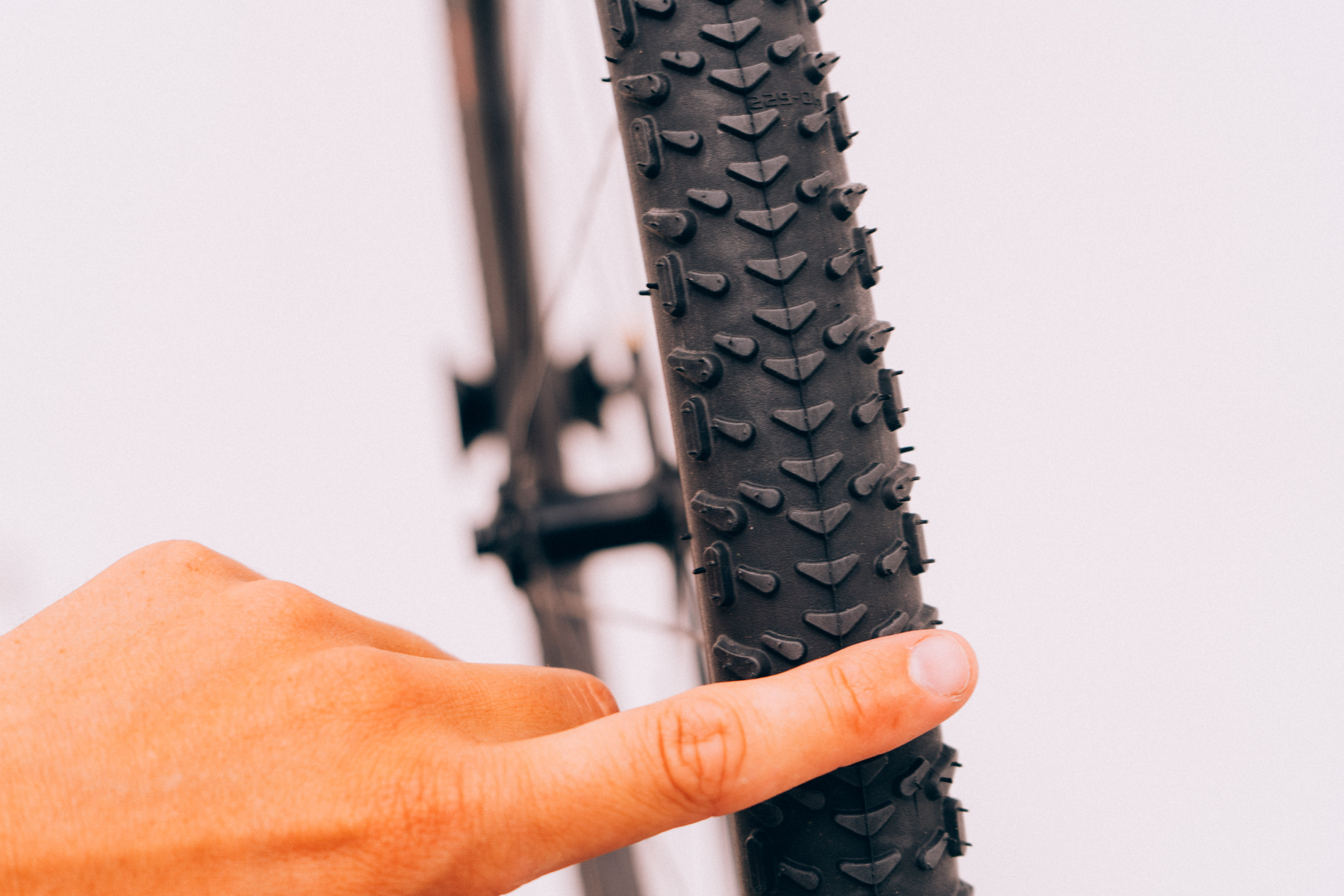 G-One RX Pro(Image credit: Will Jones)
Are knobbly tyres less aerodynamic than their smooth counterparts? In order to answer this, we used a few spare moments during our wind tunnel time to fit various 40mm tyres, primarily to Hunt rims, to see what happened.
In order of increasing knobby-ness, we had the basically smooth Goodyear Vector, then the Terreno Dry (or T30, as it is now known), then the Panaracer Gravelking X1, and finally the Panaracer G-One RX Pro, which is very knobbly indeed. These were tested using an identical protocol to the rest of our wind tunnel testing, and weighted in the same fashion, and the results are as follows:
From this, we can see that the Zipp wheels are marginally faster than the Hunts when set up with the Goodyear tyres, which were designed for these rims (SRAM can breathe a sigh of relief now).
We can also see that the totally smooth tyre is marginally faster than the knobby options, but between treaded tyres, there’s functionally no difference, so you can at least fit knobbly tyres safe in the knowledge that they aren’t slowing you down aerodynamically compared to smoother alternatives.
Surprisingly, running a fat front tyre and a skinny rear is faster than the opposite setup, by almost exactly half a watt. These were two extreme ends of the setup spectrum, and neither is one we suspect anyone will actually use, but it perhaps serves to illustrate that there’s very little penalty (and perhaps a minor benefit, though it’s very close to our error margin) in fitting a wider front tyre even if you can’t match it at the rear.
(Image credit: Will Jones)
ConclusionsAre wider gravel tyres faster?
In a word, no. Our previous testing on road tyres up to 40mm seemed to suggest that the wider you go, the faster you get, especially on rougher surfaces, but the opposite appears to be true in this case, with both the aerodynamic drag and rolling resistance increasing from 38 to 55mm sizes. It’s pretty clear the MTB options are of a different and much faster construction, and had they been constructed in the same manner as the rest of the cohort, we may well have had a nice linear, predictable rule to follow, but that is speculative.
To throw a slight spanner in the works, the MTB sizes did get faster with increasing size, but we only have two data points for each, though the relationship held true in almost every combination of rim, surface, and speed.
Once we ascertained that there was a clear difference between the gravel and MTB sizes, I went back to Vittoria for some clarification on the tyre construction, and was given the following information:
Gravel endurance – Engineered with 100 TPI nylon, the Endurance Casing is built to handle the harsh demands of gravel riding. Its durable threads reduce rolling resistance while preserving a responsive ride feel, and help absorb trail chatter for added comfort and control on rough terrain. Designed for long-distance durability, it’s the foundation of reliable performance on every ride.
XC Race – This Race Casing 60 TPI Nylon offers a supple yet robust structure that enhances puncture resistance and impact absorption without compromising speed. Consistent deformation across tread and sidewall ensures peak performance in cross-country racing.
XC Trail – A durable 60-TPI nylon casing built for exploration. It resists abrasion and punctures while maintaining your connection to the trail with a mid-tier suppleness.
Cutting through the marketing lingo, there’s no real way to tell without further testing whether the ‘XC Trail’ tyres would have been more closely analogous to the gravel models. It also shows that you cannot base your rolling resistance assumptions purely on the TPI (threads per inch) of the tyre, as, on the face of it, 100TPI should be more supple than 60TPI.
It is entirely possible that there is no hard and fast rule, and there is something in the construction of the Pirelli road tyres we tested, insofar as they get more supple with increasing width, whereas these Vittorias get less supple with increasing width. There are limitations that come with testing a single tyre model, and in order to investigate this further, we would need to test a full suite of widths of multiple tyre models.
Given the relationship was consistent in almost all scenarios, regardless of surface, differing only in magnitude, we could dispense with the tarmac and cobbles and stick to setts, freeing up time to test more tyre models.
Doesn’t this contradict your previous tests?
In our test from 2025, we did a smaller study into increasing tyre width. In that test, it showed that wider tyres are faster, but there was a clear jump from tyres that were broadly similar in terms of rolling resistance, to getting a lot faster for the 2.1″ size, which I suspect also had an MTB casing difference as we have seen here.
In some ways, our testing here supports the data there: wider, MTB size tyres are faster, and while it appeared that the 2.1″ tyre had a similar construction to the rest of the cohort in 2025, I suspect it was probably utilising a more supple construction.
We can see that in 2025, the smallest size was slower, but this was labelled as a ‘cyclocross’ tyre rather than ‘gravel endurance’, so again, on a second reading with the benefit of hindsight, I think this is an outcome based on construction differences, not necessarily width. In our most recent testing here, the smallest sizes are at least labelled identically to the rest of the test cohort, which cleans up the datas markedy.
Ultimately, our previous study concluded that wider tyres are faster. I’m not going to say those results are totally wrong, but I think this time, with the benefit of both hindsight and experience, we have done a better job of isolating the casing differences and honing in on how much changing only width affects things.
It’s also worth bearing in mind that in 2025 we were testing the rolling resistance of ‘Terreno Dry’ tyres, while in 2026 we were testing ‘T30’ models. Same tread, but we are unable to say for sure if there have been some tweaks to the construction under the hood to go along with the size labelling changes. Both sets of data, therefore, can be true.
Should you fit MTB tyres to your gravel bike?
The data certainly seems to suggest that you should, but it’s a slightly lunatic suggestion to say that you should either fit 2.4” rubber, or something 38mm wide; there’s a danger of real-world advice being totally derailed by lab-derived numbers here.
If it is true that MTB tyres in general are made more supple than gravel options, then yes, you probably should fit MTB tyres to your gravel bike – you will be faster. I would caveat that with the fact that we have only tested a single tyre model, and so further study that would pay dividends would be a direct comparison in terms of rolling resistance of MTB tyres and their gravel equivalents to see if there are broader market trends that can be ascertained.
There’s also some good reverse-advice for the MTB crowd here, too, in that there’s probably no benefit, and actually a penalty for swapping your chunky MTB tyres for something skinnier if you choose to use your MTB as a gravel bike, or even a road bike.
What does this mean for bike design?
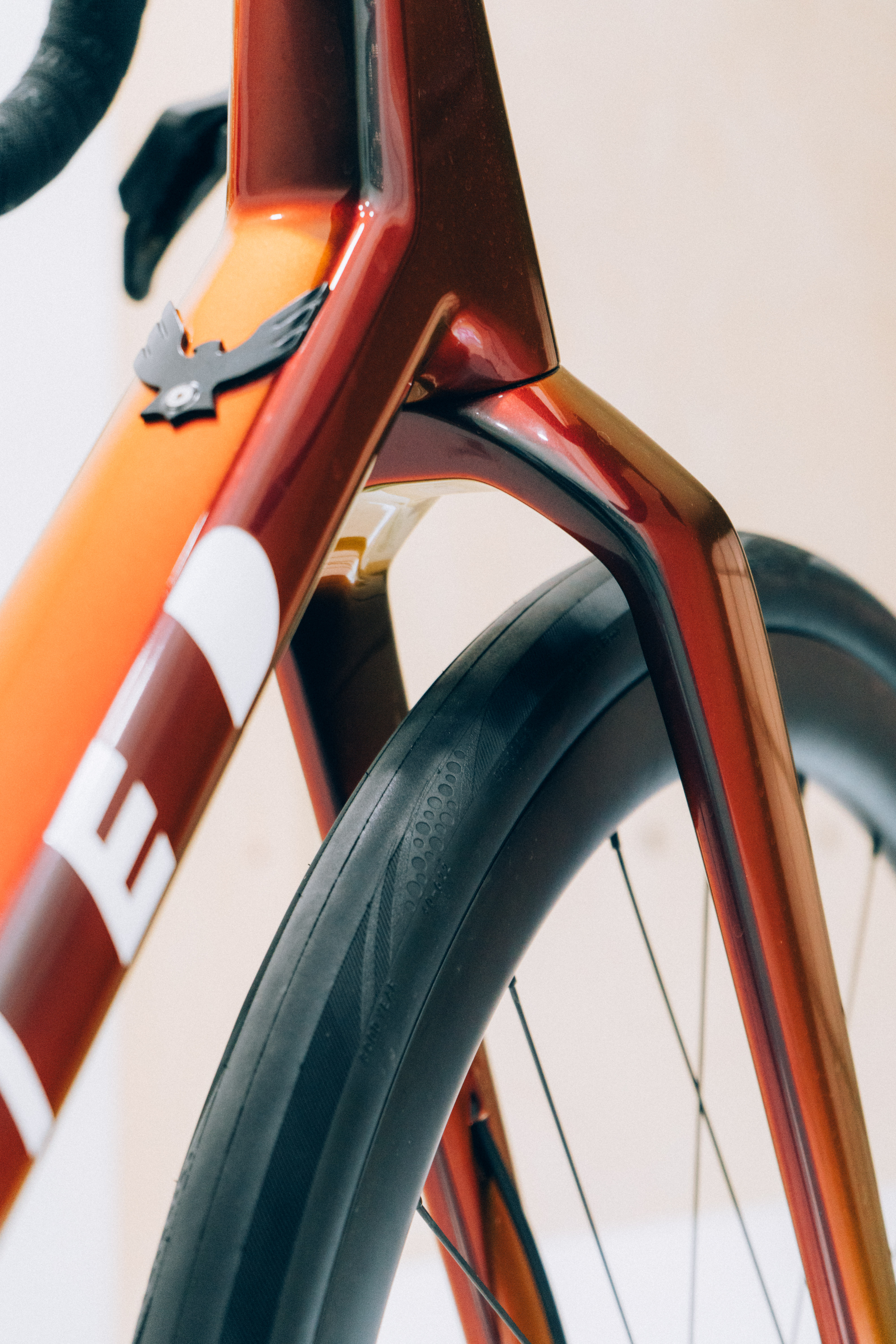
Gravel racing is continuing to grow, both in popularity and professionalism. We have gravel race teams now, supplanting the privateer model, and with more sponsor money comes a greater focus on performance. There are clear wattage gains to be had when it comes to fitting extremely large MTB tyres to gravel bikes, but we are butting up against the limitations of design using road standards. Many new gravel bikes can just fit a 2.1” or sometimes a 2.25” tyre, and even our test bikes, both the Lauf and the Allied, could only run a 2.4” in a lab situation; the clearances were too tight to run out on the trail when you add wheel and frame flex and mud into the mix.
It’s not hard to see that in a few years, we could well see MTB standards replacing road ones for gravel. MTB width bottom brackets, combined with boost-spacing rear wheels, would allow chain and seat stays to more easily clear larger volume tyres and still leave room for mud and stones. This will no doubt cause some consternation amongst some readers and customers, but ultimately, it’s the simplest way to create the end goal the industry seems to be working towards. A slightly larger Q-factor may be the price we all have to pay.
(Image credit: Will Jones)
A sense of perspective
It’s very easy to get drawn into the data and come out with conclusions that are simply not applicable to the real world. While it may be faster, I cannot in good conscience recommend you fit 38mm tyres to your gravel bike if you can only clear a 50mm just because our data says it’s better. I’ve tried it, and it isn’t.
I can also attest that MTB tyres aren’t just faster because they have a lower rolling resistance, but because they allow you to absolutely barrel down bumpy descents with far greater control and, dare I say it, in a safer fashion. They’re more fun to ride, in my opinion, and offer better grip on loose and technical climbs.
They’re also heavier and do feel more cumbersome on the road, and accelerate more reluctantly compared to skinnier alternatives. I’ve tried cramming giant tyres into bikes that really can’t accommodate them – if you read my Specialized Diverge review, you’ll see I squeezed 2.25” tyres into the frame and fork – and you risk damaging your frame too much in most cases for me to suggest it’s a good idea. If you’re a sponsored athlete who doesn’t buy their frames, I can see the appeal, but for consumers and amateur racers, it isn’t worth the risk.
What I’m trying to say is that there is more to choosing a tyre size than aero or rolling resistance data. Grip, handling, and ride feel are just as important as wattage gains, and all should be taken into account when choosing what you run. While I don’t think you should use this data as an impetus to fit bigger tyres than it can handle into a gravel bike you already own, I do think it serves as an extremely useful slice of information if you’re considering buying a new gravel bike.
Personally, looking at the data contained within this article, I’d be reluctant to buy a gravel bike nowadays that I couldn’t comfortably fit at least a 2.1” MTB tyre into, and ideally a 2.25”. There aren’t many of these about, but give it time…
Thank you’s
Firstly, thank you to you, our paying subscribers. Without you, we wouldn’t be able to indulge our professional curiosity to quite the same degree, and certainly unable to do so in the impartial and unbiased way we manage to do things at present. We hope articles like this continue to provide you with something that is either interesting, useful, or ideally both.
Thanks to Tom for helping to make sure everything went smoothly, was measured accurately, and run in a timely manner.
Thanks to Jamie for spending all day riding a static bike on rough surfaces. Nearly 100km indoors is bad enough without adding cobbles into the mix; rather you than me, pal!
As always, thanks to the SSE team, and an apology for sending sealant all over the windows. Lesson learned, I think!
Finally, thanks to the brands that sent us kit to use for this test – Lauf and Allied for the bikes, Hunt and Zipp for the wheels, Vittoria for the tyres, SRAM for the cassettes, and Juice Lubes for the sealant and valves. We couldn’t do this without your help.
Image 1 of 4
 (Image credit: Will Jones)
 (Image credit: Will Jones)
 (Image credit: Will Jones)
 (Image credit: Will Jones)