
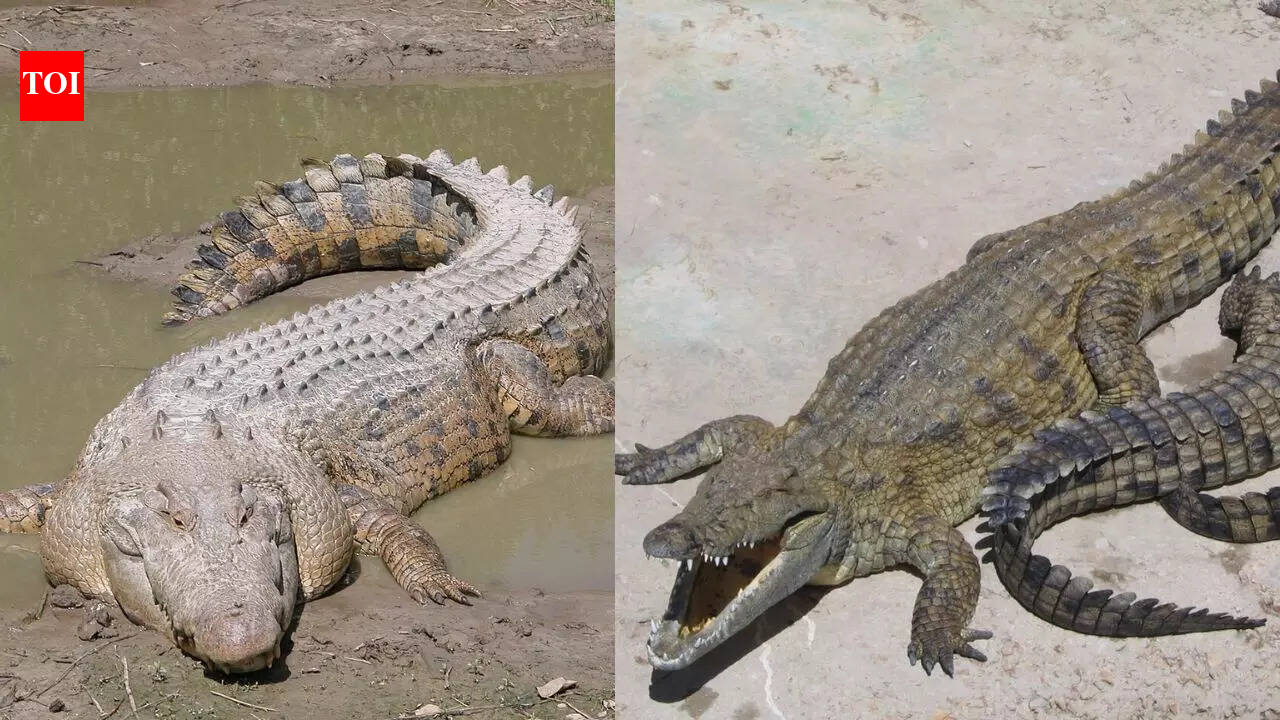
 Crocodiles are often described as survivors from a distant past. Creatures that have changed very little despite millions of years passing. Among them, two species repeatedly capture attention: the Nile crocodile and the saltwater crocodile. Both are enormous reptiles and dominant hunters in their ecosystems. At first glance, telling them apart can be difficult. Long snouts, heavily armoured bodies, and a tendency to lie motionless before a sudden attack create a similar impression.Yet researchers say those similarities can be misleading. Differences in size, habitat preference, behaviour, and interactions with people shape how each species lives and hunts. Know how each species has adapted to its surroundings and why they continue to command both respect and caution.
List of key differences between Nile crocodiles and saltwater crocodiles
Nile crocodiles and saltwater crocodiles are often confused. Despite similarities, they differ in size, habitat, hunting style, aggression, and behaviour. Understanding these key differences helps reveal which truly dominates its environment.Feature
Nile crocodile
Saltwater crocodile
Average size
Typically 3–5 metres; exceptional individuals larger
Commonly 5–6 metres; extreme cases exceed this
Weight
Large but generally lighter on average
Can exceed one tonne in extreme individuals
Largest reptile status
Among the largest crocodiles
Widely regarded as the largest living reptile
Body colour
Bronze or brown tones with pale underside
Greyish or greenish with faint markings
Primary habitat
Freshwater rivers, lakes, marshes, and floodplains
Rivers, estuaries, mangroves, coastal waters, and open sea
Saltwater tolerance
Can tolerate saltwater but rarely lives in it permanently
Highly adaptable to both freshwater and saltwater
Geographic range
Sub-Saharan Africa and Madagascar
Eastern India, Southeast Asia, northern Australia
Mobility across seas
Limited ocean travel
Known to travel long distances across open sea
Diet
Fish, birds, reptiles, zebras, wildebeests, and other mammals
Fish, turtles, crabs, wild boar, livestock, sharks, and varied coastal prey
Hunting style
Ambush predator targeting animals near freshwater edges
Similar ambush strategy but with broader prey due to coastal access
Nile crocodile vs saltwater crocodile
Physical traits
The saltwater crocodile is recognized as the largest reptile that is still alive. Males can easily reach a length of five or six metres, and some may even weigh more than a tonne. Nile crocodiles are also very large. They are, however, slightly smaller compared to the saltwater crocodile. Most adults reach a length of three to five metres, although some may grow longer. Both species are very similar in appearance. They have strong scales on the back, powerful tails that propel them forward with a burst of water, and strong jaws that can exert a lot of force when they bite. There are a few differences in their colours. Nile crocodiles have bronze or brown colours with lighter undersides, while saltwater crocodiles have grey or greenish colours with very faint markings.
Habitat
Nile crocodiles are closely associated with freshwater habitats in sub-Saharan Africa and parts of Madagascar. They are often found in rivers, lakes, swamps, and temporary floodplain habitats where prey congregates in shallow water along shorelines. While they can survive in slightly brackish conditions for a brief time, they normally prefer to stay within freshwater habitats. Saltwater crocodiles are found from eastern India to Southeast Asia and northern Australia. They inhabit rivers, estuaries, mangrove swamps, and coastal areas, and some have even been known to migrate over long distances across the open ocean.
Diet and hunting behaviour
Nile crocodiles are opportunistic feeders. Fish, birds, reptiles, and large mammals like zebras and wildebeests can all become prey. Their hunting strategy involves waiting patiently, sometimes for as long as an hour, before striking a sudden ambush attack at the edge of the water. Saltwater crocodiles have the same feeding patterns but have the advantage of living in coastal areas that offer them a wider range of prey. Fish, turtles, crabs, wild boars, and livestock are common in their diet, and there have been instances of them attacking sharks.
Nile crocodile vs saltwater crocodile: Who would win
In a head-to-head comparison, the saltwater crocodile would probably have an edge in terms of size and adaptability to their surroundings, based on their ability to survive in both freshwater and saltwater habitats. The Nile crocodile, on the other hand, is a top predator in the African freshwater environment and is known for its strong territorial behaviour.