
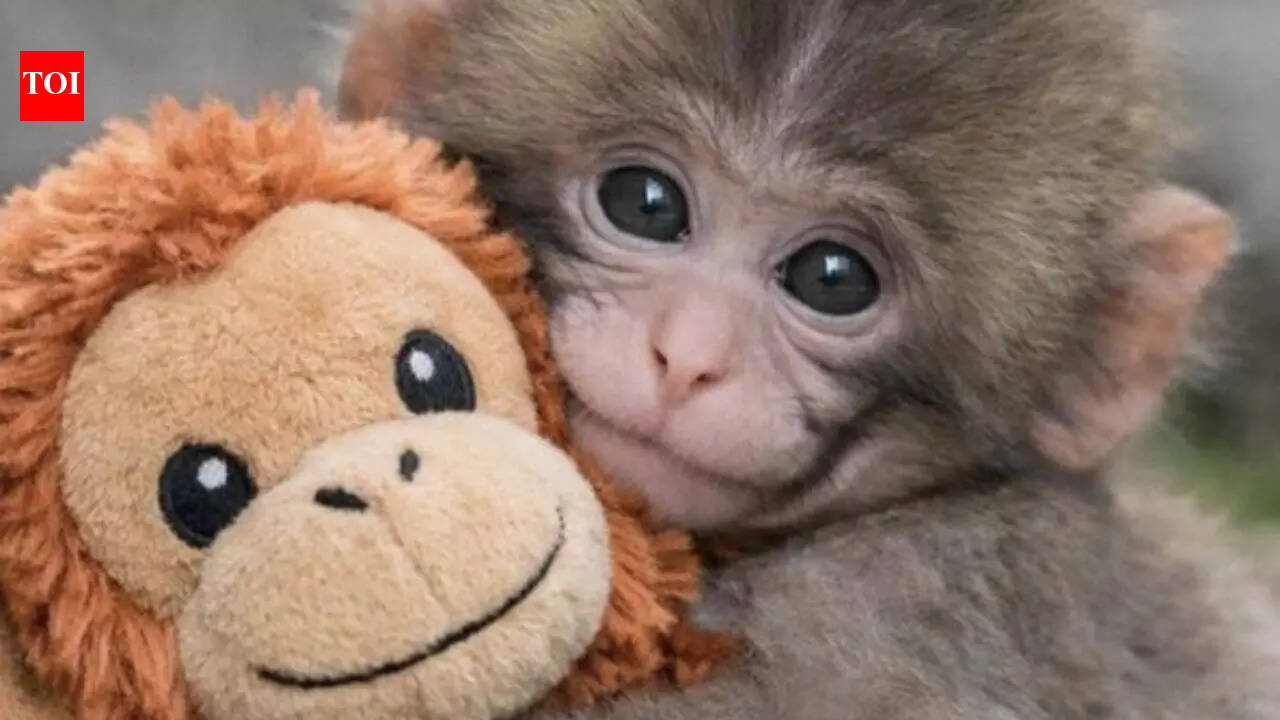
 For the past week, the emotional state of the internet seemed to hinge on one tiny life, a baby macaque named Punch. Known as Panchi-kun in Japanese, Punch lives at Ichikawa City Zoo near Tokyo. His story, one of rejection, isolation and fragile hope has resonated far beyond Japan, prompting strangers across the world to plan visits, send gifts and rally behind a single hashtag: #HangInTherePunch.The young macaque wanders through the enclosure searching for connection. When attempts to bond fall flat, he retreats to a bright orange plush orangutan, dragging it gently into a corner and curling up beside it. His only consistent comfort has been his caretaker, whom he clings to during feeding time.
Who is Punch?
Videos of Punch being dragged and bullied by other adult monkeys in the zoo had many crying into their pillows at night. Once they saw him getting rejected by others, well, the internet collectively adopted Punch as its baby. But who is this small macaque that has pulled at thousands of hearts?Born in July 2025, Punch was rejected by his mother, a devastating start for a Japanese macaque, whose early survival depends heavily on maternal bonding and social learning. Without that foundation, he was hand-raised by zookeepers. He formed a strong bond with a plush Ikea orangutan dubbed “Ora-mama,” which provided him with a sense of comfort and security. “This stuffed animal has relatively long hair and several easy places to hold,” zookeeper Kosuke Shikano said. “We thought that its resemblance to a monkey might help Punch integrate back into the troop later on, and that’s why we chose it.”Among Japanese macaques, social hierarchy is everything. Young monkeys learn by observing their mothers — who grooms whom, who defers to whom, who belongs. When Punch was introduced to the zoo’s ‘Monkey Mountain’ in January, he lacked that social roadmap since infancy.Videos soon surfaced of him cautiously approaching other monkeys, only to be swatted away or ignored. The clips, showing him clutching his plush toy or burying his face into its fabric, struck a nerve online. Viewers projected onto him their own stories of abandonment, resilience and longing. #HangInTherePunch began trending on social media platforms including X, Instagram and Reddit.
A social media clan
Punch became not only a symbol of resilience but also persistence against some of the heaviest emotions life can dole out on the smallest and weakest of creatures. “I would adopt Punch and love him forever,” one person wrote. Another admitted, “3 days in a row crying over Punch.” Even public figures took notice. While Tristan Tate, brother of controversial influencer Andrew Tate offered to buy out Punch for $250,000, American activist Ryan Fournier offered $50,000 to adopt him.When footage showed an adult monkey dragging Punch aggressively, outrage followed. In response, the zoo clarified that Punch had been attempting to communicate with another infant macaque. The adult, believed to be the infant’s mother, intervened defensively.“Even though Punch gets scolded, he also possesses very strong mental resilience and recovers quickly. The fact that he repeatedly receives the cold shoulder and exclusion from group members after trying to communicate with various monkeys is not something to simply feel sorry about.”The statement added: “We hope you will see it as cheering for and supporting Punch’s persistence and efforts.”
A small acceptance and a big win
Punch’s tale event made it to the American late-night TV with Stephen Colbert revealing that Punch’s soft toy, the Ikea Djungelskog design worth $19.99 could bring people all the ease they seek these days. IKEA found increasing demand for soft toys in Japan, the US and South Korea and quickly pumped up the marketing bandwagon, featuring it in social media updates and ad campaigns. On February 17, the brand gifted Punch numerous stuffed animals, including the orangutan figure he bonded with. While some comforts went toward helping Punch, others found placement in zones meant for young guests at the facility. Then came the breakthrough, Punch was accepted! A video of him being groomed by another monkey in the troop, an established sign of inclusion among macaques had many clutching their hearts in peace. Another video showed a monkey following him around and the internet was quick to celebrate Punch getting a “bodyguard.” Such care indicates reliability and connection within the group; it helps him by encouraging him to begin engaging in play with juveniles of a similar age. In the matrilineal world of Japanese macaques, Punch’s path to full integration remains ongoing. He still clings to his plush companion. He is still learning the rhythms of troop life. But he is no longer entirely alone.Punch’s story has become more than a viral moment. It is a reminder of the universal need for belonging — of maternal bonds, of patience, of resilience. And if nothing else, it has made millions pause to appreciate the quiet comfort of home and perhaps to hug their own mothers a little tighter.