
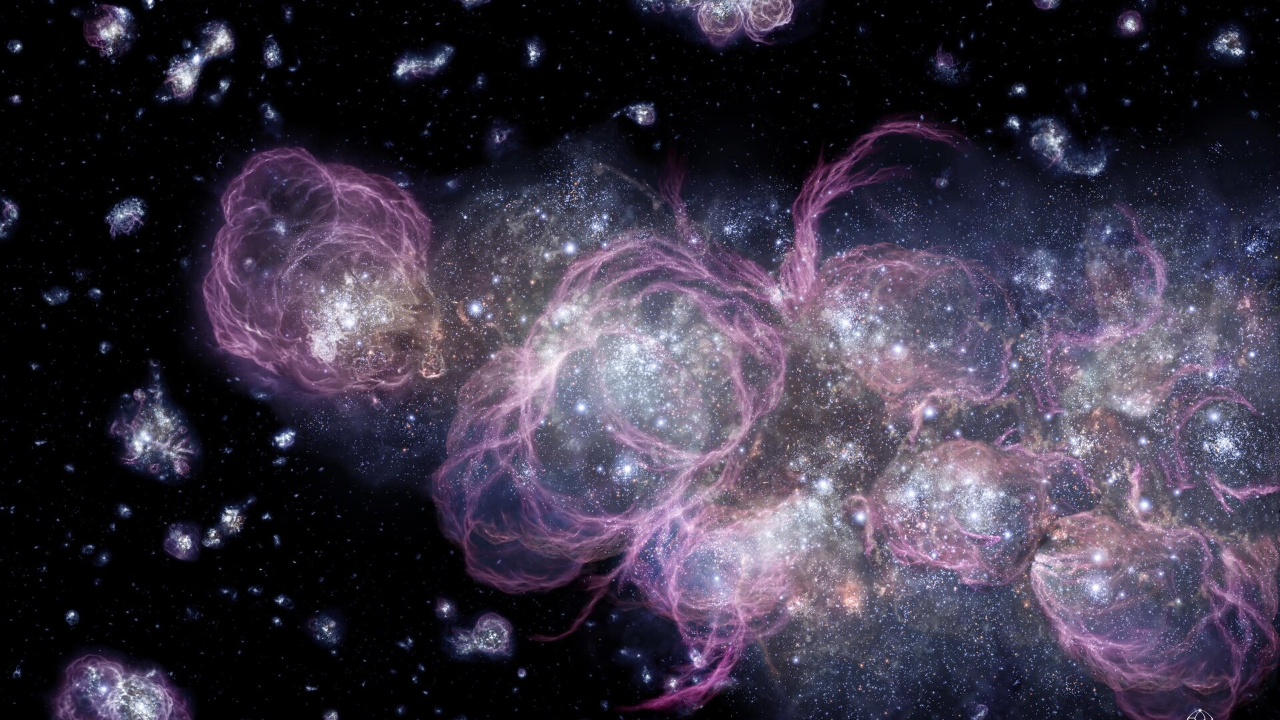
Understanding dark energy and the role it plays in our universe has been a topic of concern and debate for physicists and scientists alike. The release of the second batch of data from the Dark Energy Spectroscopic Instrument (DESI), DR2, has sparked more debates over the topic.
Another Approach Towards Understanding Dark Energy
After comparing the data from DESI’s new galaxy map with the Cosmic Microwave Background (CMB), which scientists believe to be leftover remnants of the Big Bang, a disconnect is noticed. There are various explanations that physicists have come up with, but one of the more popular explanations is that dark energy is evolving.
This evolution of dark energy means it has been either getting stronger or weaker over billions of years. However, this is a claim, and Dr Slava Turyshev rightfully points out that such extraordinary claims require extraordinary evidence.
At this time, there is no evidence to prove that dark energy in the universe is evolving, so Dr Turyshev looks to explain the disconnect in DR2 data and the CMB. He claims that the disconnect between these data sets can be explained by a potential error in the measurements of supernovae (used for distance measurements at cosmological scales).
To accurately measure supernovae, it is important to correctly get their brightness, and Dr Turyshev argues that current telescopes aren’t capable of this. The sound horizon, which measures the distance covered by matter moving through space at the speed of sound from its starting point into the Universe, is yet another potential point of error.
This measurement helps physicists judge the rate of expansion of the universe by telling how far matter moved from its starting point. But how can physicists correct the errors potentially caused by these measurements, hence helping us better understand dark energy?
Correcting The Disconnect Between Data From DESI And CMB To Help Us Better Understand Dark Energy
To correct this disconnect, it is important to adjust the errors that come from measuring the sound horizon. Dr Turyshev turns to the Alcock-Paczynski (AP) diagnostics, which uses a calculated shape of the Universe with proper measurements, for calculations in place of the sound horizon.
If this move doesn’t correct the disconnect between DESI and CMB datasets, then Dr Turyshev suggests using what he calls the Late-transition Interacting Thawer (LTIT) model. This models the thaw of dark energy from a certain time after the start of the universe till date.
The theory of Phantom Crossing might also explain this disconnect, but according to Dr Turyshev, a new set of physics is required to explain it. A lot of work is required to properly help us better understand the existence of dark energy.