
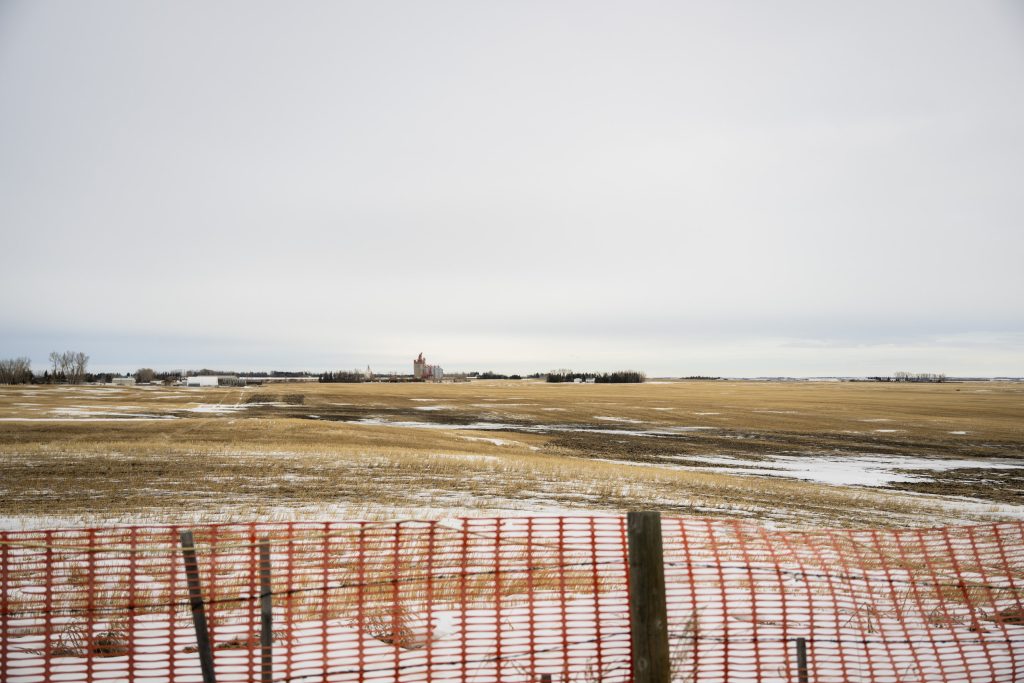
Just past the sign that welcomes drivers to Olds, Alta., sits a parcel of farmland. It’s on the edge of town, across the street from homes and tucked behind the old municipal building, which was sold to the local Co-op two years ago.
It’s where a developer is proposing to build a $10-billion data centre, along with the second-largest power plant in Alberta, to satisfy the world’s seemingly voracious appetite for data.
The natural gas facility, proposed by Synapse Data Centre Inc., will produce 1.4 gigawatts of energy each day, solely to power what could become the largest artificial intelligence (AI) data centre in the country.
That’s equivalent to the daily demand for the entire city of Edmonton.
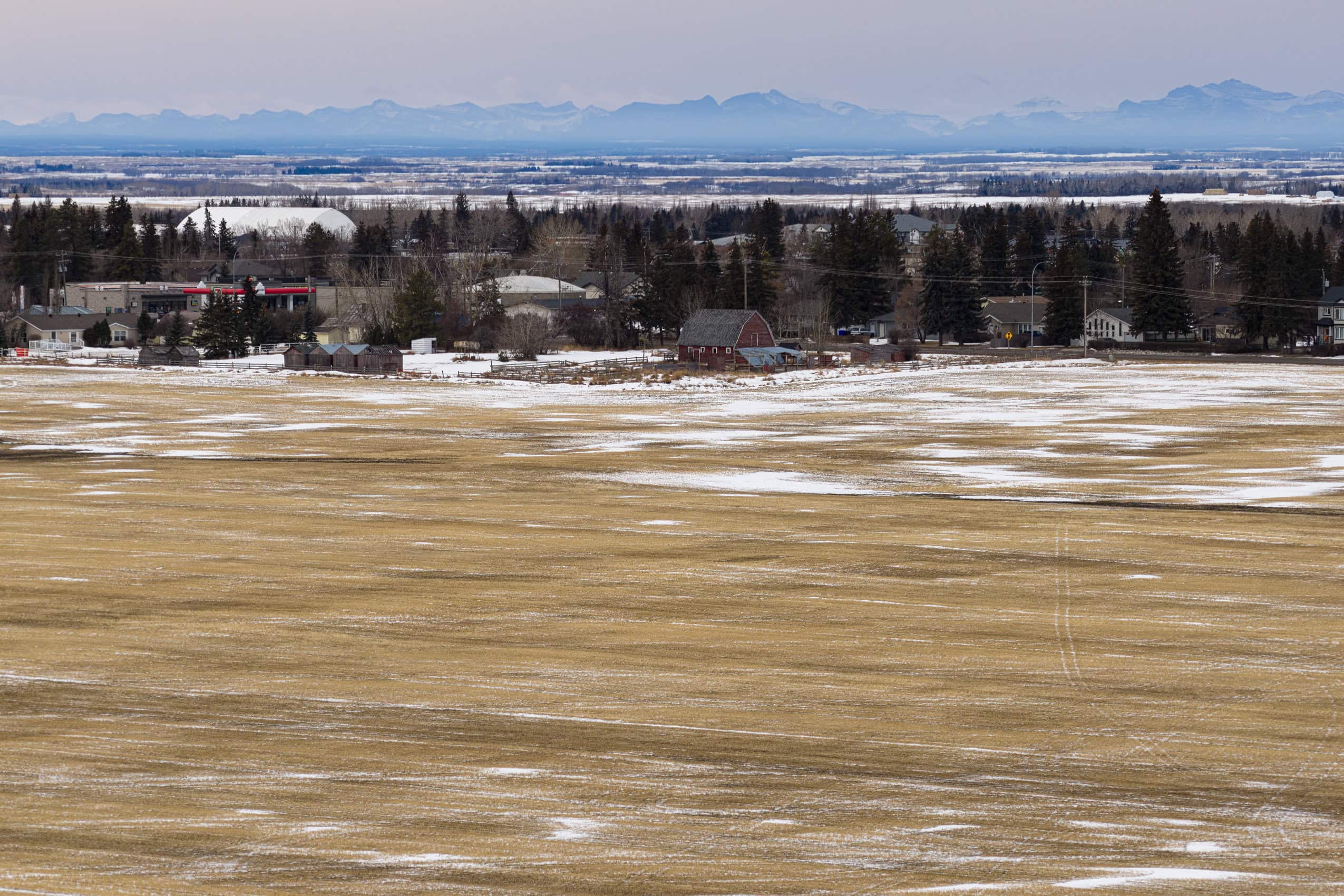 This parcel of farmland in Olds, Alta., was recently rezoned to allow for the proposed data centre. A natural gas plant is also planned for the site to power the data centre, which will use about as much electricity as the city of Edmonton.
For some, including a town council wrestling with debt and eager to find new income, it’s a boon. For others, including residents caught off guard by a fast-moving developer, it raises concerns over air and water pollution, noise and more.
That sort of investment in a town of just under 10,000 is significant.
The developer approached the town last November, and went public near the end of January regarding its plans. Synapse has said it wants to start construction in March — something Mayor Dan Daley calls “pretty optimistic.”
The data centre, if built, would be the biggest project amidst a potential building boom in Alberta, pushed by a provincial data centre strategy launched in 2024 that seeks to attract $100 billion worth of investment to the province.
It’s also a significant test of the government’s “bring your own energy” part of that strategy, which prioritizes data centre projects that include on-site power generation, separate from the provincial electricity grid.
But closer to home, the project has raised more immediate concerns for residents of Olds.
Janae Johnson, who lives near the proposed facility, worries about how close the data centre will be to homes, but also the wetlands and fields of Olds College, just across the street. She worries about air pollution, water, noise and a project that seems to be moving fast with little public information.
“We’re talking about the biggest plant, that’s using new technology that hasn’t been proven, that is not typically located right in a residential area,” she says.
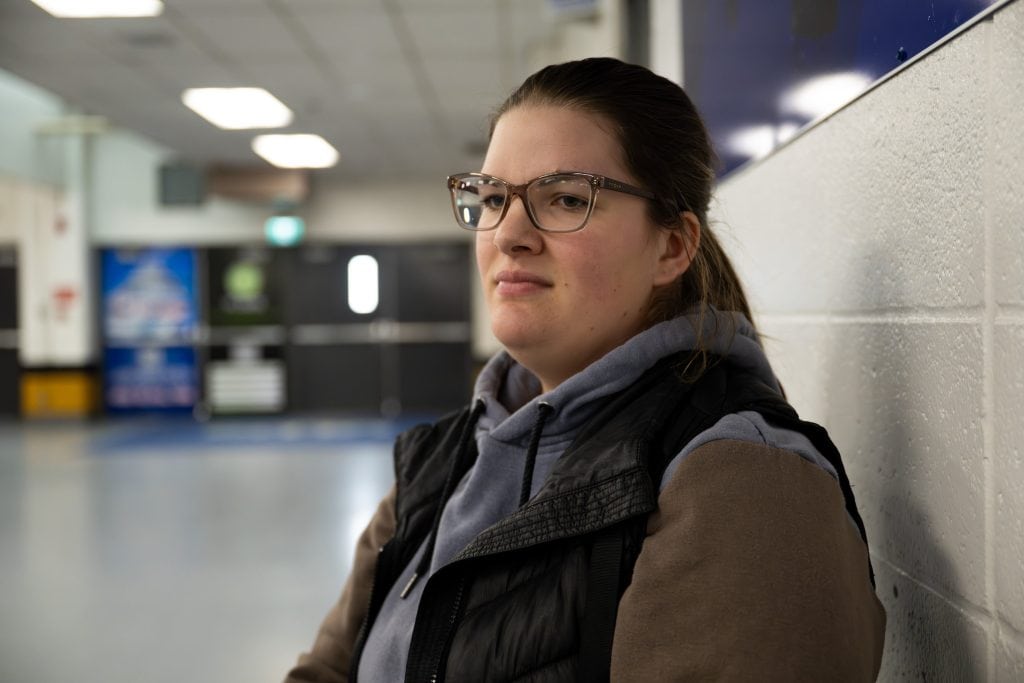 Janae Johnson lives near the proposed data centre. She’s concerned about potential air and noise pollution from the centre and its associated gas power plant.
Olds AI project announced in January — company wants to start construction in March
The Synapse data centre will actually be ten data centres and ten power plants, cobbled together on the same parcel of land on the edge of Olds, across from the agriculture and technology college. All together, the computer servers alone would eat up a gigawatt of electricity daily.
The company says it will use a closed-loop water cooling system for both its data centre and the attached power plant, claiming it only needs to pull water to fill the systems once, a relatively new technology for data centres. The power will be produced by natural gas units tapping local reservoirs of gas.
AI data centres are the backbone of plans to dramatically ramp up artificial intelligence use in all aspects of life, from surfing the internet to use in hospitals, military applications and so much more. Data centres themselves are largely unassuming: inside are what look like rows of neatly arranged boxes — servers stacked on what look like bookshelves.
Sandra Blyth, the economic development manager for the town’s investment agency, Invest Olds, says she signed a non-disclosure agreement with Synapse to protect some of the more detailed information, so she’s limited in what she can reveal about more technical aspects of the plan.
She says the company approached the town in November and then moved quickly, with the project announced on Jan. 27. The land in question was rezoned to allow the project on Feb. 9 and the company says it wants to start construction in March.
 Sandra Blyth is the economic development manager for Invest Olds. She says Synapse Data Centres Inc. first approached the town with its proposal in November 2025.
Synapse still has to go through the regulatory process with the Alberta Utilities Commission, the provincial regulator of the electricity grid, and Alberta Environment and Parks, making the March construction start date unlikely.
“There’s a lot of regulation to get through, and so it’s hard to say, but that’s the target,” Blyth says about the construction timeline. “Targets are good.”
But the speed of that target has caused concern.
Residents concerned about emissions, water contamination and more
Johnson, who lives near the site, says there’s been a lack of clarity on the project and a lack of transparency from council, which doesn’t help convince her of the project’s benefits. She also learned about the development in late January, when three representatives from Synapse knocked on her door.
“My biggest concern is going to be air pollution, noise pollution,” she says. “We have populations of deer and geese and loons and beavers. What is the impact of this going to be? That has not been addressed whatsoever.”
She’s not alone. Dozens of letters and comments sent to town council in February reveal extensive concern.
“Has there been any consideration of the amount of emissions that the gas-fired power plant will create?” one resident wrote to the town council.
“How will wastewater be disposed of as it will likely be contaminated?” the same resident asked.
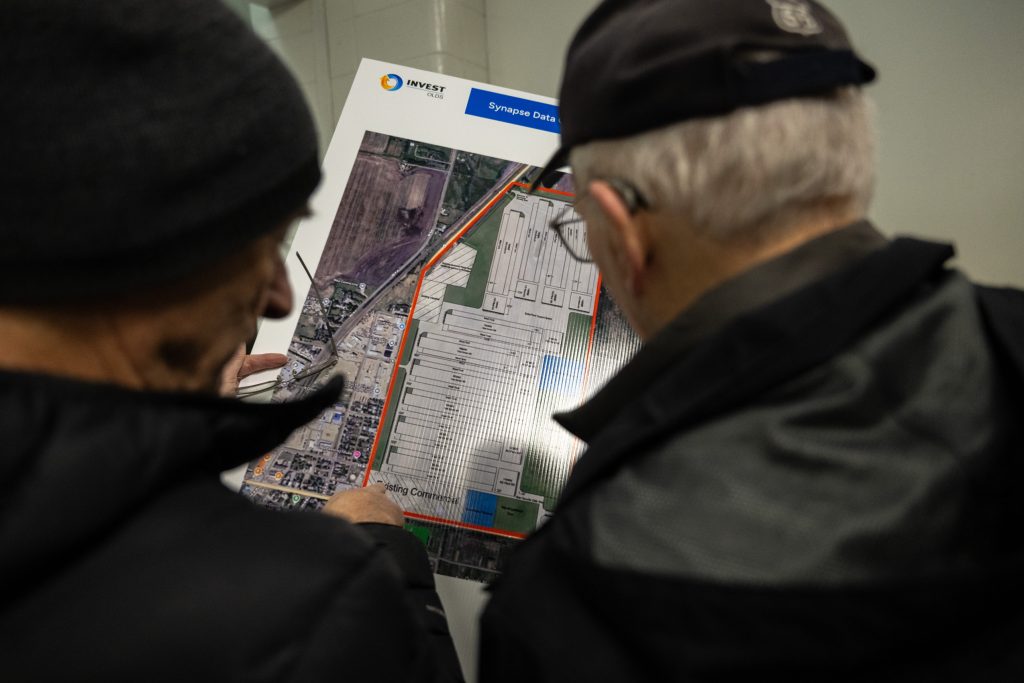
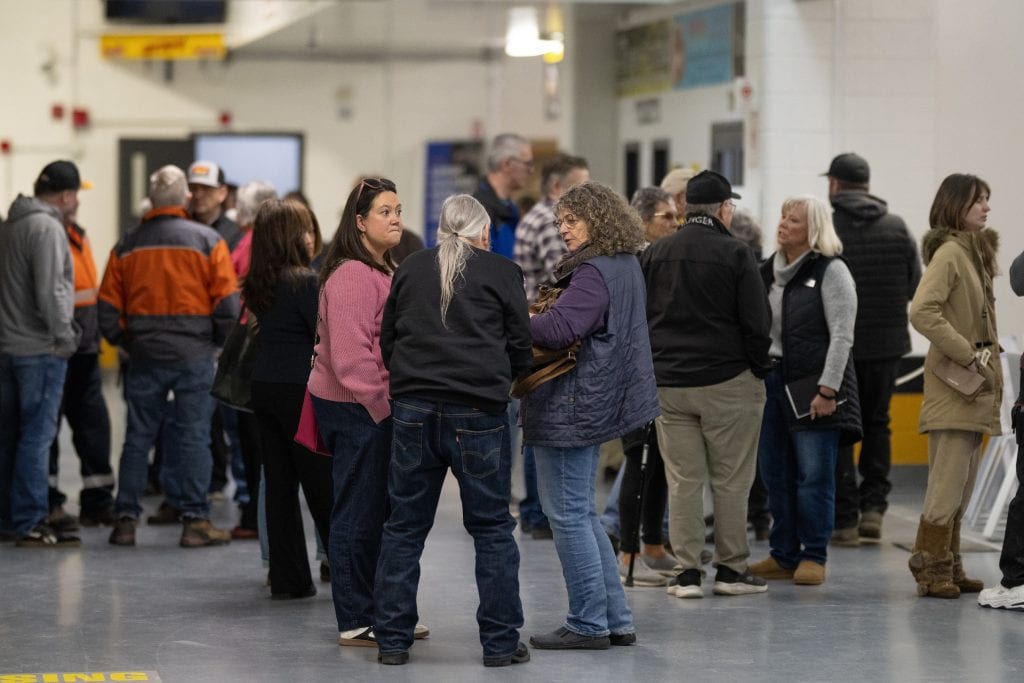
Community members attended an information session at the local community centre earlier this month to learn more about the proposed data centre.
Others wanted to see examples of existing closed-loop systems, remediation plans for the site, clarity on how air quality will be monitored and information on how contraventions would be enforced.
Standing in the parking lot of the Co-op building, overlooking the site, Peter Grenier says he’s opposed to the project. He lives across the street from the proposed data centre.
He thinks the project is too close to homes and is upset with what he sees as late consultation.
Daley, the mayor of Olds, says he’s sympathetic to residents’ concerns, but there aren’t many answers he can provide.
“A lot of their questions and concerns that they had directed towards council, we didn’t have answers on yet because these studies and assessments haven’t taken place yet,” he says.
Electricity use of proposed data centres in Alberta would be more than double the province’s average
Jason van Gaal, the president and CEO of Synapse, says the company has submitted applications to the utility regulator and the government, both of which are focused on the power generation aspect of the project.
He says the company could, “in theory,” start construction on the data centre prior to receiving those approvals.
The natural gas power generation will produce greenhouse gas emissions as well as pollutants including nitrous oxides, something van Gaal says is a focus of provincial regulations.
“What the province wants to see is nitrous oxides below a certain threshold, and other things as well, but the reason they focus on nitrous oxide is because that is, typically, for natural gas plants, the hardest one to be compliant with.”
Van Gaal wasn’t able to provide figures on greenhouse gas emissions from the project. Natural gas produces methane, a potent greenhouse gas. He did say there could be carbon capture on the power plant in the future.
The Synapse project isn’t the only project of its scale proposed for Alberta. The list of data centres that want to connect to the provincial grid include one project near Red Deer that would reach 1.8 gigawatts, another near Calgary requiring 1.4 gigawatts and several nearing the one-gigawatt mark.
The province capped the total amount of power that could be drawn from the grid for all data centres at 1.2 gigawatts for the first round of applications. All of that power went to two projects, both near Edmonton, leaving 40 to wait in the queue or build their own power source.
In total, power demand for proposed data centres currently listed by the Alberta Electric System Operator sits at 21.2 gigawatts per day — more than double the average electricity use for the entire province. And that figure doesn’t yet include the Synapse project.
“Someone asked me at one of the meetings, are you okay living beside it? And I said, ‘Sure, no problem.’ The more I’ve gone down this, the less concerned I would be about it,” says van Gaal. “If the community wants me to live beside the natural gas plant myself, I don’t have a problem doing it.”
‘Feeling the pinch’: huge AI investment could help Olds’ finances
The prospect of a multibillion-dollar investment is particularly attractive, as Olds has struggled financially in recent years. Olds lost millions building a local fibre optic network that it recently sold to Telus at a loss, a large cannabis operation pulled up stakes in 2022 and provincial funding for municipalities has dried up. The town has eaten into reserves and cut services as it fights to balance the books.
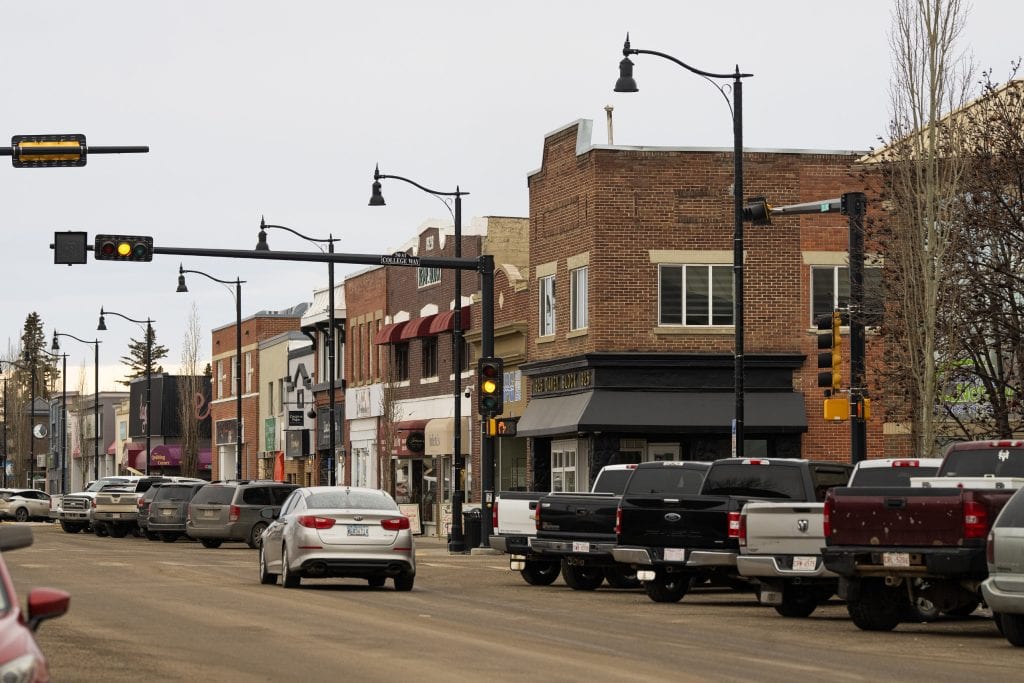 The town of Olds, Alta., has struggled financially in recent years, and some municipal leaders are eyeing the proposed data centre as a way to boost property tax revenue. Mayor Dan Daley says the municipality is “feeling the pinch” of provincial funding cutbacks.
Mayor Daley says Synapse would be responsible for paying to bring utilities such as water and sewage to the area, a significant investment that could attract more businesses to that currently unserviced area of town.
“The tax revenue that’s going to come off of that will definitely help,” he says. “As all other municipalities in Alberta, we’re feeling the pinch of the cutbacks to our funding from the provincial government.”
While that funding shrinks, the province is busy promoting data centres as an economic driver. There’s also more than $1 billion from the federal government as part of a data sovereignty strategy.
That funding, and the enormous amounts of corporate money being dumped into the building boom, mean the dilemma of data centres is something more and more communities will face.
Grenier, who worries about looking out over the data centre instead of the sunrises he has enjoyed for years, expresses a sort of fatalism about it, especially after Alberta Premier Danielle Smith weighed in with her support, saying on Facebook she’s “thrilled” to welcome the project.
“Once your premier has it on her Facebook page — she’s done, boys,” Grenier says.
Updated on Feb. 23, 2026, at 2:28 p.m. MT: This story has been updated to correct a typo. A previous version of this article stated Synapse Data Centre Inc. could become the largest artificial intelligence data centre in the county. It could be the largest in the country, not the county.