
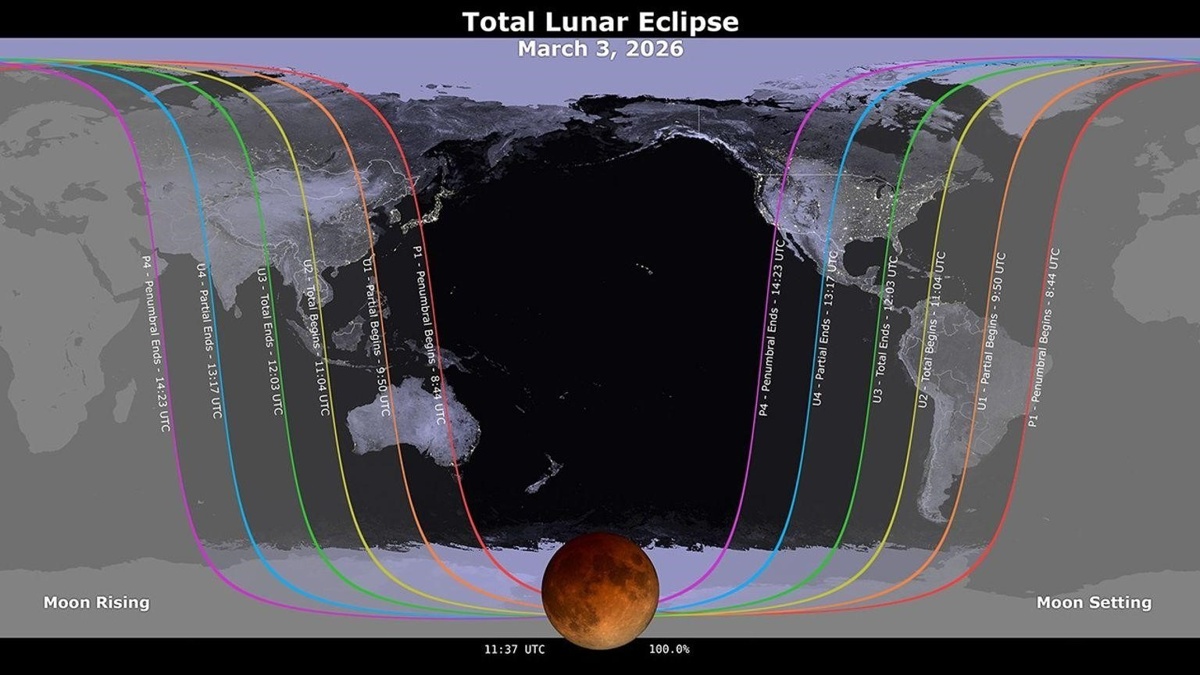
The total phase is set to begin at around 4 AM EST and end at approximately 7 AM EST, with the partial eclipse continuing until about 9 AM EST.
The eclipse will be visible in the evening from eastern Asia and Australia, throughout the night across the Pacific, and in the early morning hours in North and Central America, as well as far western South America. It will appear as a partial eclipse in central Asia and much of South America. The phenomenon will not be visible in Africa or Europe.
A lunar eclipse occurs when Earth passes between the Sun and the Moon, casting a shadow over the lunar surface. During totality, the Moon can take on a dark red or orange color, a phenomenon commonly referred to as a “blood moon.”
“During a total lunar eclipse, the Moon appears dark red or orange. This is because our planet blocks most of the Sun’s light from reaching the Moon, and the light that does reach the lunar surface is filtered through a thick slice of Earth’s atmosphere. It’s as if all of the world’s sunrises and sunsets are projected onto the Moon,” NASA explained.
The eclipse can be observed with the naked eye, though binoculars or a telescope may provide a clearer view. Observers are advised to choose a dark location away from bright city lights.
Last September, Qazinform published images of a rare “blood moon” eclipse as it appeared over Astana.