
Hello, welcome to Politics Insider. Let’s look at what happened today.
Foreign Affairs Minister Anita Anand is ruling out the deployment of aircraft to help evacuate Canadians from Mexico after a wave of violence erupted in the country in the wake of the death of a cartel leader.
“No, not at this time,” Anand told a news conference today on Parliament Hill when asked for the possibility of sending flights.
Ian Bailey and Jeff Gray report that, instead, the government is urging Canadians to register with Global Affairs Canada and to heed local advice on safety, and only travel when it is safe to do so.
There’s an additional overview on the situation here.
Meanwhile, Ontario Premier Doug Ford warned against vacationing in Mexico and said Ontarians there should come home.
He also said those considering vacations should look at other destinations and that his government would help if needed to get Ontarians in the country out.
“I highly recommend, don’t go to Mexico. I highly recommended that before this happened,” Ford said at Queen’s Park.
“That’s pretty unstable, when you’re taking out drug cartels and all of sudden they’re hitting back against tourists and everyone else. It’s, my opinion, it’s not a stable country right now. Don’t go there, and maybe pick an island somewhere or here in Canada.”
In other news, Canadians currently view the United States as more of a risk than a partner, according to a new poll that finds three-quarters dispute the idea that our southern neighbour is a trustworthy ally.
Steven Chase reports that a Nanos Research survey for The Globe and Mail took stock of deteriorating Canadian opinions of the United States after U.S. President Donald Trump’s first year back in office.
The findings suggest a profound level of distrust and a significant recasting of how Canadians see the U.S.
The survey asked Canadians if they agree with the statement that “the United States is a trustworthy ally of Canada.” Nearly half – 49.2 per cent – disagreed and another 26.9 per cent said they somewhat disagreed. Only 9.2 per cent agreed with the statement; 12.5 per cent somewhat agreed.
“These are probably the worst numbers in any era where polling was done,” pollster Nik Nanos said of the survey tracking Canadian attitudes to the United States.
The results detail a backlash against the mercurial and protectionist U.S. President, who regularly belittles Canada as “the 51st state.” They also illuminate the underlying thinking that has affected Canadian travel plans, purchasing behaviour and eroded misgivings about trading with the authoritarian state of China.
Since taking office in early 2025, the U.S. President imposed a slew of tariffs on Canada, and while products traded under United States-Mexico-Canada Agreement rules are exempt, that hasn’t shielded steel, aluminum and autos from damaging levies.
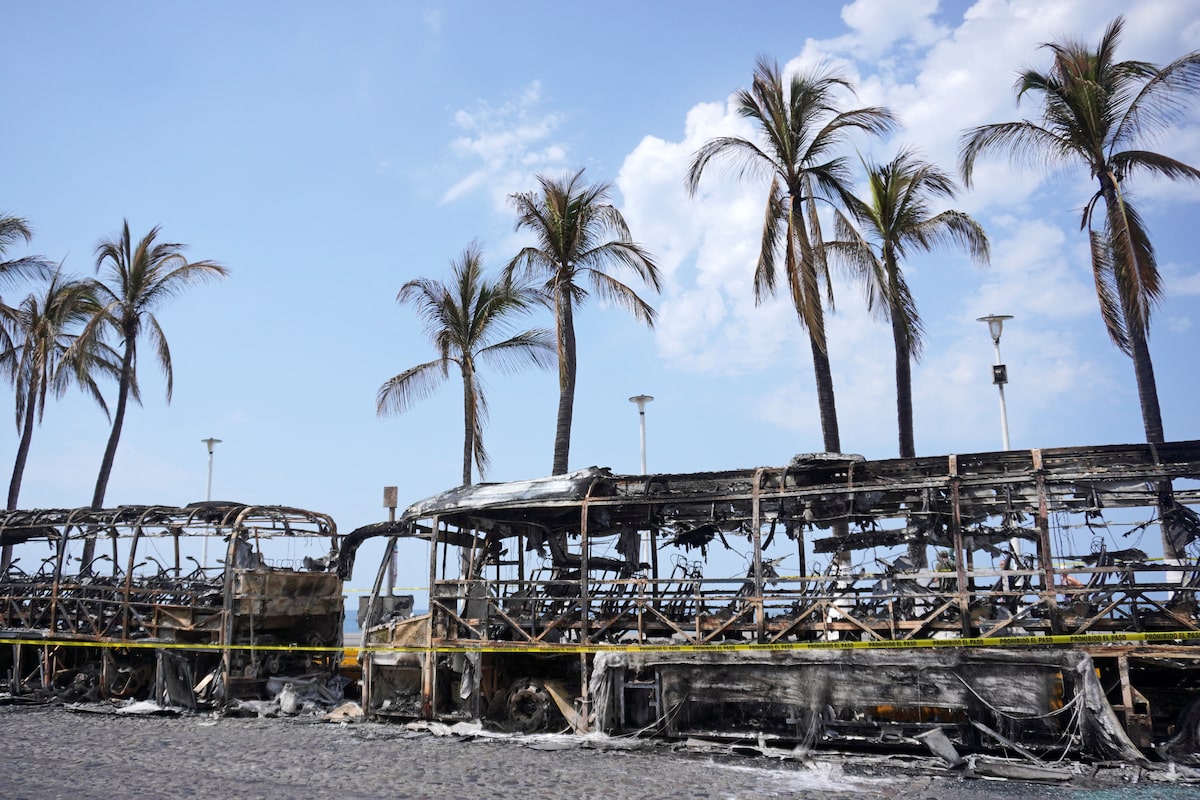
Burned-out buses are seen in Puerto Vallarta, Jalisco state, Mexico, on Monday.ARTURO MONTERO/AFP/Getty Images
This is the daily Politics Insider newsletter, curated by Ian Bailey. It is available exclusively to our digital subscribers. You can sign up for more than 20 other newsletters on our signup page.What else is going on
AI minister summons OpenAI safety chiefs over Tumbler Ridge shooting: Evan Solomon says he wants the senior safety team from an AI company, whose chatbot the Tumbler Ridge shooter interacted with before the massacre, to provide a deeper explanation of why the shooter’s concerning comments were not reported to police.
Senate committee calls for gutting flagship immigration bill: A bill that would tighten Canada’s immigration and asylum rules should be gutted, with key sections removed to address concerns regarding human rights, privacy and civil liberties, a Senate committee has recommended.
Conservatives call for investigation into asylum seekers’ health care access: The Official Opposition plans to put a motion before the House of Commons on Tuesday aimed at reviewing how health benefits are provided to asylum seekers and restricting who has access to those services.
Big banks set to post higher profits: Elevated trading activity boosted by volatile equity markets is expected to curb the impact of softening loan demand from consumers and businesses.
Online harms bill needs framework for reporting threats in AI chats, experts say: Two experts in artificial-intelligence policy say the forthcoming federal online harms bill must address AI chatbots and create a framework for reporting credible threats, after it emerged that concerning content from the Tumbler Ridge shooter was flagged but not reported to police.
On our radar
Prime Minister’s Day: Mark Carney has no public events today. His office announced that Carney will visit India, Australia and Japan between Thursday and March 7.
Party Leaders: Green Party Leader Elizabeth May returned from her B.C. riding to attend Parliament in person. No schedules released for other party leaders.
Notable Floor-Crossers: Floor-crossing has long been a routine of federal and provincial politics. Now, there’s a sense that any day now, another MP is going to make the move in Ottawa.
Three Conservative MPs have crossed the floor to join the Liberals since November.
According to the Parliamentary Library, the trio are among 276 MPs who have changed their political affiliation since 1900. Of the total, 133 changed affiliations from one party to another while 143 were independent either before or after changing affiliation.
Notable floor-crossers include:
1955 – Ross Thatcher, a Saskatchewan MP for the Co-operative Commonwealth Federation – a forerunner to the NDP – left to sit as an independent after being elected three times. He ran as a Liberal in 1957 and 1958, but lost. Later, he became the Saskatchewan premier, as a Liberal.
1971 – Liberal Paul Hellyer, a cabinet minister under Lester Pearson and Pierre Elliott Trudeau, left his party to sit as an independent, then joined the Progressive Conservatives in 1972, was re-elected as a PC, seeking its leadership in 1976. He lost to Joe Clark. Eventually, he returned to the Liberals.
2000 – Progressive Conservative MPs David Price, Diane St-Jacques and André Harvey all joined the Liberals.
2003 – Days after the Conservatives and Progressive Conservatives merged, Nova Scotia MP Scott Brison departed the conservative movement to join the Liberals. Brison served in the cabinets of prime ministers Paul Martin and Justin Trudeau before leaving politics in 2019.
2005 – Belinda Stronach, a Conservative MP who vied for the leadership of the party in the race that Stephen Harper won in 2004, joined the Liberals under Paul Martin and was appointed human resources minister. Although the Liberals were defeated in the 2006 election, Stronach was re-elected in her Toronto-area riding. She left politics in 2008.
2006 – Two weeks after being re-elected in a federal election, Liberal MP David Emerson joined the Conservatives, stunning many in his Vancouver-Kingsway riding. Then-prime minister Stephen Harper appointed Emerson to three cabinet posts, including foreign affairs, before Emerson declined a re-election bid in the 2008 election.
2018 – Liberal MP Leona Alleslev left the Liberals to join the Conservatives.
2021 – Green Party MP Jenica Atwin, who represents Fredericton, joined the Liberal Party. She ruled out a bid for re-election in 2025.
Political Lives, Elly Alboim: The Ottawa bureau chief for CBC TV News for 15 years went on to have a long career as a policy adviser, in particular to Paul Martin, when Martin was finance minister and then prime minister. Alboim also worked at Earnscliffe Strategy Group, an Ottawa-based consultancy and lobbying firm, and taught at Carleton’s School of Journalism for 46 years.
Quote of the Day
“Don’t go there and maybe pick an island somewhere or here in Canada.” – Ontario Premier Doug Ford, during a news conference at Queen’s Park today, recommends against travel to Mexico given current violence in that country.
Question period
This rookie MP was appointed defence minister on this day in 1990. What riding did the new minister represent?
Scroll to the bottom of this newsletter for the answer.
PerspectivesA chance for Poilievre to flip the Trump script
On Thursday, the Conservative Leader will deliver a speech on Canada-U.S. relations at the Economic Club of Canada, and he has an opening for a judo move: pushing away Mr. Jivani and cleaving close to Prime Minister Mark Carney.
— Campbell Clark, Chief Political Writer
Alberta cannot just up and leave Canada
The minority of Albertans who appear to think they can just walk away and take all this with them are deluding themselves. They have no unilateral right to do so under the Canadian Constitution or international law. Nor could they do so without the consent of the Indigenous peoples in Alberta.
— Kent McNeil is Emeritus Distinguished Research Professor at York University’s Osgoode Hall Law School.
Trump has spurred a rush to China for trade salvation. That shouldn’t sacrifice human rights
Governments that call this approach “pragmatic” risk drifting in the same direction, and their strategies for surviving Mr. Trump’s chaos may instead hasten the arrival of the China century – one in which Beijing doesn’t just dominate geopolitics, but also makes its repressive approach to domestic governance the global norm.
— Maya Wang is deputy Asia director at Human Rights Watch.Go deeper
Got a news tip that you’d like us to look into? E-mail us at tips@globeandmail.com. Need to share documents securely? Reach out via SecureDrop.
The answer to today’s question: Kim Campbell was the Progressive Conservative MP for Vancouver Centre when she was named Canada’s first female defence minister. She was elected in the riding in 1988. Hedy Fry, a Liberal, defeated Campbell in 1993 and has been the MP there ever since.