
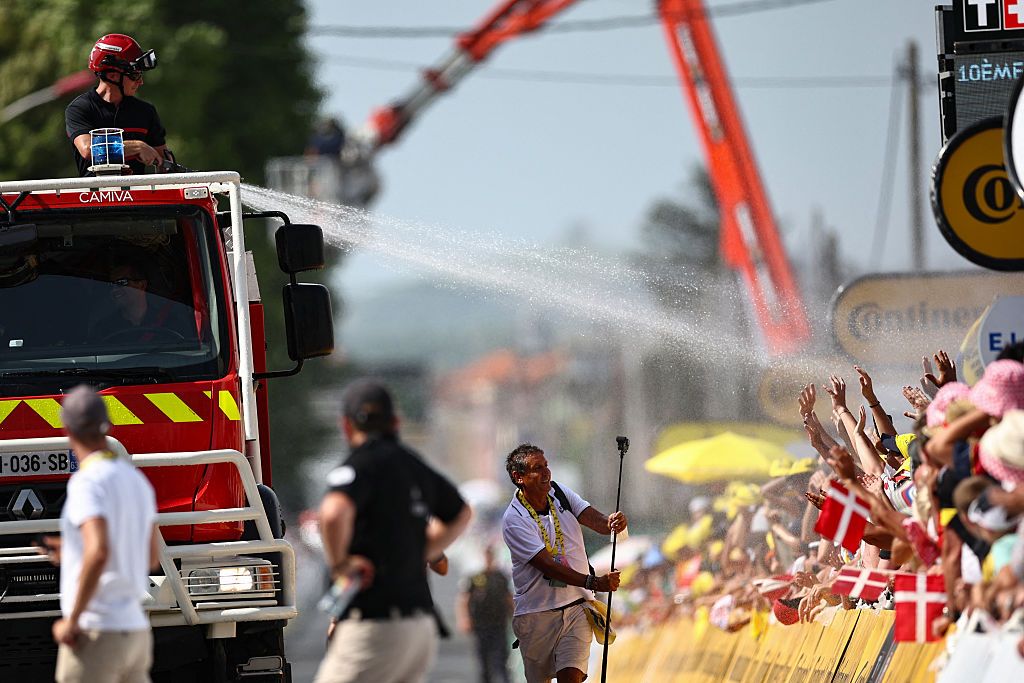
Climate researchers in France have suggested that rising temperatures during the summer could negatively impact the riders of the Tour de France more often, according to a report published in the scientific journal Nature on Tuesday.
According to the report by researchers at the National Research Institute for Sustainable Development at the University of Montpellier, the Tour de France has managed to avoid some of the worst of France’s hot weather, but they warn that more frequent and higher peak summer temperatures will create health dangers for the race and its spectators.
You may like
My first experience with seeing a rider on the ground receiving emergency medical care because of heat stroke was at the Tour of California stage in Palm Springs in 2013. The high temperature was 108°F (42°C), and a QuickStep rider collapsed after the mountaintop finish, with medics packing ice around his neck and torso to stop him from overheating. It was terrifying.
Even the riders who were upright were miserable, ice towels and cold water aside. One has to wonder why races go on during the heat of the day. Yes, logistics would be tough for transferring equipment and setting up the start and finish infrastructure, riders would have to get breakfast earlier, and the race wouldn’t be on during prime time TV. But if the weather gets to the point where athletes and spectators can’t survive the stage intact, then maybe it’s time to reconsider other ideas.
The UCI enacted the Extreme Weather Protocol in 2015, using the same measures as the authors of the study, but it has rarely been employed for high heat.
In 2022, the protocol was put into place for the Tour de France stage 15, a brutal 202.5 kilometre slog across melting tarmac from Rodez to Carcassonne when forecasts called for ambient temperatures of up to 40°C (104°F). The only changes made were opening up feeding earlier and extending the time limit, however.
Laura Weislo
Managing Editor
“If the weather gets to the point where athletes and spectators can’t survive the stage intact, then maybe it’s time to reconsider other ideas.”
While there have been numerous stages since where riders were coping with heat with ice socks and dousing themselves with cold water, there haven’t been stage cancellations due to heat, at least not at the Tour, but it’s only a matter of time before it becomes necessary.
“In a way, we can say that it is an extremely fortunate race, but with record-breaking heat waves becoming more frequent, it is only a matter of time before the Tour encounters extreme heat stress day that will test existing safety protocols,” Cvijanovic said.
You may like
Cvijanovic’s team studied the Wet Bulb Globe Temperature (WBGT – a measure of ambient air temperature, relative humidity, solar radiation and wind) at various times of day in July across six different locations in France from 1974 to 2023.
They found that in five of six regions, the highest historical WBGT at 3 p.m. has been measured since 2018, and days of ‘high heat stress’ (in alignment with the UCI’s threshold for the Extreme Weather Protocol) have been more frequent and severe in recent decades.
Additionally, in areas that frequently host Tour de France stages, such as Toulouse, Pau, Bordeaux, Perpignan and Nîmes, have a history of high heat stress episodes”, the authors write.
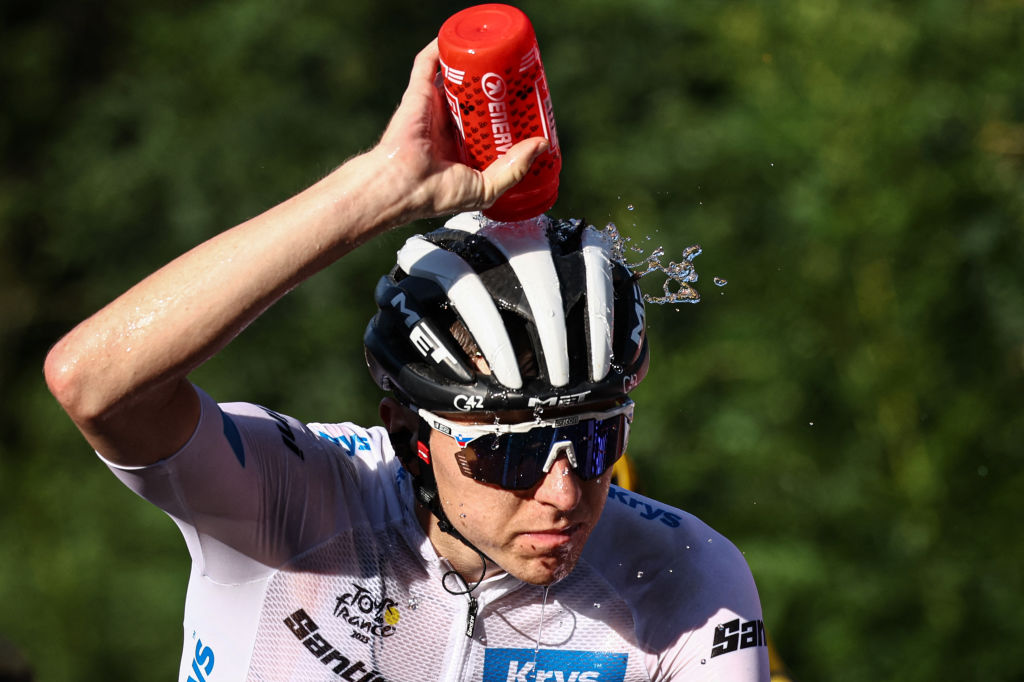
Tadej Pogacar cools down during stage 15 of the 2023 Tour de France (Image credit: Getty Images)
“New heat stress hotspots are emerging, with locations like Paris and areas across central France starting to cross the UCI’s high-risk WBGT threshold of 28°C more commonly.
“Morning hours are the safest part of the day, while high heat stress can persist during most of the afternoon,” they added. “Planning the race for the morning hours and avoiding the afternoons could substantially increase rider and spectator safety. Mountain locations largely remain within low-risk and moderate low-risk WBGT values throughout the day (for now).”
While most professional cyclists are acclimated to high exertion in the heat of summer, the conditions can become dangerous when the air temperatures rise above body temperature. At that level, riders or spectators can no longer cool themselves down through sweating, which can lead to elevated core temperatures and lead to heat exhaustion or heat stroke, which can be fatal.
In 2024, Mark Cavendish suffered from what may have been heat stroke during stage 1 of the Tour de France in Tuscany, and Antonio Tiberi dropped out of the Vuelta a España on stage 9 with what his team described as heat stroke the same year.
If climate research is accurate, high heat is coming for the Tour de France, sooner or later, and the authors (and I) think it’s time to consider tearing up the script and moving the race to earlier in the day.
When the stages start around 12 p.m. and finish around 5 p.m., it means the riders have been racing through the hottest part of the day for most of the stage. Moving the start to 9 a.m. would greatly reduce that.
“We reiterate all of these and specifically, for future Tour de France editions, recommend continued development and re-evaluation of hot weather emergency protocols,” the authors added.
They also recommend measuring riders’ core body temperatures and “education of riders and their supporting teams, as well as spectators, about heat safety and the signs of heat-related illness.”