
Nanaimo Astronomy Society members will hear ‘the Good, the Bad, and the Ugly’ of space station life
Published 5:30 am Wednesday, February 25, 2026
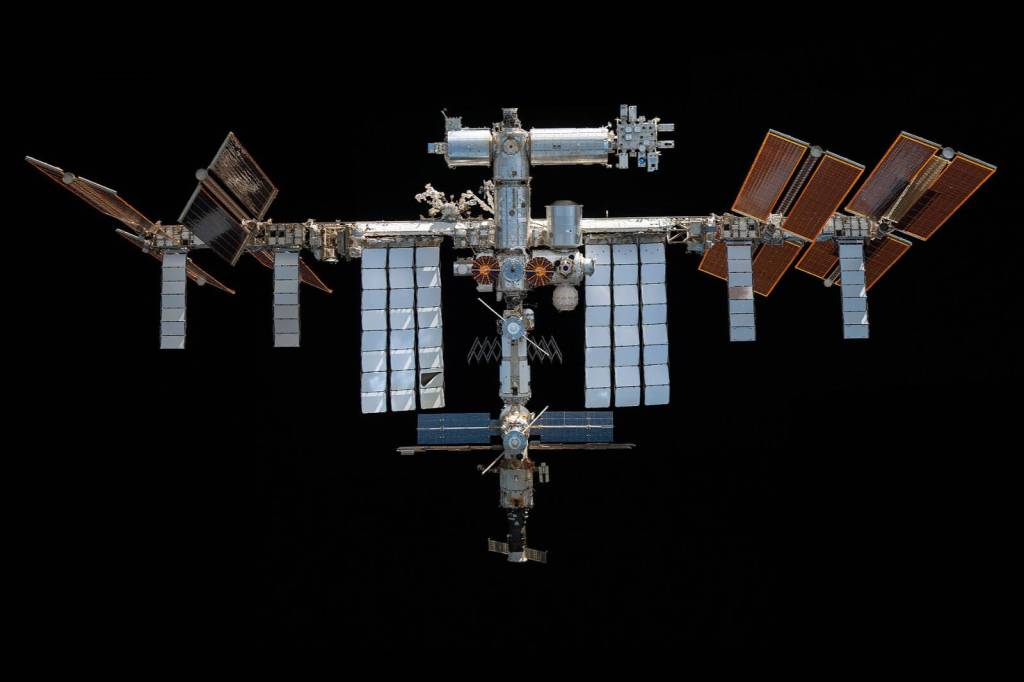
Anyone who’s ever wondered what it’s like to live without gravity, in a bubble of air trapped inside a tin can will have some musings answered when David Prud’homme presents, The International Space Station: The Good, The Bad, and the Ugly at Nanaimo Astronomy Society’s upcoming monthly meeting
The ISS, started in 1998, has been operational for 25 years now and, so far, has hosted about 300 visitors. Look up at the right time on a clear night and one can see the station glow brilliantly in the sun’s light as it orbits Earth, but what life is like within its confines will make for an entertaining and informative look into the “good, bad, and ugly” of ISS life.
Prud’homme, former president of the Edmonton Centre of the Royal Astronomical Society of Canada, has been a volunteer instructor with Elder College since 2011 – where he offers two courses, Introduction to the Night Skies and Space Race: Quest for the Moon. Prud’homme has a keen interest in astronomy and the history of space exploration, especially in researching space flight, from the earliest manned missions to long-duration stays aboard space stations.
“It’s [the] basics of everyday life that I’ll actually be talking about and one of the biggest ones is space sickness, which is really the opposite of seasickness on Earth,” he told the News Bulletin.
“With seasickness on Earth you are seeing a fixed frame of reference, but it’s moving, so your vestibular system says there’s something off here, but in space it’s actually the reverse because you’re holding still and it feels like everything’s moving around you, but it’s the same result. You get sick.”
Prud’homme noted another difficulty for humans who evolved in gravity is going to the washroom. Elaborate toilet facilities have been developed for the ISS and space shuttles that can support them, but options remain limited for space suits.
Running low on supplies on space stations can be bad, but getting resupplied can also be dangerous.
“One of the ‘uglies’ of the space program is supply missions don’t always make it to the space station,” Prud’homme said. “At times they’ve had situations where they’ve run a little low on the necessities.”
Prud’homme noted a Russian Progress supply ship collided with the Russian Mir space station in 1997. The collision caused serious damage to Mir that included a smashed solar array, that knocked out power to a section of the station, and a punctured hull. The crew was able to seal the leak and fortunately no one was injured.
“That space station also had a fire on board,” he said.
One of the good things about the ISS program is international cooperation. The ISS has been an international endeavor since its inception and, despite whatever is going on the planet’s surface, astronauts and cosmonauts from multiple nations continue working together in orbit.
“This was a major international event,” Prud’homme said. “A lot of those modules were manufactured in different countries and never met before they met in space and then they managed to get together … That’s a technological success.”
But, Prud’homme said, astronauts often work in their countries’ modules and can go for extended periods without seeing one another, but do get together about once a week for a community meal.
“At one point there were only three of them on the space station, the two Russians in their module and he was all alone in the American module,” Prud’homme said. “So you’re completely on your own. I mean, you know they’re there … Talk about extreme isolation, because you don’t even have on a regular basis, even a window to look out. There’s an observation deck, but you don’t go there all the time. You have work to do.”
The atmospheric conditions can also be lacking as well as the social atmosphere. Prud’homme said the levels of carbon dioxide inside the ISS is about twice as high as that allowed on U.S. Navy submarines, “so headaches and difficulty functioning are one of the ‘bads’ of the space station.”
There’s no way to step outside for a breath of fresh air, but astronauts that do go out for extra-vehicular activity missions also face hazards from space junk and micrometeorites.
“I’ve got a nice little graphic that talks about the magnitudes of those dangers,” Prud’homme said. “There’s a lot of little damage on the outsides [of the ISS]. Some of the astronauts have referred to that when they go out and the hand bars and stuff have little holes in them.”
Following Prud’homme’s presentation, NAS past president Chris Boar will give a quick introduction to stacking and editing raw astrophotography files.
Nanaimo Astronomy Society’s next meeting happens Thursday, Feb. 26, 7 p.m. at Beban Park Social Centre, 2300 Bowen Rd., Rooms 2 and 3.
To learn more about NAS events and how to become a member, visit www.nanaimoastronomy.com.