
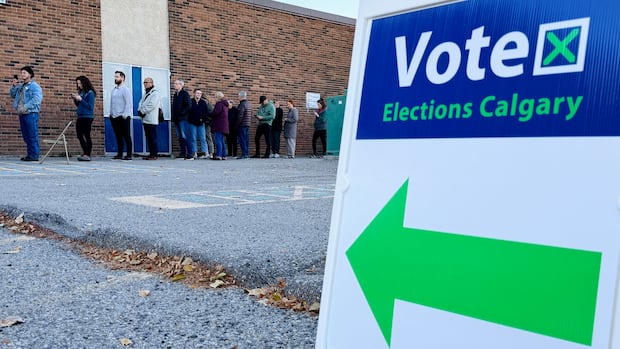
Wait times sometimes lasting more than an hour plagued Alberta’s municipal elections last October, and new data from the City of Calgary begins to paint a picture of just how long voters stood in line.
More than half of reporting voting stations around Calgary saw wait times of 20 minutes or more at 7 p.m., statistics from the city show. The data was provided to CBC News under Alberta access to information legislation.
It also lists the voting stations facing the most pressure, with two elementary schools and an Alliance church ranking at the top of the list.
“The way that we want to think about this is to say, at what point does the lineup or the wait time cause somebody to decide not to stick around and vote?” said Lisa Young, a professor of political science at the University of Calgary.
“The ideal is that people not be forced to wait for a lengthy period of time. And certainly, more than 20 minutes is becoming an impediment to voting.”
WATCH | Calgarians reacted to long lines at polling stations on election day: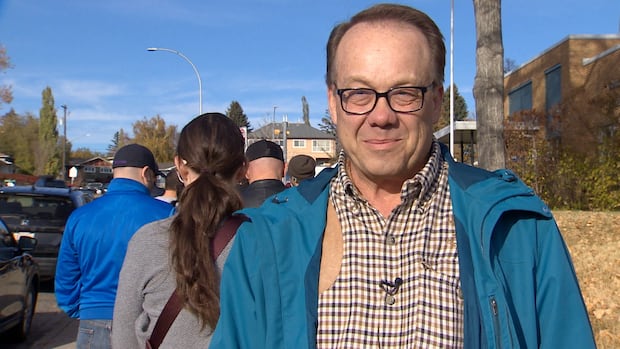
Calgarians react to long lines at polling stations
Some polling stations in Calgary are experiencing long wait times as people stand in line to vote in the 2025 municipal election.
The city breaks down wait times into five buckets: five minutes or less, five to 10 minutes, 10 to 15 minutes, 15 to 20 minutes, and 20 minutes or more.
Elections Calgary gathers wait time information from its area supervisors, who support up to three voting stations at a time, and submit what’s considered a “snapshot in time” drawing from surveys they take at each visit to a station.
At noon, 64 stations saw wait times of five minutes or less, while 74 reported times of 20 minutes or more.
By 4 p.m., numbers stayed relatively stable. Seventy-four stations reported wait times of five minutes or less, while 65 saw wait times of 20 minutes or more.
But as Calgarians left work to line up at the polls, wait times increased. Only 18 stations reported wait times of five minutes or less at 7 p.m., while 107 saw wait times of 20 minutes or more.
The city said it doesn’t typically track wait times above 20 minutes, because that’s usually the maximum amount of time area supervisors visit a voting station, unless an incident requires them to stay.
Reflecting on last fall’s election, Young said cutting the stats off at 20 minutes is probably too short, as the data doesn’t reflect how many stations reported waits far above that mark.
“A 20-minute wait is an impediment to voting, it’s a problem. A wait of an hour really means that it is a dedicated person with flexible time who has stuck around to vote,” said Young.
WATCH | Long lines led some Calgarians to bail on ballots: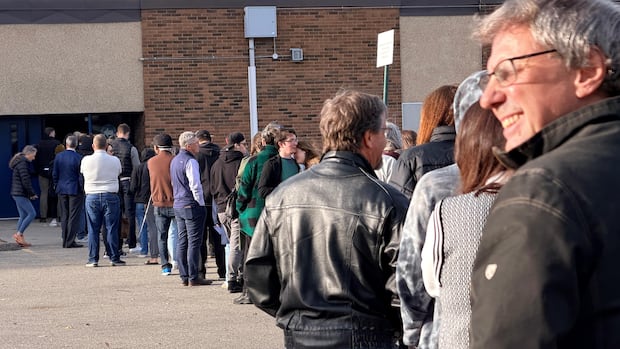
Long lines led some Calgarians to bail on ballots
Complaints of long lines and paperwork backlogs at polling stations plagued this latest Calgary municipal election. But Alberta’s Minister of Municipal Affairs Dan Williams stands behind changes made to election rules and regulations last year.Waiting in line
On election day, Calgarians at the polls voiced frustration with the lines. Some were so fed up they turned around and went home.
“I’m almost 80, and I can say that I voted in every election in my life except this one. I went to vote, I saw the line, and I decided not to vote as a protest,” resident Terry Golbeck told CBC Radio’s Alberta at Noon in October.
It’s typical for wait times to increase beginning around 4 p.m., and for most stations to see longer waits around 7 p.m., the city said.
But they noted several factors can affect voting wait times, such as the technology used in voting stations or the number of candidates on a ballot.
The city-wide average wait time during the 2021 municipal election was roughly 12 minutes, rising to around 19 minutes after 6 p.m. The city did not provide an overall average wait time for last fall’s election. It added it didn’t track station-by-station wait times before 2021.
Elections Calgary used historical data and estimated times to process a voter to predict voter turnout and guide its decisions on how to staff polling stations. But the agency said it had to account for a major change in 2025 tied to new provincial requirements for a permanent electors register.
As a result, Elections Calgary lowered its estimate of how many voters an average deputy returning officer could get through on election day, from about 225 to about 190.
The data released to CBC News illustrated how many voters were processed by all the deputy returning officers, on average, in each voting station. While some stations saw numbers below that 190 figure, others reported numbers well above.
For instance, on election day, CBC News spoke to Mieka West, who voted at the Ward 9 Colonel Walker School polling station in Inglewood in the late afternoon and estimated she had been waiting for hours. That station saw 230 average ballots per deputy returning officer.
“Every time I voted in the past, it’s been about five to maybe 30 minutes. It felt like it was a bit of a waste of our time,” West said in October.
The city’s data also pointed to a shift in when people voted. It said the advance vote turnout dropped compared to 2021, which likely meant more people showed up on election day instead, raising the workload at some stations. The agency said it’s been looking to continue to expand voting opportunities to minimize wait times on election day.
Along with long lines and more voters reported at some stations than expected, voter turnout dropped in Calgary to 39 per cent last fall, down from 46 per cent in 2021.
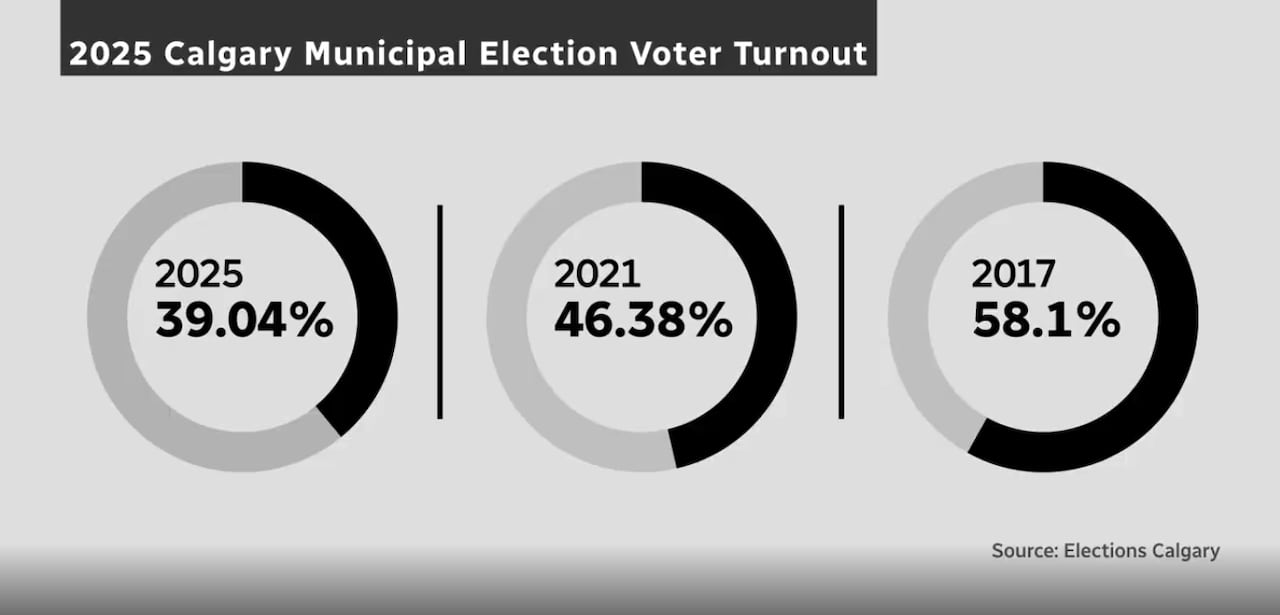 Turnout was down in Calgary in 2025, in comparison to the past two municipal elections in 2021 and 2017. (CBC News)
Edmonton saw a similar problem last fall. After its election, 16 per cent of voters who were surveyed reported needing more than an hour to cast a ballot, a city auditor report said. Extremely long lines and low turnout were also reported in other cities, like Lethbridge.
Young said the province should review its new rules for voters and polling stations, before the next municipal election.
“The province needs to look at its requirements and whether they are causing a barrier,” said Young.
The city should also review how it staffs polling stations, and assess potential hot spots for long wait times to vote, she added.
Voters out of line more quickly in federal election
Wait times were shorter in recent federal elections than in last fall’s municipal vote.
In the 2021 general election, voters reported taking an average of 13 minutes to cast their ballot, a survey for national electors found.
A comparable report is not yet publicly available for last year’s general election, but Elections Canada said survey results indicate respondents reported on average 12 minutes to vote in person.
Elections Alberta said it has not collected data on wait times in the past.
A spokesperson for Municipal Affairs Minister Dan Williams said a review of last fall’s municipal election is still ongoing.
On Alberta at Noon in October, Williams said he doesn’t want to see delays, and encouraged municipalities to provide feedback to the province about any concerns with the election. But he said municipalities were informed a year and a half ahead of time about how the election would be run, and it’s their responsibility to administer the election.
“I want to make sure that folks have access to democracy, I want to make sure that the folks voting are also from that municipality and are Canadian citizens,” said Williams on Alberta at Noon in October. “This isn’t a partisan position for me, this is a practical one.”
Williams said new provincial rules surrounding municipal elections were introduced to bolster voters’ confidence in election results. Last fall, Elections Alberta confirmed it had issued just four letters of reprimand to people who were found to be ineligible after casting a vote, and three letters to voters who cast more than one ballot in the same election.
The city says more information will be included in the returning officer’s report, along with public survey results, to be released this spring to city council, school boards and the public.