
Yung-Yu Ma, chief investment strategist at PNC Financial Services Group, joins BNN Bloomberg to discuss the markets as investors mull Trump’s State of the Union
U.S. President Donald Trump defended his tariff strategy in a lengthy State of the Union address, even as trade uncertainty and signs of strain in the labour market continue to unsettle investors. Markets are weighing whether policy clarity and steady growth can offset rising disruption from artificial intelligence.
BNN Bloomberg spoke with Yung-Yu Ma, chief investment strategist at PNC Financial Services Group, who said affordability concerns, muted hiring and evolving tariff policy are creating near-term volatility, even as business investment and AI spending continue to support economic growth.
Key TakeawaysAffordability and muted hiring, rather than tariffs alone, are central concerns for U.S. consumers and investors.Reworking the tariff regime is creating medium-term uncertainty, though overall rates may ultimately come in lower than feared.U.S. growth remains supported by strong business capital expenditures, particularly in AI, data centres and hyperscale infrastructure.Hiring levels appear recessionary despite stable employment, raising concerns that labour market softness could spread.Equity markets remain sensitive to long-term cash flow risk, with tariff policy and AI disruption contributing to periodic volatility.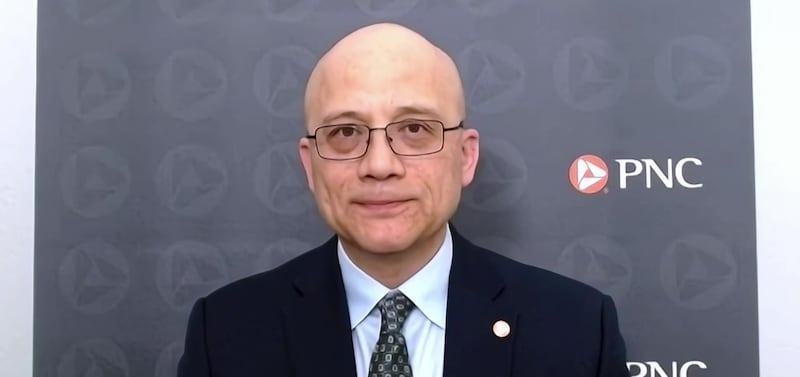 Yung-Yu Ma, chief investment strategist at PNC Financial Services Group Yung-Yu Ma, chief investment strategist at PNC Financial Services Group
Read the full transcript below:
ANDREW: U.S. President Donald Trump spoke for a record one hour and 47 minutes in his State of the Union address last night. As you might imagine, he praised his tariff strategy and said the U.S. economy has never done as well as it is right now. Let’s get more from Yung-Yu Ma, chief investment strategist at PNC Financial Services Group. Thanks very much for joining us.
YUNG-YU: Thanks, Andrew. Great to be here.
ANDREW: There was lots of rhetoric from Mr. Trump. Politicians, of course, like to tout their achievements. They all do. Did anything jump out at you in this speech?
YUNG-YU: I think the topic most important to Americans right now is affordability, which relates to inflation. Inflation has been elevated for years and is causing strain in the economy, especially among consumers on the lower end of the socioeconomic spectrum. The president did talk about that. It is something that takes time. Inflation numbers still look a bit stickier than we would like, but we believe they will come down further by year-end. Affordability is a big issue in terms of the impact on the everyday U.S. consumer.
ANDREW: Tariffs are inflationary. U.S. consumers pay, according to one estimate, 90 per cent of the burden. Has Mr. Trump managed to disconnect tariffs from inflation in the minds of voters?
YUNG-YU: I think the average American may not feel as much of the tariff impact. I have seen estimates as high as 90 per cent pass-through, but also some that are much lower. I do not think that is the main issue right now. Most economists — and probably consumers as well — feel the tariff impact has been less than originally feared for the economy and markets.
There is uncertainty as the president tries to reconstitute the tariff regime he wants to put in place. That creates some uncertainty for the economy and the stock market. I see that as a medium-term issue. It will take months, perhaps a couple of quarters, to work through, but by year-end there should be more clarity. The bigger issues right now are affordability and job growth, which has been muted in the U.S. That is primarily what voters care about.
ANDREW: The current tariffs are based on what the administration describes as a balance-of-payments problem. Those measures expire in 150 days without congressional action. Will the president need to reach for other tools?
YUNG-YU: Without congressional action, those would expire in 150 days. There are many other avenues to impose tariffs, including Section 301 and unfair trade practices provisions. Those require more process, typically investigations, and can take more time. In the past, those measures have often been applied country by country, and that process can be drawn out.
I think the market is more concerned about that drawn-out process. Without the IEEPA tariffs, the overall rate is likely to be lower than under other avenues. On net, the tariff level may ultimately come in lower than previously feared.
ANDREW: There were reports suggesting China could face a lower tariff under the current regime.
YUNG-YU: As things stand, that is correct. Many of China’s tariffs were based on the International Emergency Economic Powers Act, which the Supreme Court struck down. The 15 per cent global tariff provides some relief. However, there are ongoing investigations under unfair trade practices.
There is a lot in the mix and more to come. It creates uncertainty for businesses and consumers. But this is something markets have worked through in the past, and participants are probably braced for it.
ANDREW: Fourth-quarter U.S. GDP showed a slowdown from the pace seen earlier in 2025, but some analysts say the underlying data remain solid.
YUNG-YU: Growth in the U.S. is still quite strong. The swing factor is business capital expenditures, particularly from hyperscalers, data centres and AI-related investment. Consumer spending is about 70 per cent of GDP and is important, but business spending can ramp up or pull back sharply.
Right now, capital expenditures are ramping up and we think that will continue, supporting growth this year.
ANDREW: Some of the fourth-quarter weakness was attributed to the government shutdown.
YUNG-YU: That did trim growth somewhat. Some of that may come back in subsequent numbers. Overall, the growth profile remains healthy. The jobs picture is different, and that is what consumers are more concerned about.
ANDREW: Jobs numbers are showing signs of weakness?
YUNG-YU: They are stable, but hiring is very low. Hiring levels look recessionary, even though we are not in a recession. There are two job markets. For people in stable jobs, conditions seem healthy. For those looking for work, it feels recessionary.
There is concern that softness in hiring could spread to layoffs. AI disruption could also accelerate in coming quarters. That underlying angst in the labour market is likely holding consumers back somewhat.
ANDREW: Thank you. That was Yung-Yu Ma, chief investment strategist at PNC Financial Services Group.
—
This BNN Bloomberg summary and transcript of the Feb. 25, 2026 interview with Yung-Yu Ma are published with the assistance of AI. Original research, interview questions and added context was created by BNN Bloomberg journalists. An editor also reviewed this material before it was published to ensure its accuracy and adherence with BNN Bloomberg editorial policies and standards.