

New numbers show cell phone thefts are on the rise across the city.
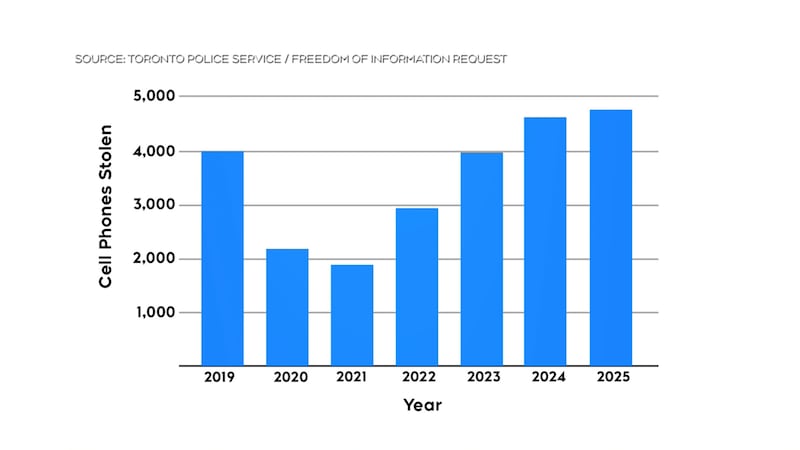
Cellphone theft in Toronto is surging past pre-pandemic levels to almost 5,000 devices reported stolen last year, putting millions of dollars in the hands of thieves and organized criminals, according to new data obtained by CTV News.
Altogether, the data, provided by the Toronto Police Service (TPS) in response to a Freedom of Information request, points to about 25,000 phones reported stolen in the city over the past six years.
 Toronto police graphic
“If you’re talking about tens of thousands of phones, that’s millions of dollars in potential revenues that help to fund not just one group but an entire ecosystem of people who apply their specialized skills to make money at this,” said cybersecurity expert Claudiu Popa in an interview.
Among the statistics are cases like Al Amin’s, who said his locker was broken into when he was swimming at the Milton Leisure Centre earlier this month.
Soon, he was tracking his iPhone’s location to Etobicoke in Toronto before the phone disappeared completely.
“It was such an emotional event for me. I felt so helpless,” Amin said afterwards.
“My phone was already out of the city within one or two hours,” he said.
Other victims of cellphone theft have said they have used apps to find their devices in other countries as far away as Vietnam—a sign of integrated international groups able to move phones quickly to find a receptive market.
Popa said those phones can be sold, stripped for parts, or used in identity theft to access bank accounts and more.
“The phone theft is often the entry event in a crime chain that can go around the world,” he said.
Toronto police warned of pickpockets at large Toronto gatherings last year, and one club has gotten wise to thieves.
Last week, Rebel Nightclub posted a statement on social media that their security team collared two people carrying multiple stolen phones in an RFID pouch.
“This was the result of a planned internal effort—our security staff took it upon themselves to spot, track, bait and stop the thieves. We can’t guarantee we’ll catch someone every time, but our team is just as fed up with this behaviour as our guests are, and we’ve been taking action behind the scenes to finally get where we are today,” the statement read.
Toronto police confirmed a person was arrested and charged in that incident, and the cellphones have been returned to the complainants.
The RFID pouch, or Faraday bag, is a tool thieves can use to shield what’s inside from electromagnetic waves, which the phones use to communicate.
“The first thing that people do when they steal a phone is they pop it into an RFID…aluminum-coated Faraday pouch so that it immediately disappears from the network. It can’t call home,” Popa said.
In the Toronto police data, about 4,000 phones were reported stolen in 2019, which was cut in half in 2020 and 2021 during shutdowns associated with COVID-19.
In 2022, the numbers climbed to about 3,000, and then 4,000 in 2023.
By 2025, a year-to-date figure, the numbers were on track to hit 5,000 by the end of the year.
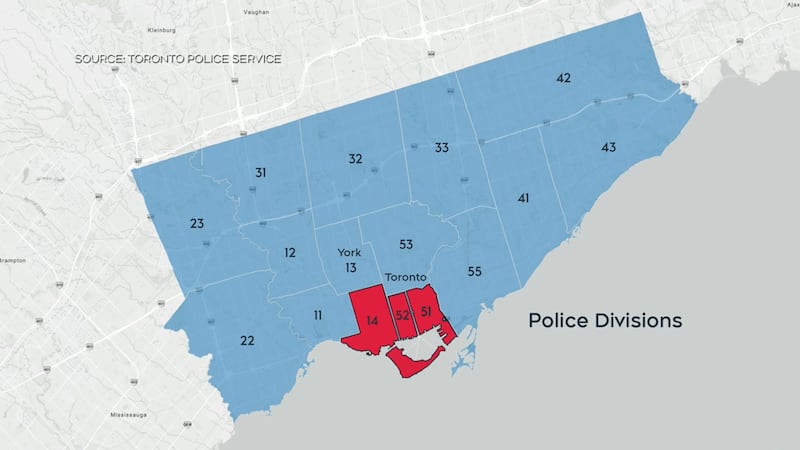 Toronto police graphic Toronto police’s 14, 52 and 51 Divisions, which are located downtown, reported the most cellphone thefts.
That doesn’t include cellphone store robberies, which were also counted in the dozens last year.
Toronto police spokesperson Cindy Chung said in an e-mail that cellphones have a lucrative return, as they can be sold again on the black market, and organized criminals often export them to other countries.
“This type of crime is also seen to give criminals a ‘high reward’ and provide low risk to them compared to other criminal offences such as drug trafficking,” she said.
Among the tips to combat this theft are keeping phones out of sight in crowded areas, using biometric locks and strong PINs, and recording the IMEI number so it can be blacklisted if reported stolen.
Amin’s phone was behind a locked door, but thieves still managed to grab it, he said. He’s hoping for more security cameras so there’s a better chance of catching the criminals.
“They were sympathetic,” Amin said. “They were sorry. And when I said it, they mentioned, ‘It happened again?’”