
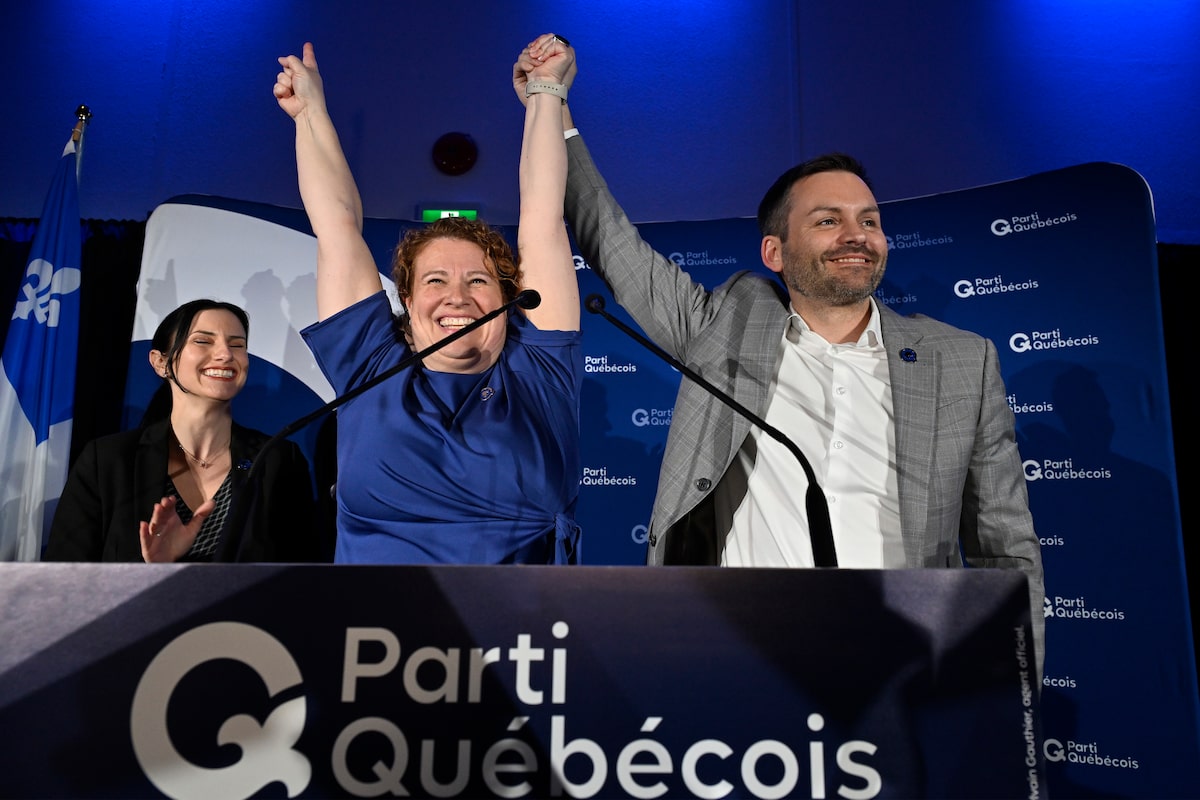
Parti Québécois candidate Marie-Karlynn Laflamme, left, and party leader Paul St-Pierre Plamondon celebrate her victory in the by-election in the riding of Chicoutimi in Saguenay, Que., on Monday.Jacques Boissinot/The Canadian Press
After his party scored its fourth by-election win in a row this week, Parti Québécois Leader Paul St-Pierre Plamondon looked to many like a premier-in-waiting.
Seven months ahead of the next provincial election, the PQ maintains a seemingly insurmountable lead over its rivals in francophone Quebec. Support for the governing Coalition Avenir Québec has cratered, while the Liberals still trail far behind the PQ everywhere outside Montreal.
Yet, as the election draws closer, Quebeckers are also becoming increasingly anxious about the PQ’s plans to hold a referendum on their province’s separation from Canada if it wins the Oct. 5 vote. Mr. St-Pierre Plamondon conceded as much in telling supporters gathered to celebrate Monday’s by-election win in Chicoutimi that “people are truly afraid” about the prospects of a prolonged tariff war with the United States on the Quebec economy.
Parti Québécois stays course on referendum despite Carney’s call for unity
Then came what sounded like the pivot the PQ Leader vowed he would never make.
“We in the Parti Québécois will use intelligence and judgment in choosing the timing of all decisions because our priority is always to protect Quebeckers,” he said after his party retook a riding it had held for 45 years before losing it to the CAQ in 2018.
Mr. St-Pierre Plamondon did not outright disavow his promise to hold a referendum during a PQ government’s first mandate. But it was hard not to detect a shift in strategy as he soft pedalled his referendum plans for the first time since becoming PQ Leader in 2020.
No one doubts Mr. St-Pierre Plamondon’s sovereigntist convictions. But like all previous PQ leaders, he faces the delicate task of placating the party’s militant base without alienating nationalist-leaning voters who abhor the idea of another divisive referendum.
For now, Mr. St-Pierre Plamondon appears to be betting that a change in U.S. leadership after the 2028 presidential election will lead to more stable Canada-U.S. trade relations, clearing the way for a referendum during the second half of a PQ mandate. But rivals seized on his Monday comments to accuse him of speaking out of both sides of his mouth.
In Quebec City, the curtain rises on an unpredictable election year
“We know the old strategy: tell sovereigntists that a referendum is coming, all while letting everyone else believe there won’t be one,” CAQ leadership candidate Bernard Drainville, a former PQ cabinet minister, wrote on X. “A fool’s bargain.”
On Wednesday, CAQ Finance Minister Eric Girard warned that investor wariness about the PQ’s referendum promise is already raising the Quebec government’s borrowing costs on financial markets. The spread between yields on 30-year Quebec bonds compared with their Ontario counterparts, which had been negative for several years, turned positive last year as the PQ’s lead in the polls grew. That is costing Quebec about $20-million more a year in interest, Mr. Girard estimated.
“We need to be clear that sovereignty is a legitimate project, but economically, it would be an extremely difficult transition,” he said. “The federal government spends on average more than $20-billion more than it collects [in annual taxes] in Quebec, including an average of $12-billion in equalization payments.”
According to federal data, Quebec will receive about $13.6-billion in equalization payments in the current fiscal year. Ottawa estimates the province will get $13.9-billion in 2026-27.
If Mr. Girard’s warning was not enough, a Pallas poll released Wednesday also served to pour cold water on the PQ’s by-election win. It showed a four-percentage-point decline in PQ support from January. At 30-per-cent support, the PQ leads the Liberals by just three points provincially.
Analysis: Legault’s ‘third way’ Quebec nationalism down but not out after resignation
The PQ still holds a 37-per-cent to 19-per-cent lead over the Liberals among francophone voters, who determine the election outcome in most of the province’s 125 ridings, according to the poll of 1,075 Quebeckers, which has margin of error of plus or minus three points.
Still, Mr. St-Pierre Plamondon has his work cut out for him. The Liberals finally have a new leader – Charles Milliard, who last week won the job by acclamation – who can take on Mr. St-Pierre Plamondon without any monkeys on his back. Pablo Rodriguez, who held the job for six months, had to quit amid a scandal surrounding the financing of his 2025 leadership campaign.
The CAQ leadership race will result in either Mr. Drainville or Christine Fréchette becoming premier on April 12. The front-runner, Ms. Fréchette, has strong favourability ratings. She may be able to claw back support for the CAQ among francophone voters.
The wild card (or spoiler) in the next election could be the Quebec Conservative Party, which finished a surprisingly strong second in the Chicoutimi race. Pallas showed the party leading in the Quebec City region and in third place provincially. It could become a refuge for nationalist voters who do not want a referendum.
It is still too soon to call Mr. St-Pierre Plamondon a premier-in-waiting.