

Renting in B.C. is fraught with challenges, ranging from the high cost of rent to legal battles in court. But there’s a glimmer of hope that things may be moving in the right direction for Vancouver renters looking to stretch their budget further.
A new report from Rentals.ca reveals that affordability pressures are easing for renters in the city at a faster rate compared to other parts of Canada.
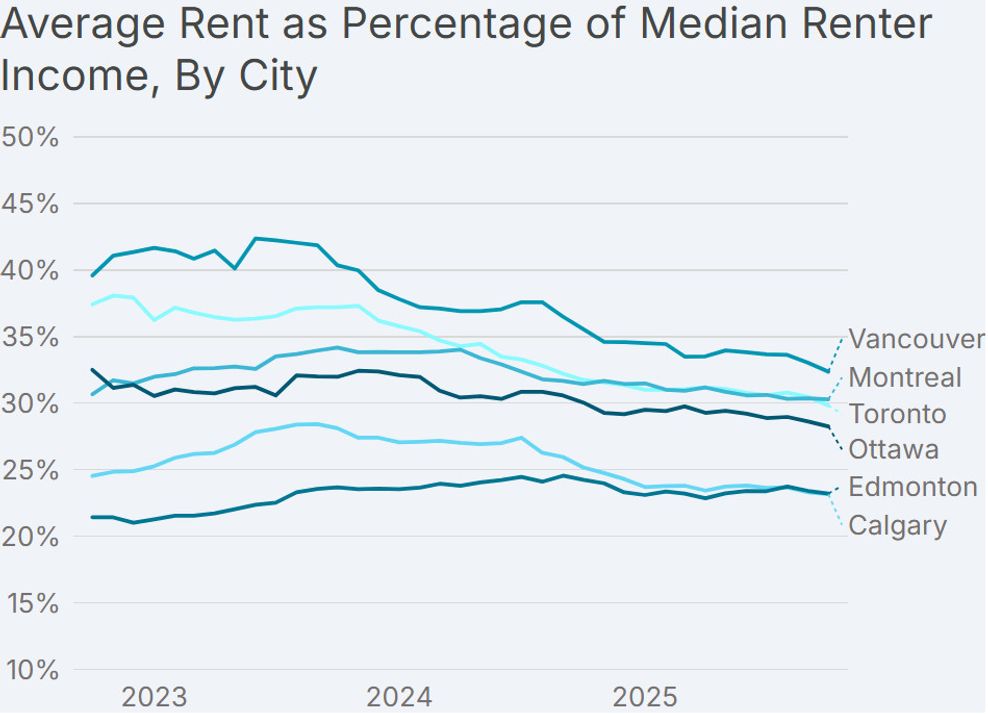
According to the recent affordability index created by Rentals.ca and Urbanation, Vancouver is the city with the biggest decline in the share of median renter household income needed to afford average asking rents since 2022.

Shutterstock
“While rent levels remain historically elevated and many households still feel financially stretched, particularly those searching for larger homes, the data suggest that the rent-to-income gap has narrowed meaningfully in several major cities since its peak in 2023,” said Rentals.ca.
“Even as overall affordability pressures ease, the improvement has not been uniform across unit types. Studio and one-bedroom trends have improved more consistently across markets, while three-bedroom rents still represent a substantially higher share of renter income in many cities.”
According to the real estate platform, Vancouver renters saw “the most pronounced shift” with a 10.1 per cent drop in the share of income required for average asking rents.
Rentals.ca
In comparison, Toronto saw an 8.3 per cent dip in average asking rents versus renter household income, and Montreal had a 3.9 percent drop.
According to Rentals.ca, a combination of factors is driving the shift in rental markets across Canada.
“Average asking rents peaked at 42.4 per cent of renter household income in June 2023, before declining to 32.3 per cent by October 2025,” said the report. “Over the same period, average asking rents declined by approximately $566 per month, from $3,304 at peak levels to $2,738 in October 2025.”
Margarita Young/Shutterstock
“Rent growth is moderating from peak levels in many markets, with some cities experiencing outright declines as elevated levels of new rental supply have come online and demand conditions have normalized.
“Income growth has continued steadily since 2022, with Statistics Canada reporting an 11.7 per cent increase in nominal average weekly earnings nationwide from October 2022 to October 2025.”
The full Rentals.ca affordability report can be found online.