
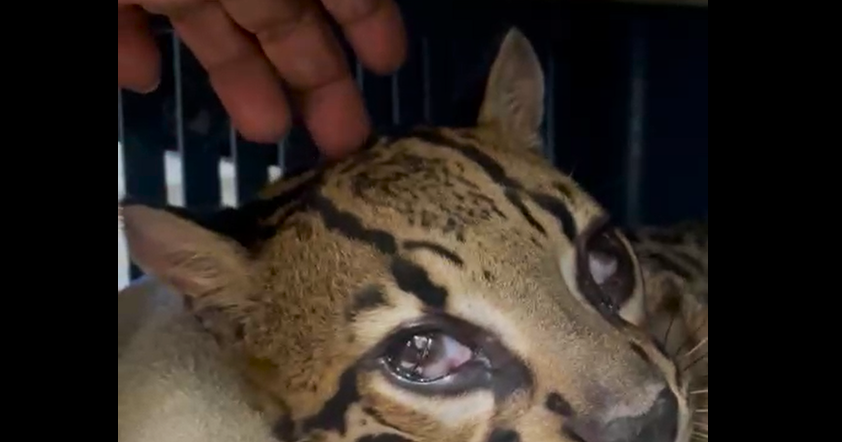
Papaoutai, the ocelot rescued from Granville, Cedros with a gunshot wound, is responding well to rehabilitation therapy at the La Romaine Veterinary Clinic under the care of Dr Kriyaan Singh.
Dr Singh shared that Papaoutai’s passive range of motion (PROM) therapy is conducted in near-dark conditions using only black lighting. This approach reduces nerve stimulation in the eyes and helps maintain the ocelot’s natural circadian rhythm, essential for nocturnal hunters. During therapy, Singh also manually expresses the animal’s bladder to preserve optimal renal function. He emphasized that Papaoutai remains completely wild and has received no sedation since the initial surgery; the animal’s calm responses are attributed to careful, slow, and coordinated handling.
Minister of Planning, Economic Affairs and Development, Kennedy Swaratsingh, who oversees environmental matters, commended citizens, game wardens, and veterinary staff for their rescue and care of the ocelot. He highlighted that the incident follows a fatal shooting of another ocelot in December 2025 and condemned attacks on protected wildlife.
The ocelot is legally designated as an Environmental Sensitive Species (ESS) under Section 41 of the Environmental Management Act. Violations carry fines up to TT$100,000 and imprisonment for up to two years. Other ESS include the scarlet ibis, white-tailed sabre-wing hummingbird, pawi, manatees, golden tree frog, and five species of sea turtles—the leatherback, green, loggerhead, olive ridley, and hawksbill.
Swaratsingh urged stricter enforcement and collaboration between the Environmental Management Authority, Trinidad and Tobago Police Service, and the Wildlife Section of the Forestry Division to hold offenders accountable. He encouraged citizens to report wildlife crimes via the EMA hotline (367-8824), email (complaints@ema.co.tt
), or phone (226-4EMA, ext #5).
The EMA reiterated that ocelots are Trinidad’s only native wildcat and an apex predator vital for maintaining ecological balance in forest ecosystems. Papaoutai’s ongoing care highlights the importance of protecting these keystone species for the health and sustainability of the nation’s biodiversity.