


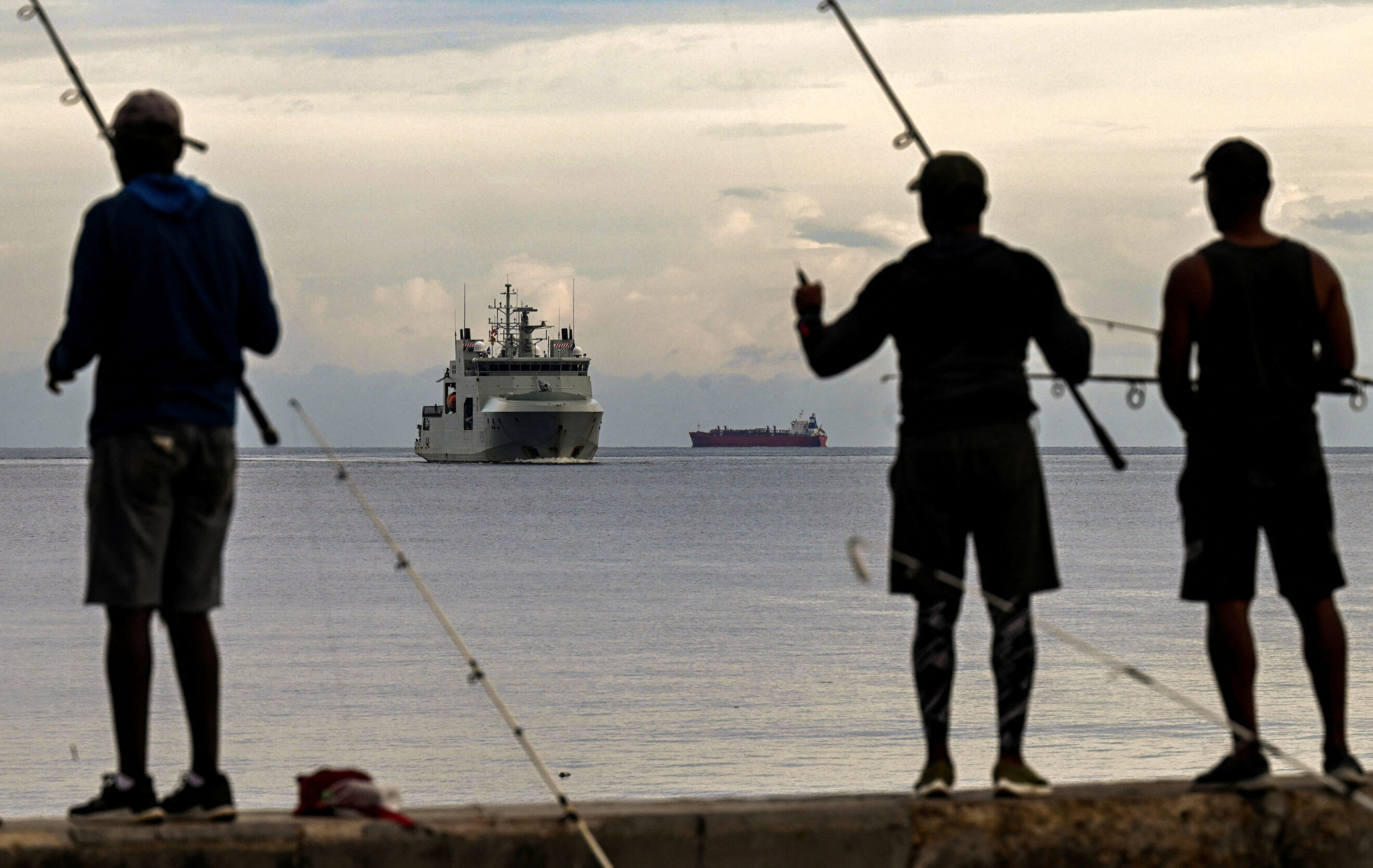
Canada’s HMCS Margaret Brooke, a patrol vessel for the Royal Canadian Navy, arrives in Havana Harbor on June 14, 2024. | Yamil Lage/AFP via Getty Images
OTTAWA — Here’s an unintended consequence of President Donald Trump’s new Western Hemisphere “Donroe” doctrine: Cuba is looking to Canada to save it from the United States. And it’s putting Canada in a very awkward position, at a moment when it’s already under Trump’s thumb.
The close Canada-Cuba ties that have coexisted with the six-decades plus of the American embargo and diplomatic freeze-out of Cuba’s communist regime have largely flown under Washington’s political radar, dating back to the 1961 Cuban missile crisis that led to the imposition of the Cuban embargo by John F. Kennedy.
Not any more.
Since the U.S. removal of Venezuelan leader Nicolás Maduro in January — which deprived Cuba of its top energy supplier — Washington has fixed its gaze on Havana. An emboldened Trump has embarked on his next hemispheric adventure, to become the first U.S. president to do what 12 predecessors have not: topple Cuba’s communist regime.
Trump has threatened additional sanctions against third countries that come to Cuba’s aid. Now, the administration is considering a full-on oil blockade to bring the country to its knees.
That context set the stage for the testimony earlier this week of Cuba’s ambassador to Canada before the House of Commons foreign affairs committee on Parliament Hill.
Speaking in the soft, measured tone of an avuncular history professor, envoy Rodrigo Malmierca Díaz left no doubt that he appreciated the conundrum facing the country to which he was now addressing, cap in hand, looking for help with the two things his country needs most right now: oil and food.
“I understand that many friends of Cuba are trying to be, maybe discreet, about their positions. They don’t want to create more trouble with the U.S. than they already have,” he said.
It’s an accurate reading of the situation. Canada and Mexico are engaged in the review of the United States-Mexico-Canada Agreement, which serves as the economic foundation of America’s northern neighbor, regardless of the “elbows up” anger many Canadians feel towards their MAGA-ruled neighbor. As expected, the Trump administration has been tough on Canada.
Before the Covid pandemic, Canadian visitors to Cuba maxed out at about 1 million per year. The last thing a Canadian passenger sees as their charter flight transits U.S. airspace, and hears the pilot’s voice announcing a descent towards Varedero, Santa Clara, or Havana — the tip of the Florida panhandle giving way to a clear, watery turquoise vista below.
The most famous Canadian visitor to Cuba was Prime Minister Pierre Trudeau in 1976, where he struck up a lifelong friendship with Fidel Castro, whose 1959 communist revolution forced the U.S.-backed dictator Fulgencio Batista to flee the island. Castro then returned the sentiment by travelling to Montreal in 2000 to serve as an honorary pallbearer at the Canadian leader’s funeral. When Castro died in 2016, Trudeau’s son, Prime Minister Justin Trudeau praised Castro, earning him the condemnation from the now U.S. Secretary of State Marco Rubio, who labelled that as “shameful & embarrassing.”
Fast forward to this month. As fuel for international airlines ran out and cancelled flights ensued, some 28,000 Canadians scrambled home. Government officials think only a few thousand remain, including about 5,000 who are full-time residents of the island.
Cuba’s beaches may be pristine, and in many cases its coastlines gloriously underdeveloped, but in recent years tourists are finding themselves in beachside resorts well below half capacity, plagued by frequent power outages, and a rotating and bizarre lack of food items. Some things that Canadians have noticed missing on any given day: bread, eggs, and — as one visitor told me after returning this past December — french fries.
It’s far worse for the Cuban people, as any hospitality worker will discreetly tell you. Malmierca painted his own picture for MPs: wheat shipments that do reach the island are trapped in ports because there isn’t enough fuel to gas up trucks; hospitals have run out of drugs, including antibiotics and painkillers, and have lost the capacity to perform dialysis and treat cancer patients.
There are differences of opinion within Canada about Cuba, and they were on full display during Malmierca’s testimony.
“First of all, we’d like to reiterate the Bloc Québécois’s solidarity with the Cuban people … Quebec has maintained a relationship that is profound and historic,” BQ MP Alexis Brunelle-Duceppe told the envoy, who hails from the French-speaking province that sends more than its share of tourists to Cuba.
Ontario Conservative MPLianne Rood peppered the envoy with questions about political prisoners, the regime’s stifling of political dissent, its support of Vladimir Putin’s war on Ukraine.
“I can think of no greater concern than the oppressive actions the socialist dictatorship imposes on its own people,” Rood told him.
Malmierca remained stoic.
The next day, Foreign Affairs Minister Anita Anand announced Canada was accelerating an C$8 million commitment to the United Nations World Food Programme for Cuba. That stood in sharp contrast to Mexico’s decision the same day to send two navy ships loaded with food to Cuba in what it called an act “of solidarity with the peoples of Latin America, and in particular with the people of Cuba.”
When a reporter asked Anand if she’d discussed Canada’s indirect food aid with anyone in the U.S. government, Anand shot back with a very sharp — and personalized — reply:
“I have not discussed Canadian aid intentions with Secretary Rubio or the United States.
“This is Canadian foreign policy, and we are focused, as I just said, on the humanitarian situation.”
Welcome to POLITICO Forecast. Reach out with news, tips and ideas at [email protected]. Or contact tonight’s author at [email protected] or on X (formerly known as Twitter) @mblanchfield.

Trump’s next tariff fight is keeping the money: Officials across the Trump administration are scrambling to devise legal strategies that would allow the government to keep billions of dollars in tariff revenue the Supreme Court said was illegally collected. Early ideas include policies to discourage companies from claiming their refunds, prevent the government from paying the money back or otherwise preserve at least some of the tariff revenue, according to five people familiar with the conversations, granted anonymity to discuss them.
Davos boss quits over Epstein links: Børge Brende, head of the World Economic Forum (WEF), on Thursday said he is resigning over his relationship with convicted sex offender Jeffrey Epstein. “After careful consideration, I have decided to step down as president and CEO of the World Economic Forum,” Brende, who became the president in 2017, said in a statement on the WEF website. “My time here, spanning 8½ years, has been profoundly rewarding.” The forum launched an investigation into Brende in early February after his relationship with Epstein came to light in the latest document release by the U.S. Justice Department.
White House officials believe ‘the politics are a lot better’ if Israel strikes Iran first: Senior advisers to President Donald Trump would prefer Israel strike Iran before the United States launches an assault on the country, according to two people familiar with ongoing discussions. These Trump administration officials are privately arguing that an Israeli attack would trigger Iran to retaliate, helping muster support from American voters for a U.S. strike. The calculus is a political one — that more Americans would stomach a war with Iran if the United States or an ally were attacked first.


Solar-generated energy met a large proportion of US electricity demand growth in 2025 — 61 percent of the 135 terawatt-hour (TWh) rise in electricity demand, compared to 49 percent in 2024.

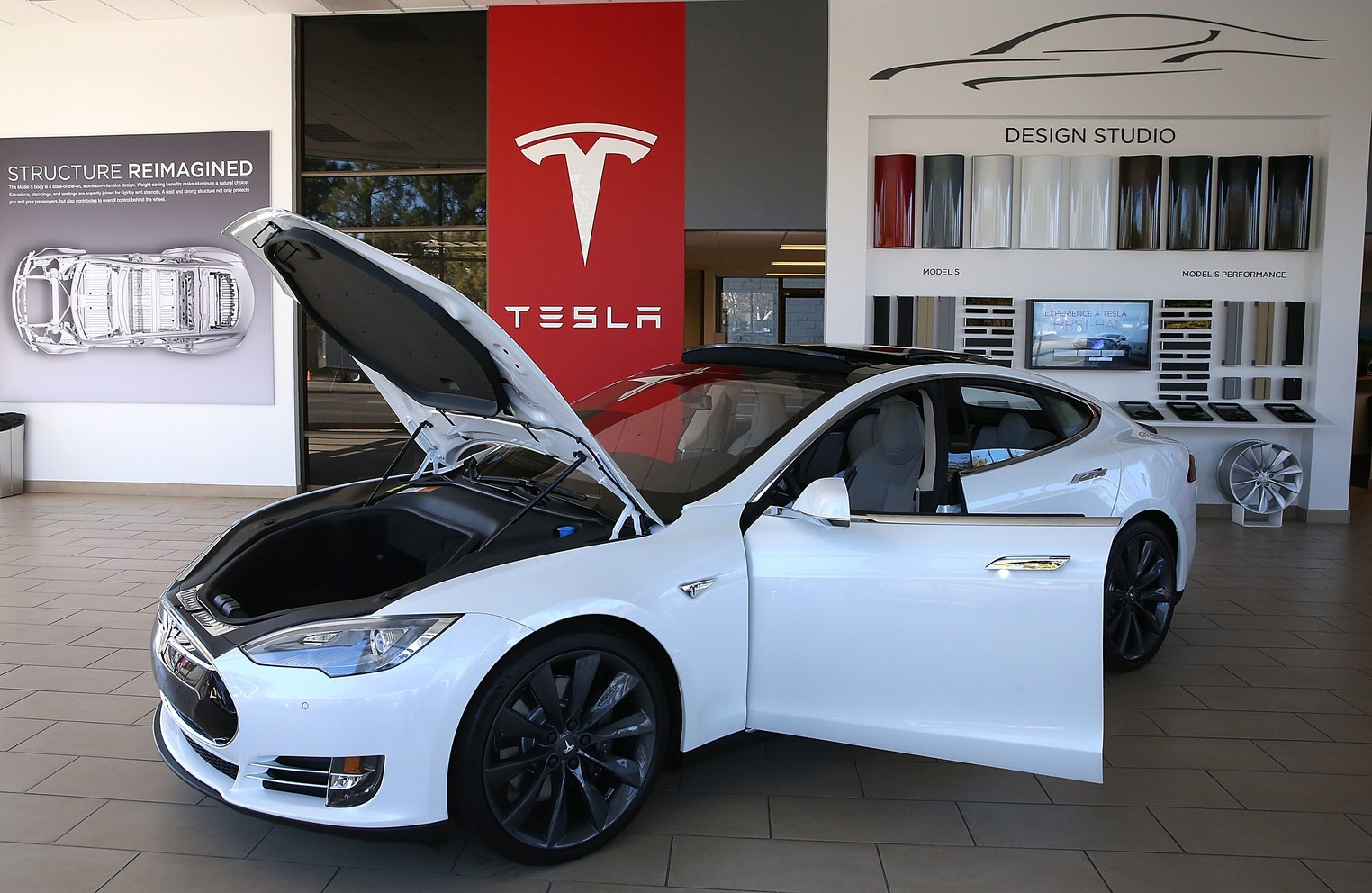
A Tesla Model S car is displayed at a Tesla showroom in Palo Alto, Calif. | Justin Sullivan/Getty Images
Europe is falling behind the United States, including in industries where it used to excel — like carmaking, writes Pieter Garicano in the Substack Works in Progress. Germany, for example, was a major power player in the world’s automobile field. But American companies like Tesla and Waymo are dominating a new era of automobile innovation.
“Understanding why Europe doesn’t have Google,” Garicano writes, “is important. Understanding why it doesn’t have a Tesla is existential.”
“There are many partial explanations: high energy prices, expensive housing, excessive proceduralism, high taxes, extractive interest groups, and politicians with a penchant for degrowth. But all of these problems are true of California as well, which is nonetheless home to Waymo and birthed Tesla before it moved its headquarters to Texas in 2021. Explanations often blame Europe’s lack of research spending, but governments spend more on research in Europe than in America. And just seven companies globally — Google, Apple, Amazon, Meta, Microsoft, Samsung, and Huawei — spend more on research each year than Volkswagen.
What really sets Europe apart from states like California is different. Relative to income, it costs large companies four times more to lay off Germans and French than American workers, a difference arising entirely from different regulatory approaches. As a result, it virtually never happens: Americans are ten times more likely to be fired than Germans in any given year. …
This may sound like a great virtue of European life, and in a way it is. But it has costs. If it is expensive to fire people, then companies may pay them less in order to balance out employment costs, or they may not employ people at all. To understand the innovation gap, however, there is a third effect that is even more important. If it is expensive to lay people off, employers avoid creating jobs that they might subsequently discontinue. Innovation involves experimentation and risk, so jobs in innovative areas of the economy are more likely to be discontinued than jobs elsewhere. High severance costs create a fundamental incentive for European businesses to avoid innovative areas and concentrate on safe, unchanging ones. In the long run, this is a recipe for decline.”
Did someone forward this email to you? Sign up here.
SUBSCRIBE to the POLITICO newsletter family: Brussels Playbook | London Playbook | London Playbook PM | Playbook Paris | Berlin Playbook | POLITICO Confidential | Sunday Crunch | EU Influence | London Influence | Berlin Bulletin | D.C. Playbook | D.C. Influence | Canada Playbook | POLITICO Forecast | All our POLITICO Pro policy morning newsletters