
Most people living outside Africa carry small traces of Neanderthal DNA. These inherited fragments appear across many human chromosomes. One part of the genome stands apart. The human X chromosome contains long regions where Neanderthal ancestry almost never appears. Geneticists have debated this pattern for more than two decades.
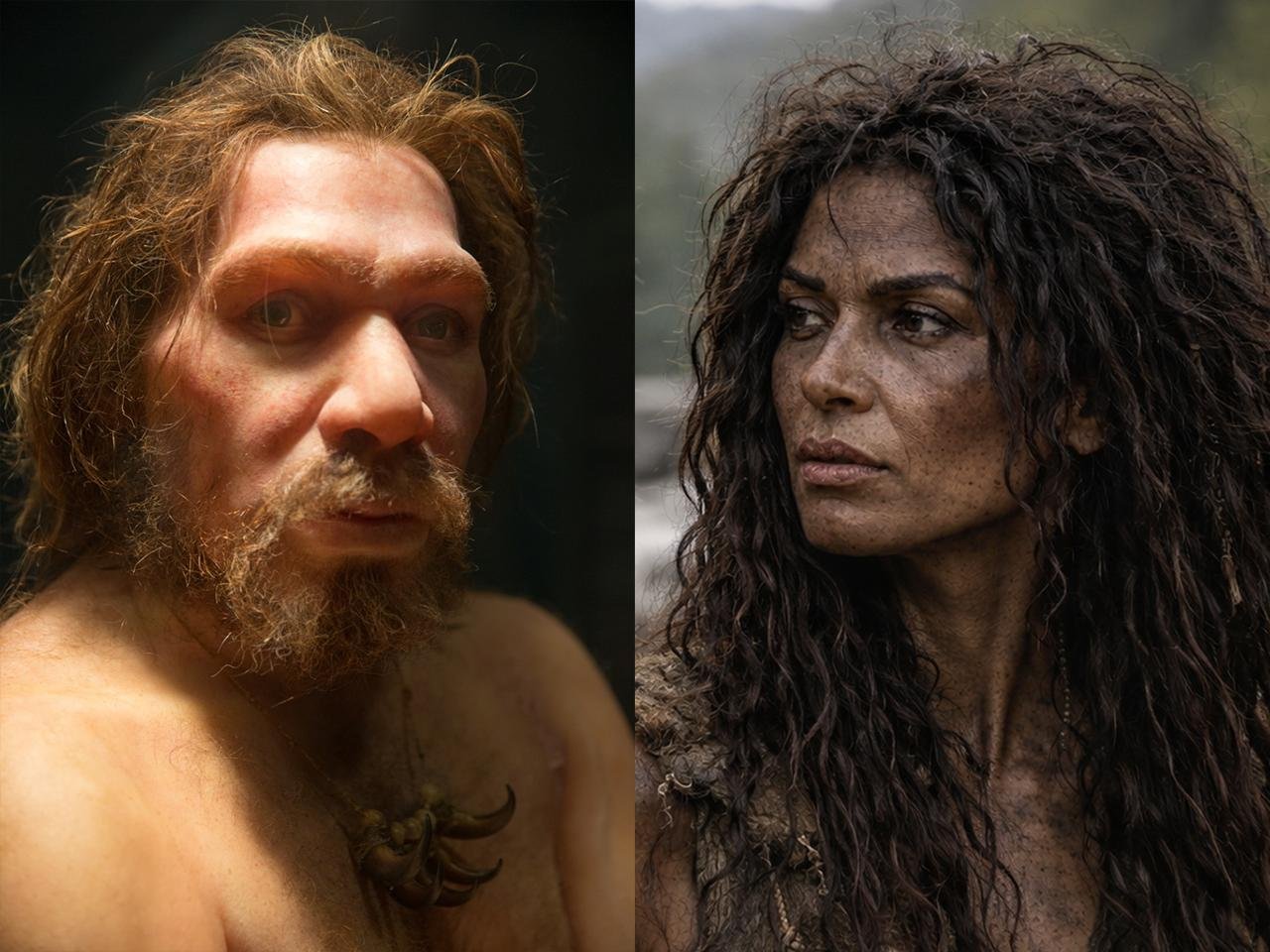 A portrait of a male Neanderthal displayed in a museum alongside a reconstruction of a female Homo sapiens.
Earlier explanations focused on biology. Scientists proposed that Neanderthal genes harmed fertility or health when mixed with modern human DNA. Natural selection would then remove those segments over thousands of generations. A new study led by researchers at the University of Pennsylvania presents a different explanation built around mating behavior rather than genetic failure.
Modern humans and Neanderthals separated from a shared ancestor around 600,000 years ago. Human populations developed in Africa while Neanderthals lived across Eurasia. Contact occurred several times after humans moved into Eurasian regions. Interbreeding followed these encounters. Today, people with non-African ancestry carry about 2 percent Neanderthal DNA.
Researchers compared genomes from three Neanderthals—Altai, Chagyrskaya, and Vindija—with DNA from African populations whose ancestors never met Neanderthals. The African genomes served as a reference point free from Neanderthal ancestry. The team focused on how genetic material moved between species through the X chromosome, which males and females inherit in different ways.
The analysis produced an unexpected result. Neanderthals carried far more modern human DNA on their X chromosomes than on other chromosomes. The increase reached about 62 percent. Modern humans showed the reverse pattern, with very little Neanderthal DNA on their own X chromosomes. If biological incompatibility drove gene loss, both species would show reduced foreign DNA in the same regions. The data did not match such expectations.
The inheritance pattern points toward repeated pairings between Neanderthal males and human females. Females carry two X chromosomes, while males carry one. Children born from these unions would receive fewer Neanderthal X chromosomes across later generations. Human X chromosomes would move more easily into Neanderthal groups under the same conditions. Computer models reproduced the genetic pattern using this mating bias alone.
Other explanations, such as sex-specific migration, required shifting population movements across time and geography. Those scenarios demanded many assumptions. Mate preference produced the observed genetic distribution with fewer variables.
Evidence from earlier studies of Neanderthal Y chromosomes shows that gene exchange occurred in both directions. The new results suggest uneven pairing patterns shaped long-term inheritance. Researchers now aim to examine population structure within Neanderthal communities. Questions remain about whether one sex moved between groups more often or whether social traditions influenced partner choice.
Ancient encounters between humans and Neanderthals left a measurable record inside modern genomes. Patterns preserved within the X chromosome suggest that social interaction played a direct role in human evolution, recorded through ancestry carried across generations.
Publication: Platt, A., Harris, D. N., & Tishkoff, S. A. (2026). Interbreeding between Neanderthals and modern humans was strongly sex biased. Science (New York, N.Y.), 391(6788), 922–925. doi:10.1126/science.aea6774