
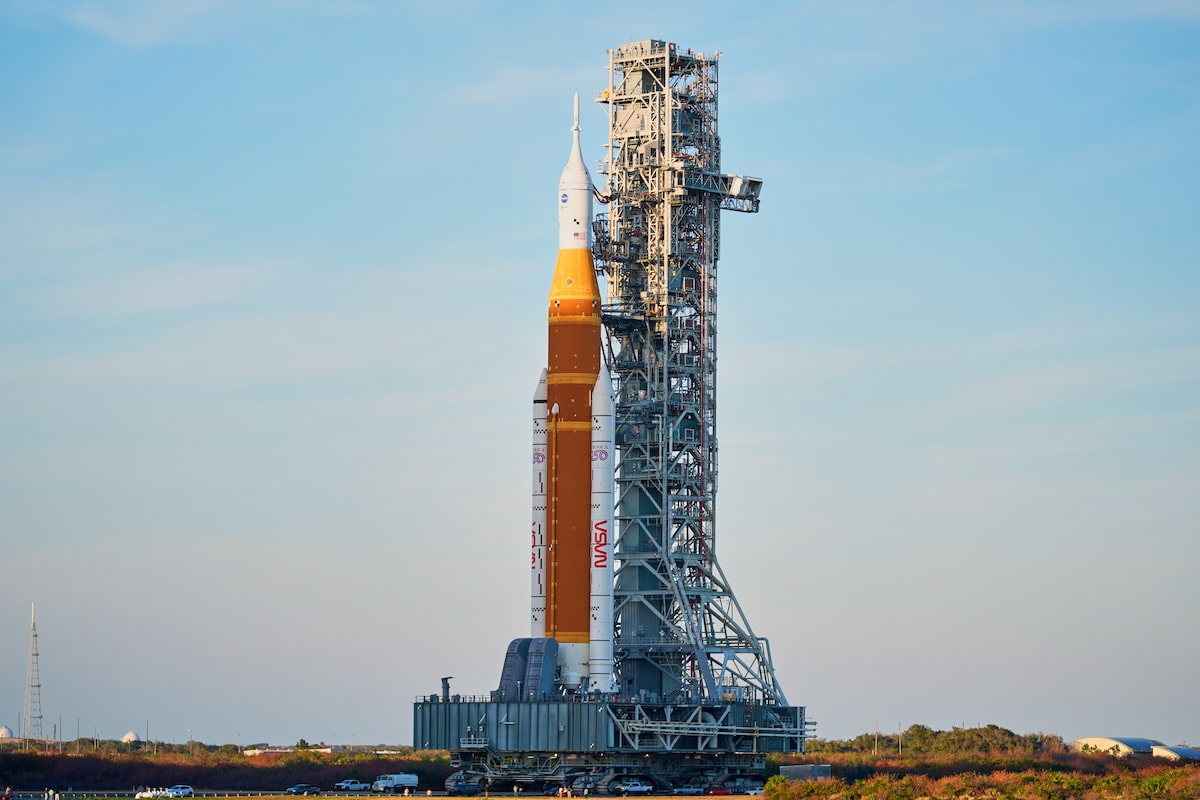
NASA’s Artemis II SLS moon rocket with the Orion spacecraft rolls back toward the Vehicle Assembly Building at the Kennedy Space Center on Wednesday in Cape Canaveral, Fla.John Raoux/The Associated Press
Two days after rolling its towering SLS rocket off of the launch pad for repairs, the U.S. space agency NASA is not yet sure when the Artemis II lunar mission will be ready to launch, but it is making changes to subsequent flights to the moon in the face of harsh realities about the program’s slow pace.
“Launching a rocket as important and as complex as SLS every three years is not a path to success,” said NASA administrator Jared Isaacman at a news briefing on Friday to discuss the program’s status.
The blunt assessment comes as engineers investigate a helium flow issue in the upper stage of the SLS that was first flagged last Saturday and requiring moving the rocket back into the giant vehicle assembly building at the Kennedy Space Center in Florida.
Canada is a partner in the Artemis program. Canadian astronaut Jeremy Hansen is among four crewmembers slated to fly on Artemis II, the first human mission to fly around the moon in more than 53 years.
During the Friday briefing, mission managers confirmed that repairs are underway in hopes of having the rocket back on the launch pad and ready to lift off ahead of a launch window in early April. It is not yet clear if issues with the rocket can be resolved in time.
NASA’s Artemis II launch hits new problem, putting March date in jeopardy
Mr. Isaacman pointed to the long lag time between launches as part of the reason why it is difficult to eliminate technical issues with the SLS.
“When you are launching every three years, your skills atrophy. You lose muscle memory,” he said.
Mr. Isaacman outlined several changes to the program, including redirecting Artemis III from a mission to land on the lunar surface in 2028 to an intermediate step on the way to that goal.
Under the new plan, Artemis III will be a mission to low Earth orbit to test the ability to rendezvous with one or both of the lunar landers that are currently being developed by private sector partners, SpaceX and Blue Origin.
The aim would be to launch the flight next year, Mr. Isaacman said, with the possibility of up to two lunar landing attempts to follow in 2028.
Mr. Isaacman said that discussions about adjusting the program were already underway before a problem surfaced last weekend that delayed the launch of Artemis II.
The rocket was rolled out in mid-January in advance of a launch opportunity in early February. Hydrogen fuel leaks that occurred during a dress rehearsal stymied those plans. Following a second dress rehearsal, mission managers said last week that they were ready for a launch attempt beginning on March 6.
Less than 24 hours later, the helium flow problem was detected and it became clear the rocket would need to be removed from the launch pad so that engineers could access the problem.
“The data were pretty clear that we were in a no-go situation,” said Lori Glaze, acting associate administrator for NASA’s Exploration Systems Development Mission Directorate.
Dr. Glaze added the team working on the rocket was streamlining its efforts, “to give us the very best possible chance at a launch in the early April launch period.”
To achieve its mission, Artemis II can only launch during a limited period of time each lunar month, when the moon, Earth and Sun are correctly positioned for the flight.
The April launch window runs from April 1 through April 6. If the rocket is not ready to lift off by then, the launch will slide to the next window, which opens on April 30.
But the larger ripples from Friday’s briefing will undoubtedly be from the “course correction” to the Artemis program, which critics have said is moving too slowly and calls for too many untested leaps from one mission to the next.
Mr. Isaacman, who stepped into his role leading NASA in December, said that contractors and government officials had been briefed on the changes to the program ahead of Friday’s announcement.