

Listen to this article
Estimated 4 minutes
The audio version of this article is generated by AI-based technology. Mispronunciations can occur. We are working with our partners to continually review and improve the results.
Around 8 p.m. one night in late January, police saw what they say was a stolen vehicle travelling from north Calgary through downtown towards the south, reaching speeds near 180 km/hr and running multiple red lights.
After tracking the vehicle by air with HAWCS and on the ground, police deployed tire deflation devices to stop the vehicle, and sent a canine team member after the driver when they fled on foot.
Police say the driver was a habitual offender — and only 15 years old.
The incident, shared in the monthly report to the police commission this week, is what police say is an example of the increasingly dangerous behaviour they are seeing on Calgary roads, and the tactics they are using to address it.
There have been seven traffic fatalities so far this year, including three pedestrians, according to police. It follows a deadly year on the roads in 2025, where 38 people lost their lives on Calgary roads.
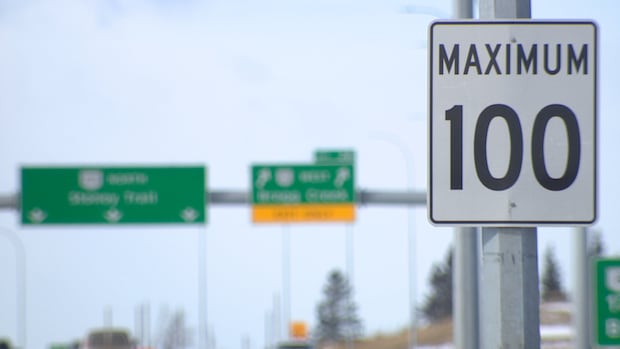
In January, police issued 677 speeding tickets on Stoney Trail, an average of more than 20 per day. They also issued 149 speeding tickets on Deerfoot Trail.
Thirty-five of those tickets went to drivers speeding more than 51 kilometres over the limit, which comes with a mandatory court hearing where a judge can impose higher fines or penalties.
But at the commission hearing Feb. 25, vice chair Kelly Ogle questioned why police powers do not go further to allow them to impound a vehicle for excessive speeding.
“So just to be clear, someone’s going 155 on Stoney, they get pulled over, they get a ticket … and they get back in their car and drive away,” said Ogle.
“This is ludicrous.”
WATCH | Calgary police commission wants to see harsher penalties for excessive speeders: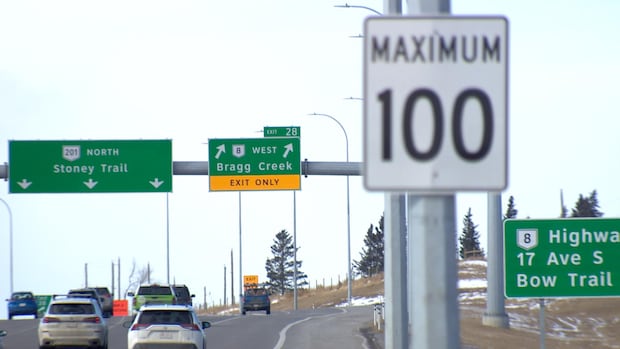
Calgary police commission wants to see harsher penalties for excessive speeders
Calgary police reported issuing 677 speeding tickets on Stoney Trail in January, and 149 along Deerfoot Trail. Alberta legislation doesn’t allow officers to impound vehicles for speeding infractions. But the province says fines for excessive speeding and racing will increase by 50 per cent next month.
Deputy Chief Cliff O’Brien said legislation does not allow for police to seize vehicles for speeding, but the idea has been discussed.
“I know there’s been conversations with the [government] about the potential of doing that or some other sanctions, whether that be a licence suspension or whether it be a vehicle seizure for a period of time, which other provinces have,” said O’Brien.
British Columbia, Saskatchewan and Ontario allow officers to impound vehicles for excessive speeding.
The province is hiking speeding fines in March, so that speeding a kilometre over the limit will cost $88, up from $81, while speeding 50 kilometres over the limit will cost $620, up from $495.
“This is the first time that traffic fines have increased since 2015,” Heather Jenkins, press secretary to Justice Minister Mickey Amery said in a statement.
“Improving safety requires coordination at every level of government, and Alberta remains committed to working with municipal and policing partners to help keep all road users safe.”
Chief Katie McLellan told the commission that officers are working to stop dangerous drivers nightly, and are deploying tire deflation devices — like they did in the January speeding incident — more frequently than ever.
“Something needs to change, something needs to give. We can not continue on this path. People need to focus when they’re on our roadways,” said McLellan.
The Calgary Police Commission said in a statement it continues to advocate for the return of photo radar enforcement, after the province restricted its use to school, playground and construction zones last year. The province has since granted a request by Calgary police to return the radar at several high-risk intersections.
Crime down in January
The police report to the commission says total crime in January 2026 was down 18 per cent compared to the same month last year.
Police say a decline in property crime helped drive down the overall numbers. Break and enters at homes and commercial buildings were down 29 per cent and 27 per cent, respectively, compared to the same time period last year.
Vehicle thefts, street robberies and commercial robberies were also down.
It came as the police year-end report showed 2025 had a two per cent bump in violent crime. There was also an increase in calls for non-criminal social disorder incidents, which police say is a positive sign as they encourage communities and businesses to report issues.