
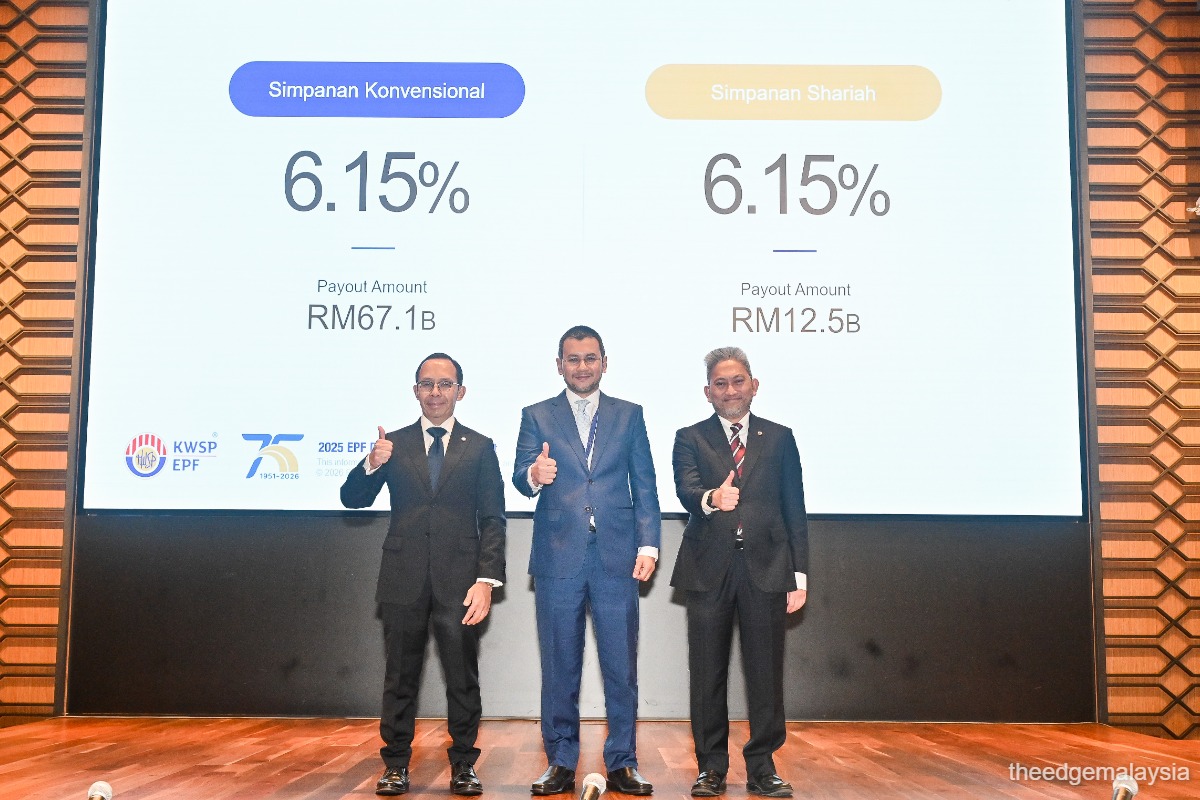
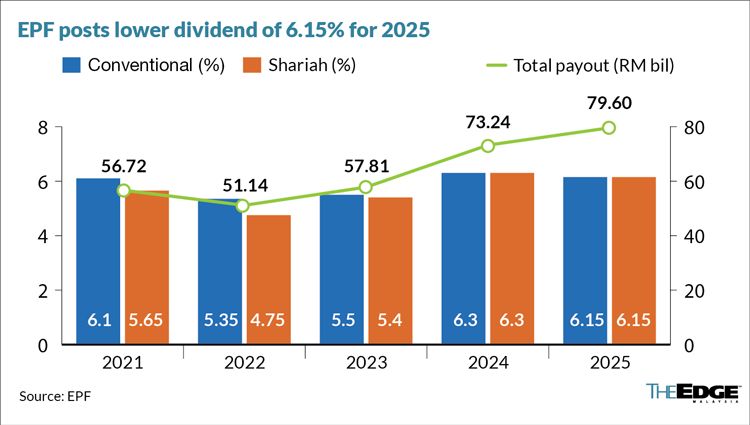
SHAH ALAM (Feb 28): The Employees Provident Fund (EPF) has announced dividend payout of 6.15% for both conventional and shariah savings for 2025. This results in a total payout of RM79.6 billion, an increase of 8.68% from the previous year.
This marks the second consecutive year the retirement fund has provided similar payout for both savings categories, following the 6.3% payout for 2024.
The crediting of dividends for both savings categories will be completed on Sunday (March 1).
The slightly lower dividend was mainly due to a weaker Malaysian market, said EPF chief executive officer Ahmad Zulqarnain Onn at the fund’s results briefing here on Saturday.
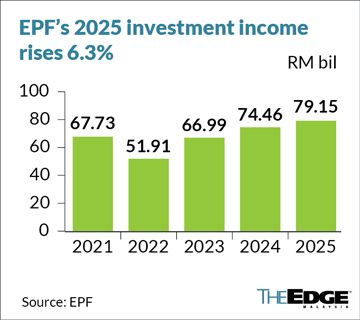
The EPF’s gross investment income grew 6.3% to RM79.15 billion from RM74.46 billion in 2024. This follows a high-growth year in 2024, when gross investment income jumped 11% from RM66.99 billion in 2023, on the back of a much stronger domestic market.
Total investment assets saw robust growth, rising 12.72% to reach RM1.409 trillion by the end of 2025. For comparison, assets grew 10% in 2024 to reach RM1.25 trillion, from RM1.136 trillion in 2023.
The fund’s performance was also influenced by a stronger ringgit, which impacted its international portfolio. Foreign assets now account for 38% of total assets, surpassing the half-a-trillion mark, at RM539 billion.
To maintain stability, the EPF plans to keep its current asset allocation, which is split between fixed income (45%), public equity (42%), the money market (3%), and the private market (10%) across real estate, infrastructure and private companies.
Economic outlook
The fund projects a conservative gross domestic product growth for Malaysia at 4.3% in 2026, within the official forecast of 4%-4.8%. Ahmad Zulkarnain noted there is potential for the economy to outperform this target, following several strong quarters recently.
“We believe Malaysia is in a good place. There is high interest from investors, both domestic and international, in our growth story. The top three themes from Malaysia that we believe will be persisted for the next decade are healthcare, digitalisation and energy,” he said.
Total membership saw unusual spike of 11.5% during the year, reaching 18.1 million. This was driven by a new policy that onboarded 1.5 million migrant workers for the first time. For perspective, in 2024, total membership grew by only 150,051 (0.9%).
Active members rose 20.6% to 10.6 million, with voluntary contributors making up about 924,000 of total contributors.
Contributions climbed 10.4% to RM130.2 billion, while withdrawals fell 6.6% following a rise in 2024 from the introduction of the fully-accessible Account 3 that year.
Ahmad Zulqarnain highlighted the rise in voluntary savings as the “number that we are most happy about”, noting that it reflects a significant portion of society taking charge of their financial future.
“We want to see more people, more importantly, rather than the ringgit amount, participating in voluntary contributions, particularly through i-Simpan and i-Saraan,” he said.