

Listen to this article
Estimated 5 minutes
The audio version of this article is generated by AI-based technology. Mispronunciations can occur. We are working with our partners to continually review and improve the results.
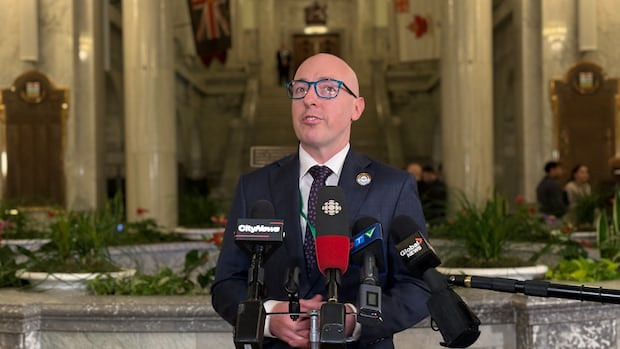
Mayor Andrew Knack says while he’s grateful the provincial government has reinstated municipal grants and is investing in Edmonton’s downtown, its latest budget doesn’t meet the mark for the city’s infrastructure needs.
“It feels like a very status quo budget,” Knack said.
The city is facing a $1.5-billion infrastructure renewal deficit.
Knack said that is partially the result of consecutive provincial governments not doling out enough for infrastructure.
“We appreciate it’s a tight budget, but what is the forward-looking plan that allows municipalities to start catching up with the incredibly rapid population growth we’ve been seeing over the last 15 years?”
Knack raised the concerns after Finance Minister Nate Horner tabled an $83.9-billion budget for the upcoming fiscal year. The province estimates it will finish out the year with a $9.4-billion deficit.
Education property taxes
Horner’s proposed budget will see education property taxes go up again. A portion of homeowners’ property taxes are collected by the province to pay for education.
In Edmonton it’s nearly 30 per cent of the total property tax bill.
Last year, the province said it would be using these taxes to pay for one-third of education operating costs.
The rate homeowners will be charged per $1,000 of their home value is increasing from $2.72 per $1,000 in assessed values for homes and farms to $2.84.
That works out to $154 more per year for the median homeowner in Edmonton.
Municipalities have called on the province to collect its own education taxes, rather than have them lumped together with municipal property taxes.
Horner said that isn’t something his government is considering.
“I don’t think it’s really something they should be asking for,” he said.
“We’re not going to create duplicate systems to collect these things.”
Grants in place of taxes
The Alberta government has lived up to its promise to restore the province’s “grants in place of taxes” program.
This is money the province gives to municipalities in lieu of paying property taxes on provincial buildings. In 2019, the province stopped paying the full amount, only giving about half of what it would pay in property tax.
In Edmonton, where a large share of provincial buildings are located, that move amounted to tens of millions of dollars less in funding.
After pushes from municipalities across the province, the provincial government said it would restore grants to 100 per cent this year.
Horner said this was a priority for Premier Danielle Smith after talking with mayors of large cities in the province.
“She felt that it was unfair the way we had gone about it in the past and wanted to rectify it,” he said.
However, infrastructure funding was reduced in the Local Government Fiscal Framework by $20 million because its formula is tied to provincial government revenue.
Knack said he’d like to see the formula of that fund changed to restore funding to 2011 levels.
Horner said he understands municipalities are facing infrastructure renewal deficits, but so is the province.
“I think everybody’s going to have to be reasonable — or equally disappointed,” he said.
“We’re trying to spread it around to make the most impact.”
What’s in the budget for Edmonton?
The budget includes $152 million over three years for Edmonton Downtown and Coliseum Site Improvements.
The budget also allocated $1.3 billion over three years to expand Edmonton’s LRT system. This includes funds to finish the Valley Line West expansion and the Capital Line South extension.
The spending plan also sets aside $5 million this year to plan LRT lines to airports in both Edmonton and Calgary. It’s part of a larger multi-year project to look into a new passenger rail system in Alberta.
A number of projects at Edmonton post-secondary institutions are being funded to help accommodate more students, including MacEwan University’s new business school, the University of Alberta’s redevelopment of its Biological Sciences Building and the Northern Alberta Institute of Technology’s Advanced Skills Centre.
There is $11 million in the budget for the Winspear expansion project, which has run over budget and is $33.4 million short in capital funding.
Getting some of Edmonton’s roadwork over the finish line also received more funding, including $99 million for the Terwillegar Drive expansion project and $83 million for the Yellowhead Trail freeway conversion project.
There is also $30 million to pay to demolish the former Royal Alberta Museum. It comes after the province had accepted proposals to save the vacant building that many Edmontonians wanted to see preserved. Horner indicated that he understands such conversations continue to be underway.
The provincial government said the budget also sets aside $38 million over three years “to acquire the selected site and complete functional programming to support development of the Stollery Children’s Hospital.” The budget also includes $7 million to plan in-patient towers at the Grey Nuns Community Hospital and at the Misericordia Community Hospital, as well as $5 million for redevelopment planning at the Royal Alexandra Hospital.