

Listen to this article
Estimated 5 minutes
The audio version of this article is generated by AI-based technology. Mispronunciations can occur. We are working with our partners to continually review and improve the results.
As soon as Simon Enoch heard about a plan by Bell Canada to build an artificial intelligence data centre near Regina, he only had one thing on his mind: details.
“I want details because we can’t really size up the impact and effect of this data centre until we have more details,” Enoch, a researcher with the Canadian Centre for Policy Alternatives, told CBC’s Blue Sky with Nichole Huck this week.
The broad strokes of the proposal can be found in documents filed with the Rural Municipality of Sherwood.
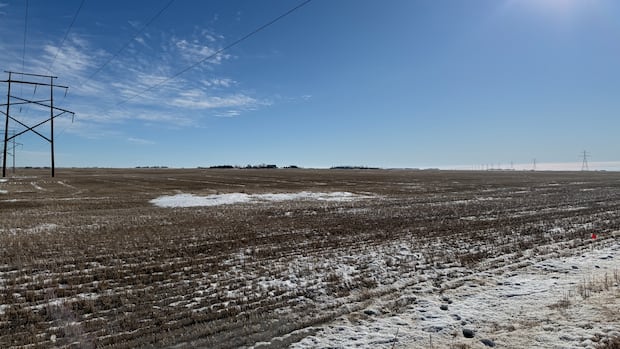
Bell Canada plans to build an unspecified number of “interconnected low-rise data centre buildings” on approximately 65 hectares of land south of the Saskatchewan Polytechnic campus, according to the documents.
The proposal in front of the RM of Sherwood was only an application for rezoning.
That means the answers to specific questions Enoch and many others have — like the size of the data centre, how much energy it will consume, its water usage and how many jobs it might create — remain unclear.
For many people in Regina, the lack of information has caused confusion and prompted even more questions.
Others are already working to have their concerns heard through several petitions circulating in the city.
Jay-Jay Bigsky, a Regina resident, has launched a letter writing campaign.
“Many people are worried about access to the water, access to power, as well as what that will look like on our upcoming bills,” Bigsky told The Morning Edition with Adam Hunter.
Water usage remains the key concern for residents, including one activist from George Gordon First Nation, which owns land bordering the proposed facility.
An AI data centre can use large amounts of water, especially if it employs an evaporative cooling system.
While the documents contain a reference to a “closed-loop cooling” system and Regina’s cooler climate, that detail alone doesn’t provide a clear answer about how much water may be needed.
A comparison to existing facilities in Canada and the United States is also impossible without more information on the size of the proposed facility near Regina.
WATCH | An exclusive look inside Calgary’s largest data centre, CAL-2: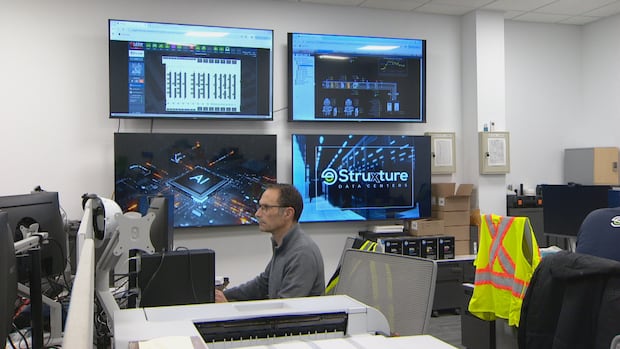
An exclusive look inside Calgary’s largest data centre, CAL-2
The province is pushing for more AI data centre investments but not all Albertans are as enthusiastic, citing concerns about their impact on the environment. The CBC’s Rukhsar Ali takes a look inside a high-tech facility to find out if ‘sustainable’ data centres are possible.
The documents do indicate the facility will rely on private cisterns for its water. However, there’s no indication of whether the cisterns would require access to municipal water services.
Regina Mayor Chad Bachynski told The Morning Edition with Adam Hunter that he welcomes the project, but acknowledged there are some concerns.
Bachynski said the City of Regina is not involved in the project but that he’ll do what is best for Regina residents.
“What I can tell you is that I have no interest in putting our water supply at risk at all for any project,” he said.
Bell Canada appears unwilling to provide answers to the many questions.
In a statement, a company spokesperson said Bell had “no announcement to make at this time.”
Bell did confirm it continues to work to “deliver sovereign AI infrastructure for Canada” and is working with municipalities across the country.
LISTEN | Proposed AI data centre near Regina prompts concerns and questions:
Blue Sky49:17Proposed AI data centre near Regina prompts concerns and questions
Bell has proposed to build an AI data centre near Regina. CBC’s Alex Quon looks into the project, and we hear from organizations that help municipalities ask the right questions about how they use AI.
Mairin Loewen, the associate program director of the Urban Climate Leadership Project, told Blue Sky that her organization is trying to educate municipal politicians about AI as the push for AI infrastructure continues across Canada.
“I think it was only a matter of time before this trend hit home in Saskatchewan,” the former Saskatoon city councillor said.
“With the federal focus on increasing sovereign data infrastructure in Canada, we can expect more of these.”
Tech giants like Amazon and Google control the majority of servers that host digital information. Few of those companies operate their servers and related infrastructure directly in Canada.
It’s why sovereign data infrastructure has become increasingly important to the federal government.
Canada wants to ensure it has the right to control access to and disclosure of its information. That access would be subject only to Canadian laws, according to a government white paper.
Loewen said councils are now being asked to consider and approve data centres when they have limited understanding of what is in front of them.
Loewen said many councils are “overwhelmed at the prospect of navigating” how to approach reviewing land use decisions around data centres.
It’s why she thinks companies are increasingly looking at rural or more remote municipalities.
“These are very large facilities. And so it’s a lot easier to build a new data centre in a rural location than it is in a very constricted urban space,” Loewen said.