
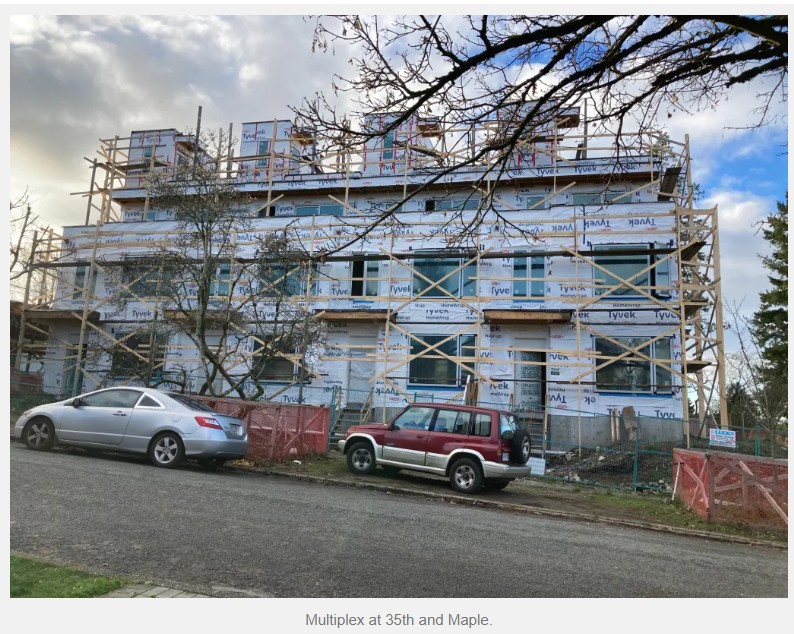
Above: An example of a multiplex under construction in Vancouver at 35th and Maple. More like these are popping up in many municipalities, not just Vancouver. Many people don’t know the ideological policy origins of densification policies underpinning Vancouver’s proposed Official Development Plan, but may be surprised to hear that there’s an ideological battle going on in real time regarding the causes and solutions for housing problems. This should come to the fore on March 10.
Photo courtesy Dunbar News – https://dunbarnews.ca/multiplexes-raise-concerns-well-beyond-dunbar/
As Vancouver prepares for the pivotal — but scarcely-announced — March 10 Public Hearing on the city-wide Official Development Plan (ODP), policies in Vancouver and province-wide that enable multiplexes (an example depicted in the photo above) are just one of the myriad aspects of the ODP, a legal document with significant implications; if adopted it would prohibit most public hearings and severely limit public oversight for developments containing residential units.
At the core of all of this, the issues are not “Do we want density?” but rather “Who is this housing for and how can we build to make it affordable for them?” Also, importantly, “How can the public hold the City and Province accountable for the actual outcomes of these massive legislative changes?“
1. Vancouver’s multiplex policy context: A history of “fast-tracked” densification without due process
The path to this moment has been paved by a series of provincial and municipal legislative moves executed with minimal public involvement. Under Bill 18 (2024), Vancouver is required to adopt an interim ODP by June 30, 2026. While the City could request an extension, Council has instead chosen to accelerate the process and “turbocharge” density. With Bill 18, the BC NDP amended the Vancouver Charter, allowing only 30 minutes of deliberations. With such vast implications, that could be considered a failure of due process. But that’s not all.
Bill 18 followed a “hammer” of legislation, including Bill 43 (2022) and Bills 44 and 47 (2023), which weakened municipal authority and mandated towers near transit hubs—often under the shadow of non-disclosure agreements that limited municipal pushback. (This is all documented on our Legislation Tracker. In fact some municipalities are preparing to call for a judicial review of all this legislation. See “In Q&A interview, “Mayor Sid Tobias explains his judicial review initiative on B.C.’s housing laws, and next steps.“)
Preemptively, in September 2023, Vancouver approved its own multiplex policy to allow up to six units on single-family lots. While billed as a “simplification,” analysts at City Duo describe the shift as a fundamental “rewiring” of the city’s residential landscape. See City Duo Multiplex Tracker.
Most of the underpinning legislation for all of this was done without meaningful public involvement.
2. Multiplexes in the pipeline—Huge numbers but who benefits?
The City Duo Multiplex Tracker currently identifies a cumulative footprint of 964 multiplex projects in the Vancouver “pipeline.” Yet, a deep dive into the active City pipeline reveals a far grimmer reality. Only 498 formal applications exist, and only 16 buildings have actually finished construction—a 3% success rate so far that suggests the “streamlined” process is anything but.
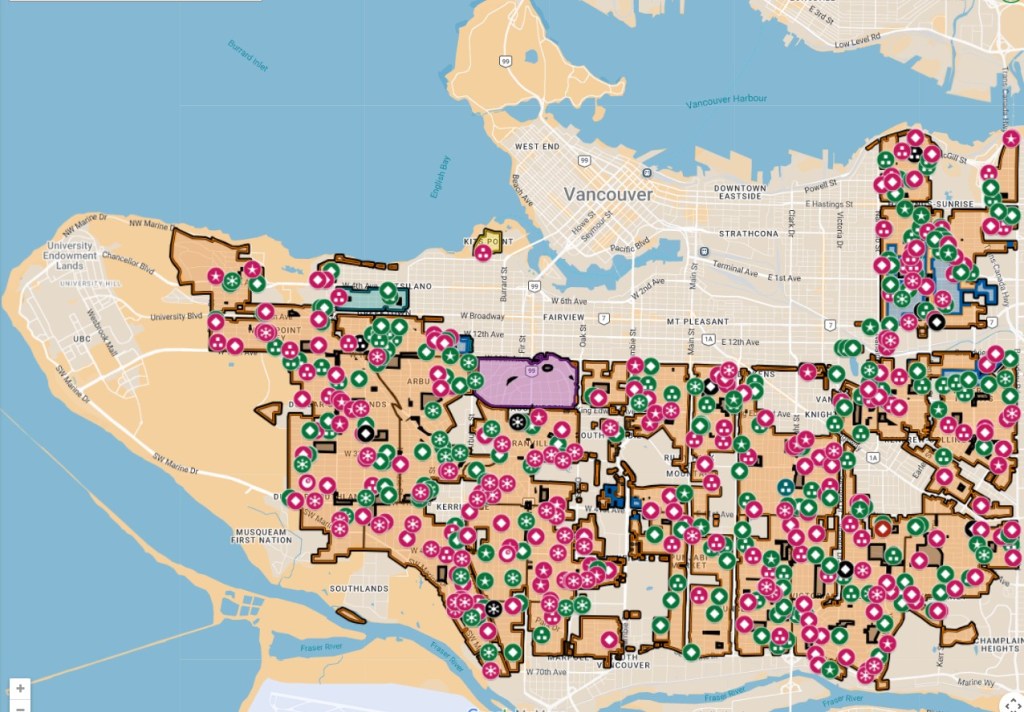 Above: City Duo’s multiplex tracker map of status of 964 multiplex projects as of 21-Feb-2026. Legend: Triplex (3 squares □), Quadplex (diamond ◆), Five-plex (star ★), Six-plex (snowflake ❄), Eight-plex (eight-ball). Credit: City Duo.
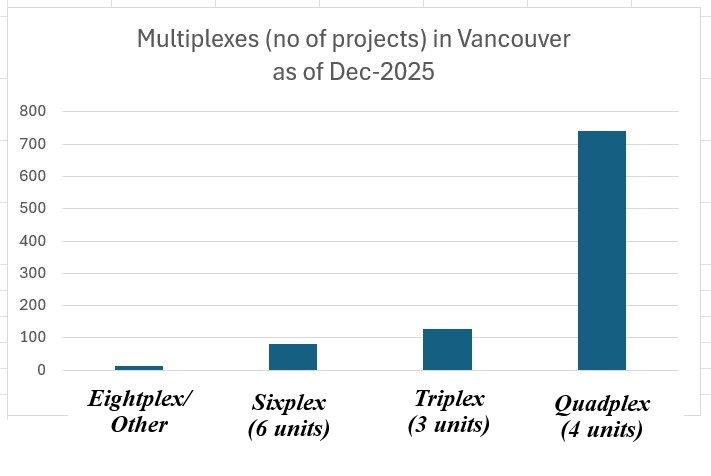
And despite the slow delivery, the project mix remains heavily skewed toward one type:

Above: Graph showing the numbers of multiplex projects (eightplex, sixplex, triplex, quadplex) in Vancouver as of Dec 2025. Prepared by CityHallWatch. Data source credit to City Duo blog.
Multiplex categoryNumber of projectsPrimary statusTriplex (3 Units)128Mostly “Permit Issued” or “Complete”Quadplex (4 Units)742Majority of current “In-Stream” appsSixplex (6 Units)81Rapidly increasing since 2025 policy shiftEightplex / Other13Newest category; high-density “experimental”TOTAL964
Above: Table of number of multiplex projects, by type, as of Dec 2025 compiled by CityHallWatch. Data source credit to City Duo blog.
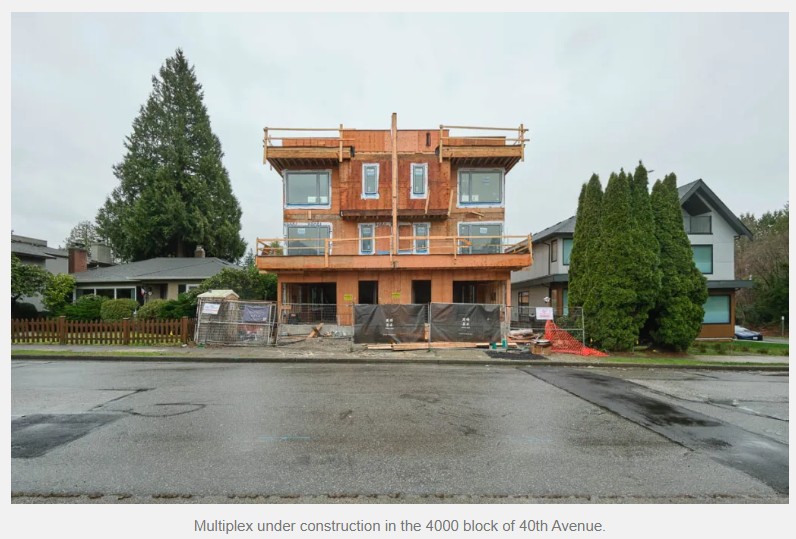 Above: Another example of how aa multiplex fits into the existing streetscape. Photo courtesy Dunbar News – https://dunbarnews.ca/multiplexes-raise-concerns-well-beyond-dunbar/
3. An epic schism in housing policy
As these numbers come to light, a bitter ideological and legal battle has emerged among BC’s policy architects.
For years, the Centre for Policy Alternatives (CCPA) functioned as the primary policy lab for the BC NDP. That changed recently when key figures, including economist Alex Hemingway, left to form a new think tank: BC Policy Solutions (BCSPS). Here is an example of Hemingway’s position on missing middle and multiplexes while still with CCPA: “B.C.’s Housing Supply Act can help break housing gridlock,” Vancouver Sun, 14-Jun-2023.
While the BCSPS now has a direct pipeline to the Ministry of Housing and the Minister herself, and continues to champion supply-side reforms, the surviving CCPA has pushed back.
A recent CCPA critique argues that “speculative appetite” and financialization—not demographics—are driving the housing crisis. The two organizations are now locked in a legal battle over assets, donor bases, and intellectual property. See the article by Niko Block: “The numbers don’t lie: The housing crisis is not caused by a supply shortage: Financialization, not demographics, caused the cost of housing to explode” (3-Feb-2026, link here).
With these fundamental issues being debated, Vancouver is ready to lock in the ODP as legal document with a 30-year time window. Is that a wise thing to do?
In fact, this fight back against the “abundance” ideology of providing supply at all costs is happening not only here, but in other cities in Canada and in other countries as well.
4. Speculation vs. stability
The tracker data supports the CCPA’s warning of financialization.
Though it is probably not City Duo’s intention, their tracker data appears to support the CCPA’s warnings about financialization of land and housing. In 2024, multiplex-focused purchases accounted for one-third of all residential land sales in Vancouver—a staggering $300 million.
When land prices are “reset” to reflect the potential of six luxury units, the resulting homes hit the market at $1.1 million to $1.8 million. This is far out of reach for the median-income families ($85,000 to $95,000) the policy was supposedly designed to assist. Investigations by CityHallWatch indicate that many of the most active buyers of land for multiplexes appear to be numbered companies, many of them associated with major developers, packaging land into de-risked portfolios for institutional investors. This appears to be the case in the Rupert and Renfrew area, where Vancouver City Council recently rezoned nearly 2,600 parcels of land, with the vast majority of residents having no idea this was happening. (See “Hundreds of quiet East Vancouver side streets upzoned for six-storey apartment blocks” by Douglas Todd in the Vancouver Sun, 26-Feb-2026.)
Once assembled, the land can be then packaged into de-risked portfolios for major public and private institutional investors, whether Canadian, American, or global.
This is the financialization of land, a process now being accelerated, aided, and abetted by provincial and municipal legislation.
It’s exactly the financialization of land and housing that underpins the Official Development Plan, and provincial housing legislation.
5. The ODP Public Hearing: The final curtain call?
The upcoming March 10 Public Hearing is not just another meeting; it is the moment the Vancouver Plan becomes the legal law of the land (the ODP). Public notification by the City of Vancouver has been kept to the absolute minimum required by law. Media coverage about the Public Hearing has been virtually non-existent.
A “Red Alert” recently issued by 30 of BC’s most senior urbanists (Letter to Vancouver on Official Development Plan) (linked here) warns that this ODP will:
Questionable population and unit projection methodology
Excessive development without affordability
Inadequate infrastructure, parks, recreation, schools and amenities
Loss of participatory planning, neighbourhood context, and transparent approvals process
Excessive literal implementation of provincial mandates
Conclusion As the CCPA notes, simply adding supply like multiplexes into a speculative “fever” does not cure the disease; it feeds it. On March 10, Vancouverites must decide if they are willing to trade their democratic voice for policies that have, so far, delivered only a small number of finished buildings in the case of multiplexes, and have significant and growing impacts on neighbourhoods, but resulted in millions in land assemblies while potential enabling land-flip profits.
The Public Hearing for the ODP is scheduled for Tuesday, March 10, 2026, at 6:00 pm. You can sign up to speak or submit comments at vancouver.ca/publichearings. See public hearing agenda page and documents here: https://council.vancouver.ca/20260310/phea20260310ag.htm