
Ontario’s tire recycling sector is ‘broken’ the industry says, as the circular tire recycling economy circles funds back to corporations and importers while leaving millions of used tires in potentially dangerous and environmentally hazardous piles all over Ontario
Editor’s note: This article originally ran on Feb. 26 but is being reprinted this weekend for those who may have missed the story on its original run.
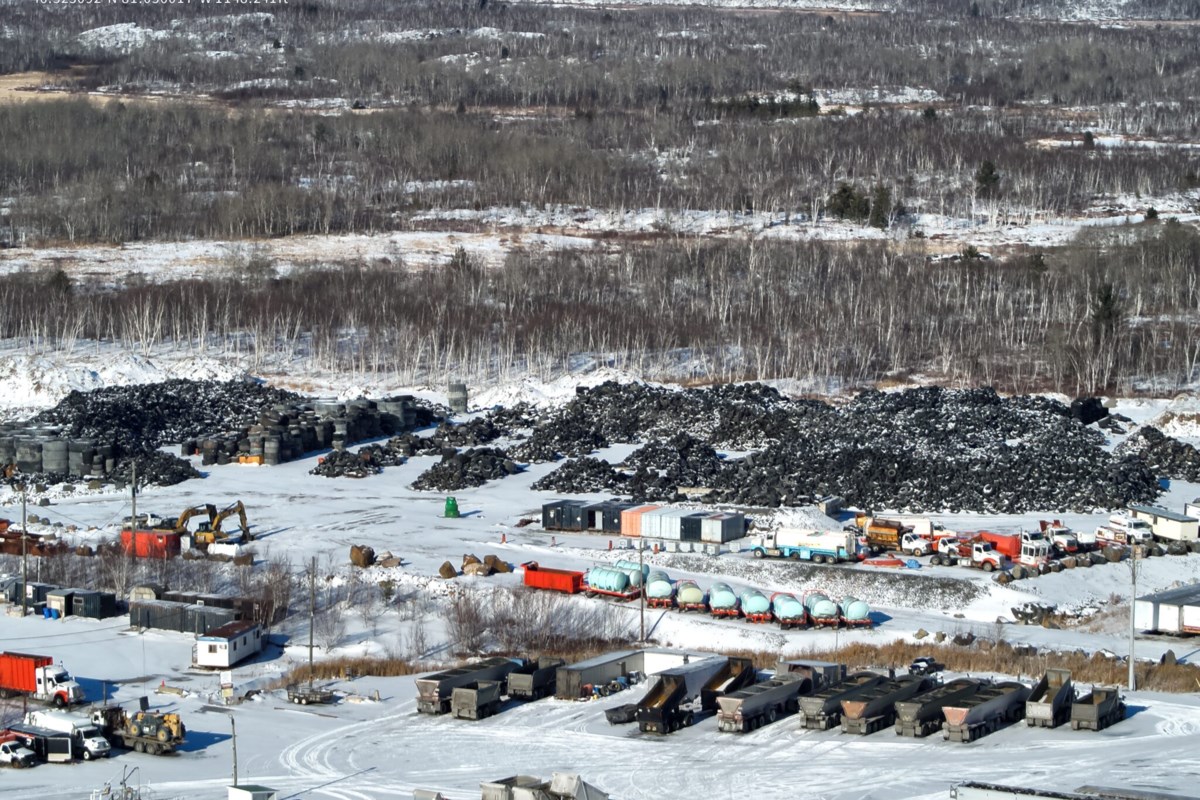
An estimated 500,000 used tires, more than 10 times the legal limit, were found in a stockpile construction yard near Azilda in January, and while those tires have been removed, hundreds of thousands more lie in storage yards across the province.
And the average Ontarian is paying for the privilege.
If the critics of recent amendments to the Resource Recovery and Circular Economy Act of 2016 are correct, the tire-recycling industry is in “a race to the bottom.”
“The system is self-imploding,” environmental policy consultant Peter Hargreave told Sudbury.com, describing the tire-recycling industry as “just depressing.”
Hargreave describes a broken system: “You’ve got a whole bunch of small auto shops and other other places that collect tires that can’t get those tires actually picked up in a timely manner, you’ve got tires that are potentially going to places which isn’t the place they should go, and you’ve got consumers that are paying for fees that they think are actually going to recycle those products, but in many cases, they may not be.”
The amendments to the act lowered the amount of tires, by weight, that tire producers — companies like Goodyear, BFGoodrich, Michelin and Pirelli, as well as major auto makers such as General Motors, Ford, Toyota and Honda — would have to recycle. With no financial incentive to continue picking up after their target is reached, tires are piling up in small yards in places like North York or Orillia, or in industrial sites such as the one in Stittsville, near Ottawa, which held 600,000 tires before the Ministry stepped in Jan. 7.
Nickel Belt MPP, France Gélinas, whose riding covers the Azilda stockpile said that within the current system, the oversight of it is left to the tire producers, “left to the industry itself.”
“Not only did the government not make sure that the industry followed the rules, they made the rules even lower,” said Gélinas. “With no oversight, it became a cash cow for the tire industry, at the expense of every one of us.”
She said while the government has the capability and has the responsibility to make it right, “This is not where their big donors fit, so they have no interest in it.”
“We have a Conservative government that has never spoken about the environment, ever, except to say that we will make it easier to open mines,” she told Sudbury.com. “The environment is not something that helps them make a ton of money, so it’s not something that they have interest in.”
The CEO of one of the affected companies, Donato Ardellini of Environmental 360 Solutions told Sudbury.com if the Act “doesn’t get fixed fast, tires are going to be accumulating in the streets.”
However, Ardellini also claims the system was broken long before the recycling targets were dropped. He described the RPRA, run by former Sudburian, Lorella Hayes, as “ineffective, slow and bureaucratic,” and in a statement posted to his website said the RPRA is “lacking an understanding of how commercial markets work” and accused them of backing down, saying the RPRA “cowed in the face of opposition” from the companies they’re supposed to regulate.
In some cases, the Auditor General agrees, noting also that the regulator has $20 million in debt “with no formal debt management policy.”
Both the Ministry of the Environment Conservation and Parks, who controls the act, and the RPRA, denied our request for an interview.
In an email statement, a Ministry spokesperson said they are working with the RPRA “to find ways to ensure that producers and PROs continue to operate their collection and recycling networks so that tires are picked up, sorted and processed in a timely fashion.”
To understand that, you’ll need a short history of tire recycling in Ontario.
A short history of tire recycling in Ontario
Hargreave said that from 2016 until December 2024, the recycling target for tire producers was 85 per cent, by weight, to allow for the approximately 15 per cent of each tire that can’t be recycled, as well as the rubber lost to the road while driving.
President of a firm he began in 2017, Policy Integrity, Hargreave was the director of policy and strategy for the Ontario Waste Management Association. Through this role, he helped develop policy around the circular economy and has also consulted with the RPRA.
He said Ontario’s issues with tires date back to 1990, when 14 million scrap tires burned over 17 days in an outside storage yard near Hagersville, Ontario.

Environmental and economic policy consultant, Peter Hargreave, (seen here) is president of a firm he began in 2017, Policy Integrity, and formerly the director of policy and strategy for the Ontario Waste Management Association. Through this role, he helped develop policy around the circular economy and has also consulted with the RPRA. . (Supplied)
According to reports from the National Research Council of Canada, a plume of dense smoke filled with small pieces of rubber led to the evacuation of approximately 4,000 people. A steady slick of oil, created by the breakdown of the heated tires, spread into the soil and surface water and reached the groundwater.
Hargreave said after that environmental catastrophe, lessons were learned. “We moved to a system where these tires were effectively getting collected right across the province.”
It even sprouted a new, “crumb”-based industry, he said, referring to the byproduct of shredding, granulation and grinding old tires.
But December 2024 brought an amendment to the 2016 act, one Hargreave said passed despite a consultation process rife with objections. It meant not just a lowered reporting requirement for certain tires, but the lowering of recycling targets: from 85 per cent by weight, to 65 per cent by weight.
“And in the span of a year, that system is self-imploding,” he told Sudbury.com. “It’s a good indication of what can go wrong when you don’t set high targets or higher environmental outcomes with legislation. I mean, it’s just depressing.”
Hargreave said all the producers met their targets in mid-2025, and since that point, most of the tires have been left in piles across the province.

A photo of the tires located at the CFT recycling site, located near Stittsville, Ontario, near Ottawa. The image is featured on the CFT website. The Ministry of the Environment, Conservation and Parks said the site contains more than 600,000 tires. . Image: CFT
But since another industry was created, there is still a need for crumb, and no tires making their way to tire processors.
A Windsor tire processor told a media outlet on Jan. 27 that he had to import used tires from the U.S. to keep his recycling plant fully operational in 2025, even as stockpiles were growing, with both Azilda and Stittsville considered illegal sites due to their size.
And all the while, the average consumer funds the system, whether it’s working or not.
Each time a new tire or new vehicle is purchased, you, the consumer, pays the producer what’s known as an “environmental handling fee”, also known as “tire stewardship fees”. They are set by the producer and usually range from $4 to $15 (or more) per tire for passenger, light truck, and small RV tires. They are to offset the cost of the infrastructure and operation of the recycling process.
It’s a part of the shift towards producer-run recycling systems, an infrastructure sold, ostensibly, as a way to save the taxpayer and government money.
Under the provincial Resource Recovery and Circular Economy Act of 2016, producers, as they are called, were required to help recycle what they make, including companies involved in the product or sales of batteries, hazardous materials and tires. Under the RPRA, a tire producer supplies tires in Ontario and is either a tire-brand-holder, an Ontario-based importer, a direct-to-consumer retailer, or the vehicle manufacturer. That list includes the large corporations who sell tires and automobiles with tires on them.
From 2016 to 2018, tire recycling in Ontario was managed by an organization called Ontario Tire Stewardship. While they successfully recycled tires, there were accusations of untoward political contributions, excess expenditures and in the case of one executive, allegations of misappropriation of funds.
As you would expect, they were shut down.
In their place came the RPRA, and while the enforcement agency is tasked with ensuring the recycling targets are met, the Ministry of the Environment is the one that sets the targets, the per cent of tire, by weight, that must be recycled by the producer, funded, in part, by consumer-paid fees.
There are more than 45 tire producers in Ontario. The largest tire manufacturer in Ontario is Goodyear Tire and Rubber, near Ottawa. When at full capacity, their Napanee-based manufacturing plant can produce 19,000 tires a day.
Rather than manage the day-to-day of recycling processes, the producers created a producer responsibility organization, or, PRO.
The PRO spends the time booking haulers to pick up used tires, ensuring they get to processing facilities and ensuring that targets are met, paid with the consumer recycling fees.
Of the six PROs, only one agreed to speak with us.
E360S’s Ardellini had a great deal to say.

Seen here is Donato Ardellini of Environmental 360 Solutions. He told Sudbury.com if the Recycling Act “doesn’t get fixed fast, tires are going to be accumulating in the streets,” Ardellini also claims the system was broken long before the recycling targets were dropped. He described the RPRA, run by former Sudburian, Lorella Hayes, as “ineffective, slow and bureaucratic.” . Supplied
E360S makes their statement
In March 2025, Ardellini posted a statement to the E360S website.
Describing the RPRA as “ineffective, slow and bureaucratic,” the statement described the RPRA as “lacking an understanding of how commercial markets work” and said the regulator has “cowed in the face of opposition from the PROs and large multi-national corporations they are supposed to regulate.”
Ardellini told Sudbury.com that when he expressed his concerns about the growing tire piles to Hayes in July of 2025, “she told us to stop collecting tires.”

In this file photo is Lorella Hayes, who serves as CAO and CFO of the Resource Productivity and Recovery Authority (RPRA), the provincial regulator enforcing the recycling act. Hayes is known to Sudburians as one-time city CFO (2005-2015) and general manager of assets and finance, but also, a name at the heart of the Laurentian University’s insolvency. She was included in a suit against several former directors and officers at the school which accused them of “alleged misuse and depletion of the university’s retiree health benefit funds, leading to their cancellation. . Sudbury.com file
“We’ve been telling her for years, if we stop collecting tires, this is gonna happen. We don’t want to do this to the province,” Ardellini told Sudbury.com. “And she said, ‘stop collecting tires, her exact words to me were, ‘stop collecting the tires’. My jaw hit the table.”
Hayes, one-time CFO (2005-2015) and general manager of assets and finance for the City of Greater Sudbury, might be more familiar to Sudburians for her role with Laurentian University during its insolvency crisis. She was included in a suit against several former directors and officers at the school which accused them of “alleged misuse and depletion of the university’s retiree health benefit funds,” leading to their cancellation.
Ardellini said without pay, he had to stop collecting tires. The ripple effect hit the other side of his business: he had to shut down his own processing facility in Barrie, cutting 110 jobs.
THE RPRA and the Auditor General
According to a December 2025 report from the Office of the Auditor General, the RPRA has been “slow to resolve its low-priority cases of potentially unregistered producers and rarely issues orders to address producers’ non-compliance with data-reporting requirements.”
The RPRA is also, per the report, “accumulating 20.9 million in long term debt with no formal debt management policy.”
The report also states that the RPRA’s processes and workflows “do not always have due regard for operational efficiency. In example, the Auditor General suggests the lack of RPRA’s escalation process for cases of non-compliance has led to enforcement delays. “RPRA’s allocation of staff resources has also resulted in operational delay in some areas, such as in public reporting and resolving cases of potentially unregistered producers,” reads the report.
The Auditor General states the RPRA “rarely escalates enforcement action against producers that have not complied with data-reporting requirements,” and while RPRA publicly reports on the results of producers’ resource recovery efforts as required, “it takes RPRA, on average, a year to publish the data after receiving it.”
Additionally, “RPRA has not finalized procedures for producers of most programs to audit their resource recovery data, increasing the risk of incorrect data being reported and relied on.”
The Auditor General’s office also concluded that the Ministry of the Environment “did not consistently support” RPRA in meeting its mandate responsibilities, stating the province “considered, but did not always address, RPRA’s concerns before making regulatory changes, resulting in operational challenges for RPRA.
The province “proceeded with regulatory changes knowing that RPRA would not have time to make operational updates to fully support those changes,” states the report, adding that the government “has never conducted a formal review of RPRA’s operations to identify areas of improvement.”
Ardellini and E360S sued the RPRA for lost revenue over what he claimed was their perceived lack of enforcement, but did not succeed with his case as the judge ruled the RPRA needed flexibility in enforcement as economies and markets change quickly, so there needs to be room for judgment calls.
He told Sudbury.com that’s why tires are piling up all over Ontario: he said rather than examine whether the targets were being enforced, the province simply dropped them by 20 per cent.

In this photo from OrilliaMatters.com, Mike’s Autobody and Tyre in Brechin is featured, overflowing with used tires as pickup delays plague the province. Danielle Pitman, Local Journalism Initiative Reporter
Producers pay, producers get paid
Ardellini said rather than prioritizing Ontario-based recycling capacity, the system is forcing businesses stuck with a significant volume of tires to send them to the United States for recycling, just to get them out of their yard, said Ardellini.
“The consumer-funded environmental handling fees collected in Ontario are being used to pay American-based processors, not being reinvested into local recycling infrastructure and local jobs,” he said
It’s often “ significantly cheaper” for producers to pay any assigned penalties than it is to pay for the recycling, Ardellini said, a figure they can accurately calculate based on their knowledge of the penalty structure.
The E360S statement reads that “to add insult to injury, they (the producers) don’t actually have to ‘pay’ anything for these penalties, because we have been told their PROs have promised to reimburse them from the extra money they have collected from Ontario’s consumers.”
“Meaning Ontario consumers are paying the fines for these large companies that have missed their recycling requirements.”
And the money paid by one producer will likely end up in the pocket of the others, not the consumer or the businesses suffering the gaps in the system.
In 2025, the RPRA issued a “Notice of Intention to serve administrative penalties” against 45 tire producers that have failed to meet their 2023 minimum collection requirements, with “proposed penalties” ranging from $70,000 to $1 million in fines.
After negotiations, the RPRA agreed to a settlement with one of them, Etracks, the largest PRO, requiring them to pay $7.4 million for not meeting the 2023 requirements.
Rather than going towards increasing the recycling efforts to meet the missed target, the money from the settlement will go to the producers who did meet the target in 2023.
The statement claims that recycling rates in Ontario are “plummeting,” and that businesses are closing and “Ontario workers” are losing their jobs.
“This is happening even as large PROs and producers collect millions of dollars in fees from consumers.”
As Hargreave said “if they’re externalizing their obligations, there’s no impact to them at the end of the day.”
But while there are many who clearly point to the issues with the recycling act and believe the consequences are playing out before the public’s eyes, there isn’t much faith that things will get better.
“What I would tell you is the legislation is clearly broken, not only related to that target, but there’s some other issues that need to be addressed within the legislation itself,” said Hargreave. “It’s a question of whether the government is going to be willing to open up that regulation again and make changes. But I think until that point, we’re going to continue to deal with all the problems that we’ve got right now.”
Jenny Lamothe is a reporter at Sudbury.com.