
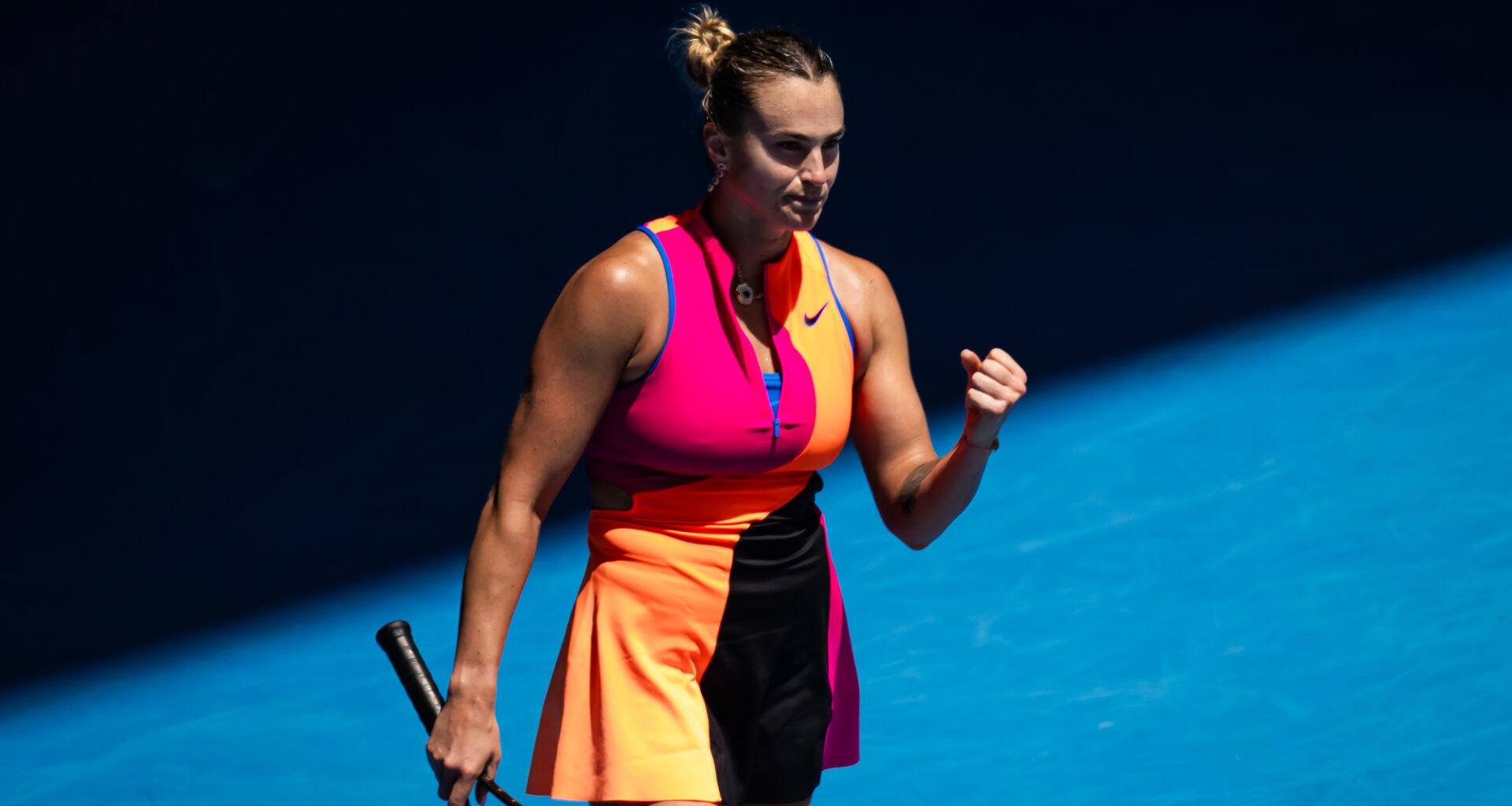
Of all her legendary accomplishments, the Sunshine Double is not one of them. But that’s only because Martina Navratilova was born ahead of the curve.
In 1985, she won the first-ever Miami tournament — it was called the International Players Championships — with a nifty 6-2, 6-4 result over Chris Evert in the final. Navratilova also won the second and third women’s events played at Indian Wells, at the age of 33 and 34.
Since then, winning Indian Wells and Miami back-to-back has become a thing, a rare accomplishment to be savored. Only four women have done it: Steffi Graf (1994 and 1996), Kim Clijsters (2005), Victoria Azarenka (2016) and Iga Swiatek (2022).
“Indian Wells, Miami,” Navratilova mused last week, “it’s a bit of a schlep. There are a lot of variables, and you lose three hours in the process. It’s hard to sustain through all of that.”
Meanwhile, Navratilova — who turns 70 later this year — is sustaining quite nicely. She’ll be working as an analyst for Britain’s Sky Sports at the BNP Paribas Open, which begins qualifying play on Sunday. And then it’s back to Miami, a home game, for a stint with Tennis Channel.
Navratilova, spirited and spontaneous as always, discussed the upcoming Sunshine Swing with wtatennis.com:
Taking stock
Why is the Sunshine Double so difficult to achieve?
Navratilova: I think it’s just because it’s tough player fields, the biggest and the best. And then there’s the adjustment as far as weather and the courts. Indian Wells is a little bit faster than Miami, and the balls fly there. In Miami, it’s more humid. It just weighs you down. With back-to-back two-week events, it’s tough to stay on top of it for so long, physically or emotionally. You stay in this state of anticipation, with those competitive juices — the neurons are firing. Even with a day off, playing golf or whatever you want to do, you’re still in the tournament, so you can’t just put your feet up like you do when the tournament’s over. It’s a longer stretch of engagement.
Based on the first two months of the WTA Tour Driven by Mercedes-Benz season, what’s your lead headline?
Navratilova: The biggest one is that [Elena] Rybakina is back. Winning the Australian Open, she played the best tennis when it mattered most. She was holding her nerves better than [Aryna] Sabalenka in the final and won in three. She was ill after Australia, which happens a lot. It’s normal to get sick after a major. More often than not, I got sick after Wimbledon and the US Open because the body just goes. After skipping Abu Dhabi, I’m hoping her immune system is OK. She won three matches in Doha and Abu Dhabi, so let’s see how she’s feeling in the desert.
Separating the front-runners
The World No.1 Aryna Sabalenka hasn’t played since the Australian Open, but she’s 11-1 in 2026. How do you see her Sunshine Swing going?
Navratilova: She played so well getting to the AO final, winning tough matches. Kept it together, but she was not nearly near her best. The good news is that she’s getting to Grand Slam finals — five of the past six. The bad news is that she’s lost three of them.
Why do you think that is?
Navratilova: It’s a tough one to get over because you can deal with it — until you get there again. When you get into that situation, the body kind of does its own thing. And you don’t know what to do. You feel like you’re outside of your body looking down. It’s so easy to develop scar tissue, considering it’s the biggest stage. The whole world is watching, which magnifies it so much more. I’m sure she can deal with it. For me, looking back, the way she fixed her serve and fixed herself speaks volumes. So I’m thinking she’s going to figure it out and learn how to manage it better.
By the elite standards Iga Swiatek and Coco Gauff have established, this stretch has been a bit quieter than usual. How do you see them navigating this challenge?
Navratilova: I think for both Iga and Coco, the matches that they used to win easily, they’re now winning sometimes with difficulty … or losing. It doesn’t take much to have that happen. What’s the final score line, maybe 6-4, 6-4, but it’s only 100 points to 94. I think the other players are beginning to figure out how to beat them because they have the tools now to get the tactics right. They have clarity of action. I also think they learn to practice against that kind of stuff. They’re used to it, so they don’t get on the court and say, `My God, I haven’t seen that much topspin ever before.’ They can create topspin with their hitting partners. They can plug those holes where they’re uncomfortable with a particular shot, the forehand or the backhand and build that confidence.
Ryan Lim/AFP via Getty Images
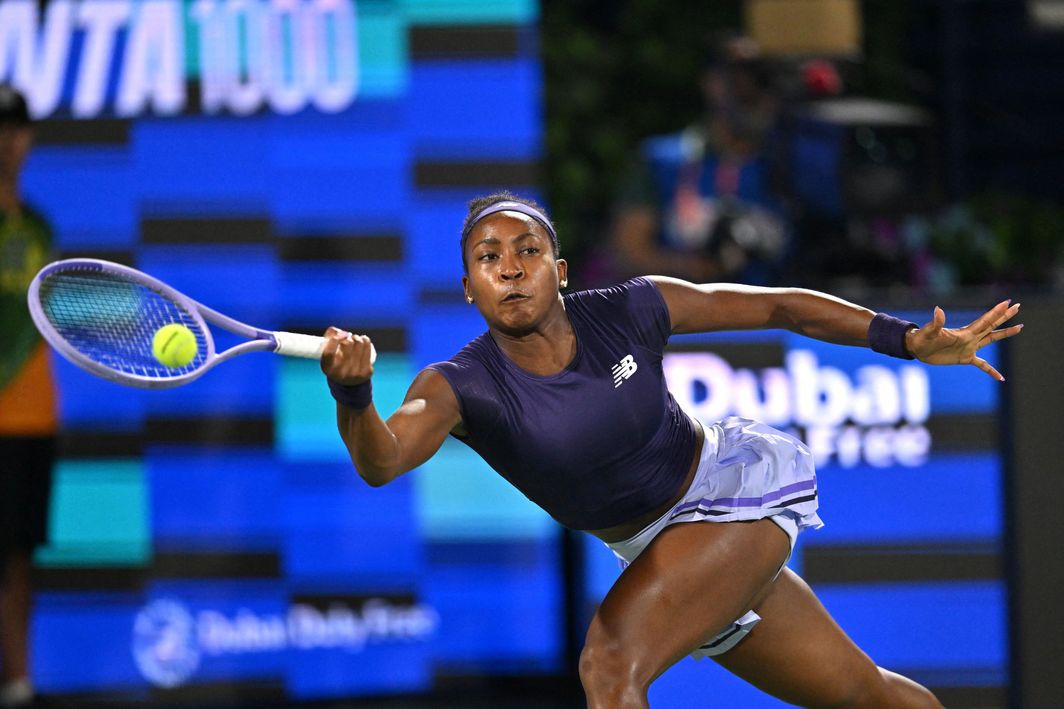
As Coco Gauff fine-tunes her serve, how much of the recent double-fault spike is simply part of that adjustment process?
Navratilova: Technically Sabalenka was all over the map with her technique when she was double faulting. Now she’s got that solved. With Coco, as far as I can see, the technique is fine. Sometimes it can become mental when the technique is OK. It gets into your head because you’re supposed to be in control. As soon as you think, `I don’t want to double fault’ — you double fault. It’s a self-fulfilling prophecy. When you’re confident, that thought doesn’t come into your head. She’s only 21 … I think she’ll get it straightened out.
Amanda Anisimova made the last two Grand Slam finals in 2025. What do you see for her in the coming weeks?
Navratilova: She’s such a perfectionist. I mean, her strokes are so good. For her, if she doesn’t hit the postage stamp on the other side of the court — even though it’s a winner — she’s like, `Oh, it should have been one foot to the right.’ She just needs to let go a little bit because she sets such a high bar with her strokes. That and I think she needs to improve her mobility — not much — but just a little. These days, the way everybody hits the ball, you must be quicker.
The teenage wave
This year, already, some young players have really distinguished themselves. Curious about your thoughts on 19-year-old Victoria Mboko from Canada, a finalist in Doha.
Navratilova: Her rise has been very meteoric, just crazy. She’s a great athlete and she doesn’t have many weaknesses. Solid on both wings, moves well. Her biggest thing was being injured. She was strapped up like crazy at the Australian Open, in Doha, I thought she was going to default — and she kept winning … She’s a competitor. I think she embraces the challenge. And technically solid, there’s nothing to break down in her game. Good shot selection. She’s got choices. Her tennis IQ is working well — and she’s just getting started.
What should we make of Iva Jovic, the 18-year-old American who arrives 13-4 this season after a quarterfinal run in Melbourne?
Navratilova: Yeah, she’s had some great results already this year. Very solid, really good head on her shoulders. She seems very put together, an Emma Navarro type player. Doesn’t panic. And also embraces the competition — I love that.
Alex Eala, the 20-year-old from the Philippines, who just reached the quarterfinals in Dubai …
Navratilova: She’s crafty. [Laughing] She’s a good lefty. She uses her variety nicely. I think where she can improve the most is her serve, or make it pay off more. She needs a bigger serve and bigger kick. She’s got the slice down pat. Just believe and hold her ground. She is slight of build so it’s harder for her to absorb all that pace. But I think she can beef up a little and punch up that serve.
Final thoughts
So, who wins at Indian Wells?
Navratilova: You still have to go with Sabalenka because she’s got the weapons. Right now, the way everything is going, if Rybakina is fully healthy, they are the top two players, clear frontrunners. They might come close to the level of Jannik Sinner and Carlos Alcaraz if they keep going this way unless Coco figures things out and Swiatek gets her mojo back. I think she’ll be out for revenge. Knowing her, Sabalenka is hoping she’s going to play Rybakina at some point.