
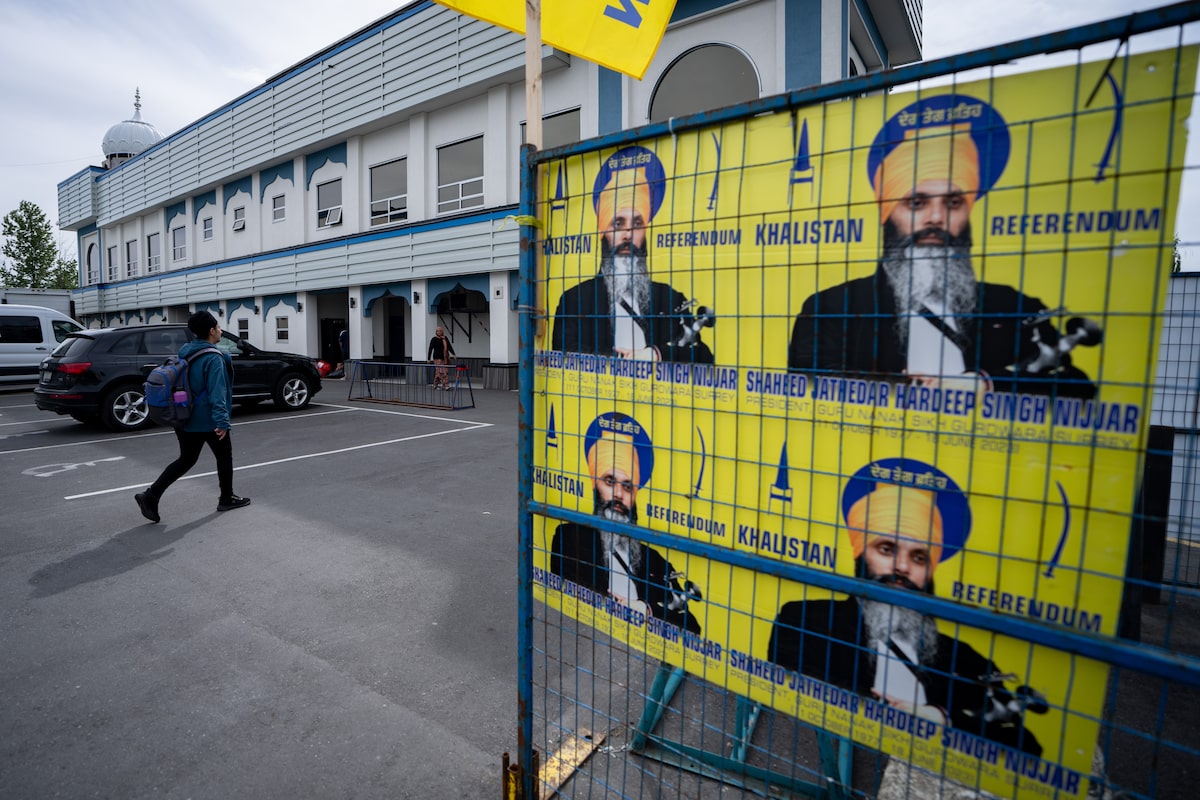
A person walks past signs of Hardeep Singh Nijjar at the Guru Nanak Sikh Gurdwara in Surrey, B.C., on May 3, 2024.ETHAN CAIRNS/The Canadian Press
Canadian national-security officials were presented with evidence that Indian consular staff operating in Vancouver supplied information to assist in the assassination of Sikh activist Hardeep Singh Nijjar, two sources told The Globe and Mail.
One of the Indian officials worked as a visa officer in the consulate, using his position to gather information about Mr. Nijjar from members of the Indian diaspora in Surrey, B.C., said the sources, one of whom is in law enforcement and one in national security.
Authorities believe the man, Kanwaljit Singh, was also an intelligence officer with India’s external intelligence agency, the Research and Analysis Wing, or RAW, the law-enforcement source said. The national-security source didn’t identify Mr. Singh by name but confirmed that CSIS was monitoring an undercover RAW agent posted to the consulate who was also working as a visa officer.
Mr. Singh worked with Manish, a career diplomat who goes by one name and was Vancouver’s consul-general at the time, both sources said.
The Globe is not identifying the sources because they were not authorized to share details of the investigation. Their information is based on the RCMP’s investigation and intelligence from Canada’s spy service and its allies in the United States and Britain.
While Ottawa has accused agents of India of being involved in the assassination, the identities of consular officials and their alleged roles in the Nijjar plot have never been publicly disclosed. The federal government expelled six diplomats in October, 2024, but only publicly named then-high commissioner Sanjay Verma.
Mr. Singh had previously been on a Canadian government list of accredited diplomats, The Canadian Press reported at the time, and his name was removed after the expulsions.
Mr. Nijjar, who was a key figure in organizing a referendum urging the creation of a separate Sikh homeland out of what is now the Indian state of Punjab, was gunned down in the parking lot of a gurdwara in Surrey, B.C., on June 18, 2023. The investigation into his death frayed an already strained relationship between Canada and the Indian government of Narendra Modi.
Prime Minister Mark Carney is currently in India trying to restore relations as part of his effort to secure a free-trade deal by the end of the year.
India has consistently denied any role in a conspiracy to kill Mr. Nijjar, a Sikh separatist who it long blamed, often without evidence, for co-ordinating violent attacks in his homeland.
India’s High Commissioner to Canada, Dinesh Patnaik, told reporters on Saturday in Mumbai that there was never any foreign interference in Canada by Indian officials, insisting “it never happened.”
The high commissioner’s office declined further comment when asked by The Globe about the allegations against Vancouver consular staff.
Mr. Manish did not respond to messages for comment on social media and an e-mail Saturday to the high commission in Cyprus, where he is now ambassador.
The Globe could not reach Mr. Singh, whose location after he was expelled from Canada isn’t known.
Information about Mr. Nijjar was passed to another RAW officer in New Delhi and that officer communicated with the Lawrence Bishnoi organized-crime group, a prominent Indian gang blamed for a rash of extortions and other offences in Canada, both sources said. A Canada-based member of the gang then helped arrange the killing of the outspoken Sikh activist, the sources said.
The New Delhi officer, The Globe’s two sources said, was Vikash Yadav, the same officer named in a U.S. indictment as the mastermind behind a foiled plot to murder another Sikh activist, an associate of Mr. Nijjar’s.
On Monday, Mr. Carney is scheduled to meet with the Indian Prime Minister in an effort to reset the Indian-Canadian relationship, diversify Canada’s international trade and lessen the country’s economic reliance on the United States.
Last week, in a briefing with journalists in advance of Mr. Carney’s trip, a senior government official said Ottawa does not believe India is continuing to interfere in Canada’s domestic politics. Public Safety Minister Gary Anandasangaree later walked that back, saying there’s “a lot more work to do” to ensure agents of the Indian government are not coercing or intimidating people in Canada.
Prior to Mr. Nijjar’s death in June, 2023, New Delhi had long accused him of being a terrorist and unsuccessfully asked the RCMP for years to arrest him and send him to India.
In late July, 2023, Canadian officials were alerted to the alleged role of the Indian government in the slaying, according to the national-security source. Canada received information that Indian officials in New Delhi had plotted to kill Mr. Nijjar and other Sikh separatists, the source said.
Canadian officials also received information gleaned through wiretaps that captured a conversation referring to how Mr. Nijjar had been successfully eliminated, the source said.
A photograph of late temple president Hardeep Singh Nijjar on a banner outside the Guru Nanak Sikh Gurdwara Sahib, in Surrey, B.C., in September, 2023.DARRYL DYCK/The Canadian Press
In September, 2023, then-prime minister Justin Trudeau told Parliament minutes after The Globe broke the story that Canadian intelligence agencies were “pursuing credible allegations of a potential link” between Indian government agents and the assassination of Mr. Nijjar.
That same day, then-minister of foreign affairs Mélanie Joly announced that she had expelled Pavan Kumar Rai, a man Ms. Jolie said was the chief of India’s foreign intelligence agency in Canada.
The RCMP gathered evidence that Mr. Singh, sometimes working with proxies in the South Asian community, used coercion and bribery to extract information on Mr. Nijjar, leveraging his authority to issue Indian travel visas to those wanting to visit family in India, the law-enforcement source said.
Some who declined to co-operate were threatened with consequences for their relatives in India, the source said.
Investigators observed Mr. Singh visiting the downtown Vancouver consulate late in the evening, the law-enforcement source said. There was also evidence gathered that Mr. Singh relayed information about Mr. Nijjar back to New Delhi, the national-security source said.
Canadian authorities believe Mr. Yadav, the RAW officer, relayed this intelligence and money to the Bishnoi group, the two sources told The Globe.
Mr. Yadav has been on the FBI’s Most Wanted List since October, 2024, and is accused by the U.S. of orchestrating a plot to kill Gurpatwant Singh Pannun, a New York-based activist who worked closely with Mr. Nijjar on a campaign to create an independent Sikh state in Punjab known as Khalistan.
American prosecutors have alleged in court documents that Mr. Yadav shared a private video of Mr. Nijjar’s dead body with a man he had asked to kill Mr. Pannun.
Mr. Yadav engaged members of the Bishnoi gang to hire the four alleged gunmen accused of opening fire on Mr. Nijjar as he attempted to drive his pickup truck off the lot of Surrey’s Guru Nanak gurdwara, the two sources said.
Canada declared the Bishnoi gang a terrorist organization in September, 2025, blaming it for a rash of extortions and violence in the South Asian community. Police agencies and local politicians had previously called for the federal government to act.
The law-enforcement source said Mr. Singh and Mr. Manish were not arrested because prosecuting them would have been impossible because of their diplomatic immunity.
Mr. Manish was officially reassigned to be India’s high commissioner to Cyprus in July, 2023 – three weeks after Mr. Nijjar was killed. But he exited Canada in May, 2024, India’s Ministry of Foreign Affairs said at the time of his departure.
Members of the Sikh community alleged that consular officials were involved in the plot, but the Vancouver consulate denied these allegations in a 2024 statement.
“Canada-based Khalistani extremists and terrorists, who do not represent the peace-loving Sikh community, are enemies of better Canada-India bilateral relations and keep making accusations without any evidence and without facing any social or legal costs,” the statement said.
Mr. Singh was expelled in 2024 as the RCMP deepened its investigation into Mr. Nijjar’s death, according to the law-enforcement source.
Dan Stanton, a former CSIS intelligence officer, said if Canada has reliable intelligence good enough to be used as evidence against Indian officials, then it needs to be included in the criminal case.
“This is precisely where intelligence should be used. In this case, secrecy serves only to protect a foreign state,” he said.
“I think the case should extend to the Indian government. If the government chooses to prosecute only those who pulled the trigger and stop there, that would effectively allow a foreign state to kill our citizens and get a free pass.”
Simon Lafortune, a spokesperson for the Public Safety Minister, said the department was working to “ensure all federal tools are being used” to disrupt transnational repression from foreign actors and extortion linked to criminal networks. He declined to comment on the specifics of the Nijjar investigation.
After Mr. Yadav was implicated by the U.S., the Indian government asserted that he was a “rogue” agent who was operating independently. India says Mr. Yadav can’t face trial in the U.S, because he has been charged in a kidnapping and extortion case in New Delhi.
Four Indian citizens have been charged in Mr. Nijjar’s slaying. Karanpreet Singh, Karan Brar, Kamalpreet Singh, and Amandeep Singh, all in their 20s, are facing charges of first-degree murder and conspiracy to commit murder. They arrived in Canada on temporary visas.
The Canadian federal justice department is fighting to prevent “sensitive” national-security information from emerging at their coming murder trial. In an application to the Federal Court, lawyers representing the Attorney-General of Canada asked for permission to withhold some evidence, arguing that releasing it “would be injurious to international relations and national security.”
No diplomats or consular staff have been charged as a result of the investigation.