
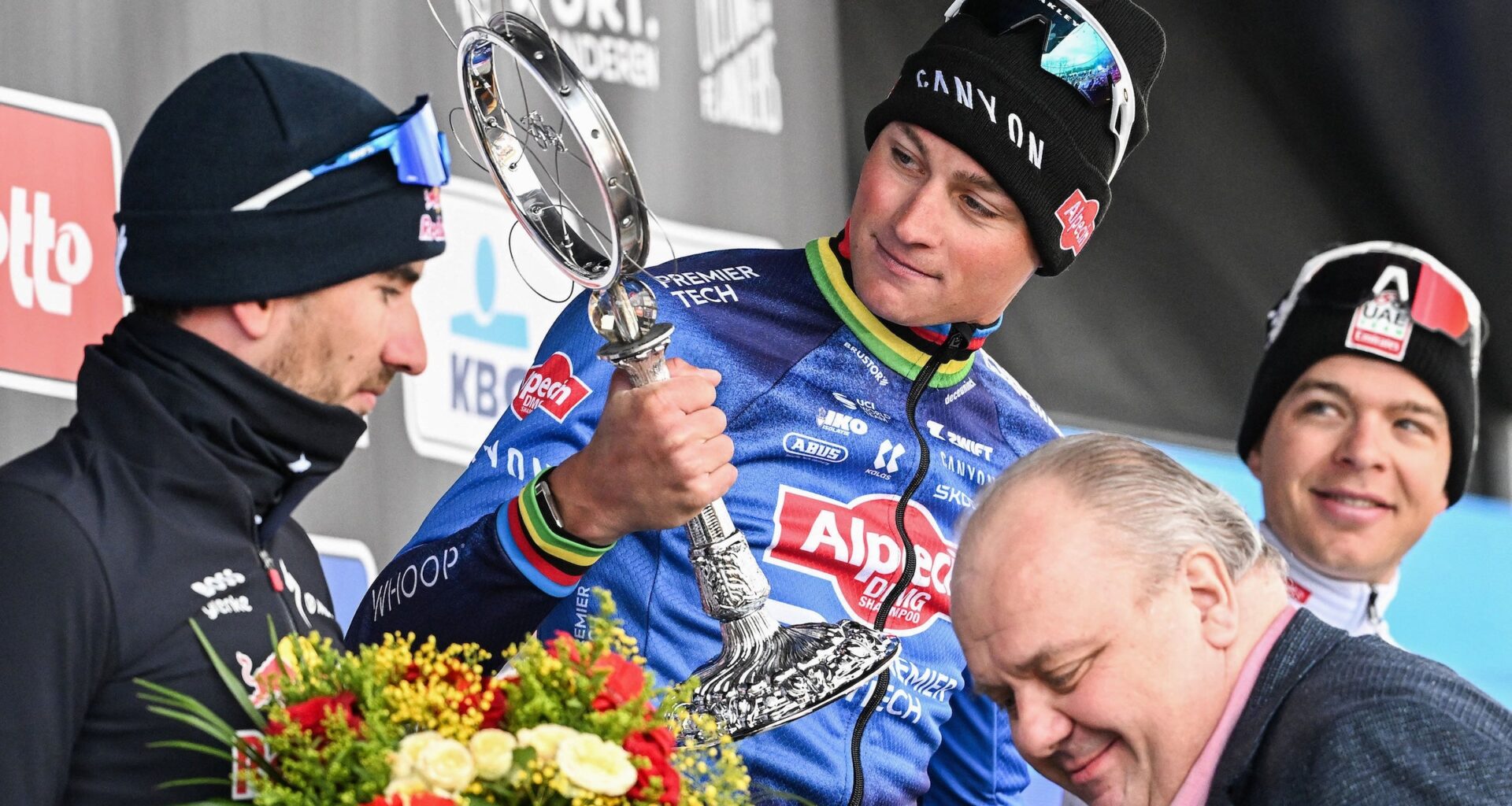
Kuurne winner not worried about bizarre statistic and mulls career longevity in the pro peloton.
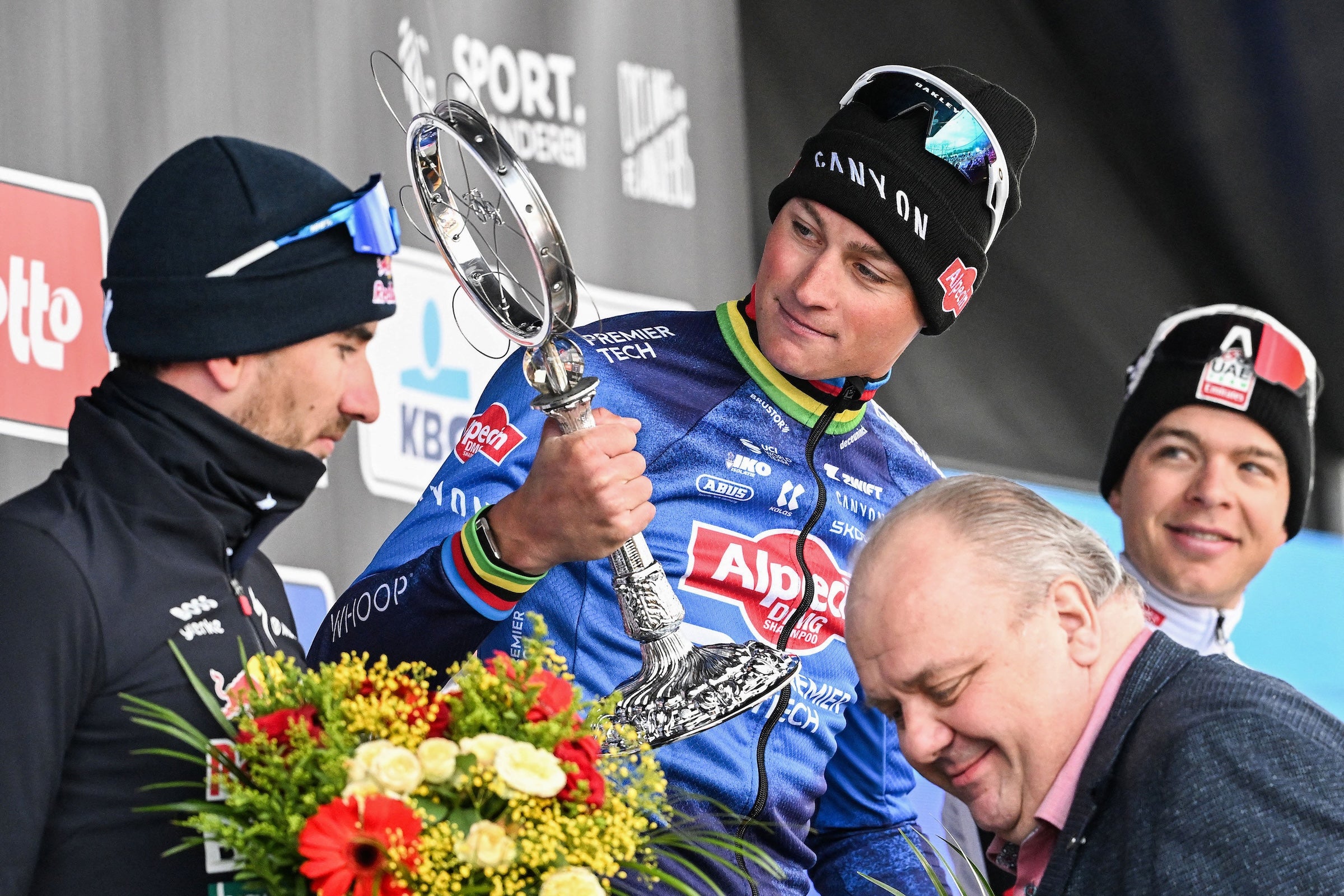
Alpecin-Premier Tech rider Mathieu van der Poel celebrates after winning the 81st edition of the men’s Omloop Het Nieuwsblad (Photo: Maarten Straetmans / Belga / AFP)
Updated March 1, 2026 02:50PM
Perhaps it’s because Mathieu van der Poel has been already setting new records this winter, but the Dutchman has said he is unconcerned about a particular historical stat that has hampered winners of the Omloop Nieuwsblad.
On Saturday he became the first person to win the men’s race on their debut in 25 years.
Doing so adds to an already formidable palmares, but there is a potential issue: nobody in the 81 year history of the Omloop has gone on to win the Tour of Flanders in the same year.
It’s an unexpected statistic: the Omloop takes in the same type of terrain, and indeed uses the iconic Muur climb which for many years was a key point in the Monument.
It would be expected that the type of rider who wins the first event would be ideally suited to go on to take the second.
Still, the stats are the stats and, on paper at least, winning on Saturday somehow makes a Flanders win less likely this year.
Is Van der Poel concerned about such a pattern?
“Not at all,” he said laughing. “I’m just happy to win this race.
“My big goals are again Flanders and Roubaix. Everyone knows how strong Tadej is there, but I’ll do what I can to be in my best possible form and then we’ll see.”
Altitude considerations
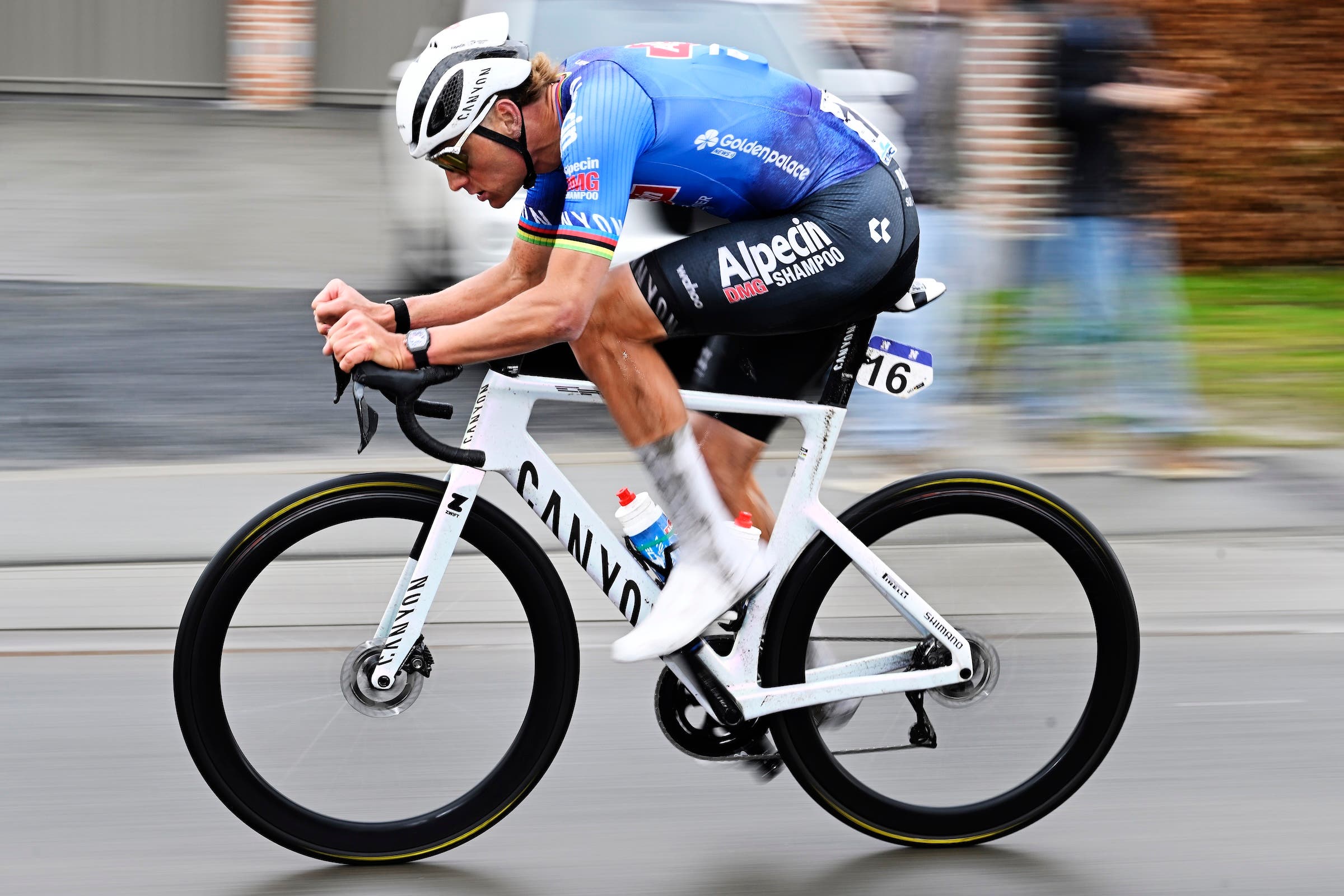 Mathieu van der Poel took a solo victory at the Omloop Het Nieuwsblad on February 28 2026 (Photo by Nico Vereecken / Photonews)
Van der Poel has already taken Flanders on three occasions, triumphing in 2020, 2022 and 2024. He was beaten by Tadej Pogačar in 2023 and 2025, with the course proving tough enough for the Slovenian’s climbing abilities to outweigh Van der Poel’s explosivity.
Barring injury, the duo are set to go head to head again this season in that, Roubaix and other races such as Milan San Remo.
Van der Poel is clearly going very well, as shown by his 100 percent win rate in his winter cyclocross program and by his dispatching of his rivals on Saturday.
As for Pogačar, he is yet to compete this season and while he has been training very hard, the full picture won’t be seen until he lines out in Strade Bianche next Saturday.
Van der Poel won’t compete there: instead he will do Tirreno Adriatico and then have his first clash with Pogačar at Milan San Remo.
Speaking after Saturday’s race, he confirmed that he won’t be doing a training camp at altitude before then.
“I’m just staying here,” he said, according to Wielerflits. “I feel comfortable with this preparation, the way I’ve done it all these years, so we’ll stick to that.”
‘I still have some margins’
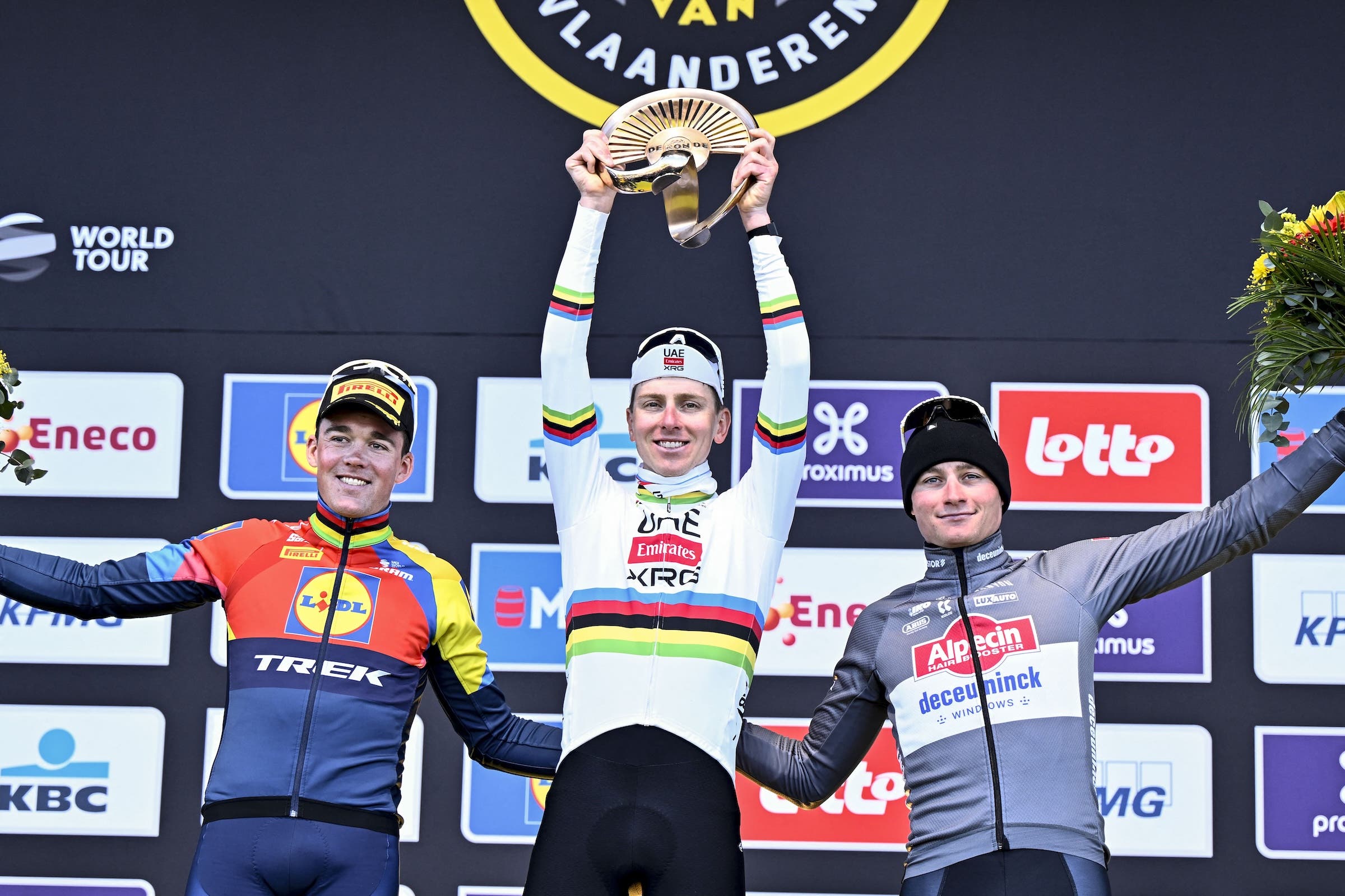 Pogačar beat Mads Pedersen and Mathieu Van der Poel to win last year’s Tour of Flanders (Photo: Eric Lalmand / Belga Mag via AFP)
Van der Poel is now 31 years of age, almost four full years older than Pogačar. Athletes are generally said to peak around 28 years of age, but Van der Poel suggests that there are still improvements to be found.
“Now that I am getting older, the engine gets bigger, so you can also train more and harder,” he said. “It is no secret that I enjoy hard training and long days.”
Indeed, asked if he is better at 31 in terms of resilience and his engine, he agreed.
“Yes, I think so. It is part of the growth I have gone through.”
However he suggests that the younger generation of riders may not have the same duration of improvement.
“Cycling is changing too; when I see what guys of 19 or 20 years old are already doing now, I wasn’t doing that at that age. That explains why I still have some margin at this moment, but honestly, I don’t see that happening with the new generation.
“If you already train 30 hours as a junior, it is difficult to make progress as you get older. But that’s how cycling is nowadays; they are already at an impressive level at that age.
“I’m not saying it’s bad, it’s just different from when I was that age.”
Van der Poel’s assertion has a certain logic to it. What’s fascinating is that Pogačar could be considered part of the new wave, in terms of working very hard as a young rider, and finding huge success at an early age.
After all he took the Tour de France at just 20, making him the second-youngest rider ever to win the race.
Will he keep improving compared to his level of the past two seasons, or will a plateau and then a gradual decline in level begin to kick in? If so, will that happen sooner than Van der Poel’s own career starts to lose pace?
It’s a fascinating thought, two different approaches to the sport and how those might affect the longevity of each career. So too their performances this season and beyond.