
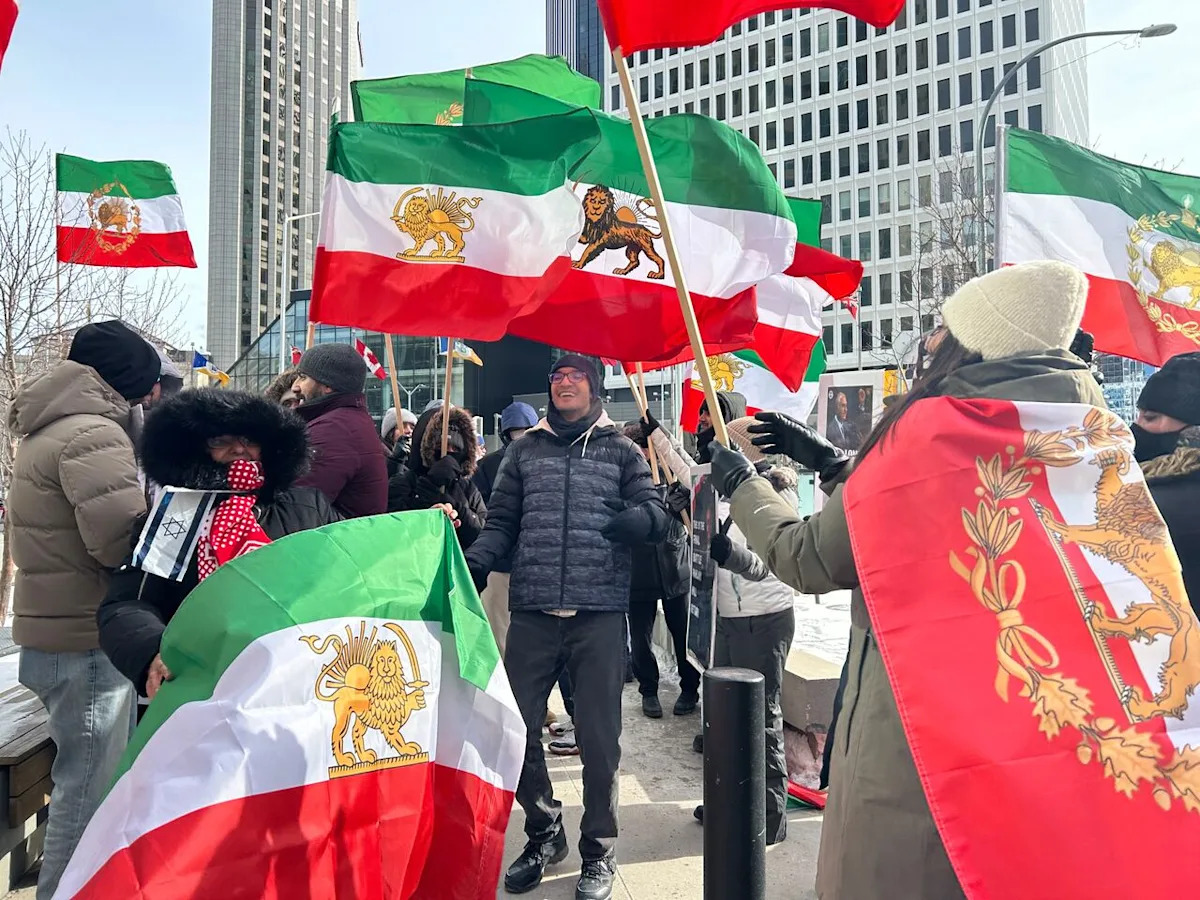
Some Iranians living in Winnipeg continued celebrating throughout the weekend after Iran’s Supreme Leader Ayatollah Ali Khamenei was killed in a joint attack launched by the U.S. and Israel.
Iranian state media announced that 86-year-old Khamenei, who had ruled the country for 36 years, died on Saturday amid air strikes on his central Tehran compound. The U.S. military said the headquarters of Iran’s paramilitary Islamic Revolutionary Guard Corps (IRCG) was also destroyed in an airstrike.
Iran has retaliated with missile and drone attacks on Israel and several neighbouring Persian Gulf countries that have a U.S. military presence.
Shahla Shojaei, a member of the Iranian Monarchists Of Manitoba who helped organize a rally near Portage Avenue and Main Street in Winnipeg on Sunday, said she and many other Iranians across the diaspora welcomed the foreign intervention.
She said they’re are feeling hopeful that Khamenei’s death will end the Islamic republic regime.
“I was just happy. I can’t hide it that I was happy,” she said. “[From the] bottom of my heart, I couldn’t believe that he really died.”
Shojaei said she saw videos online of Iranians dancing and cheering in the streets after the news broke on Saturday — before another internet blackout in Iran.
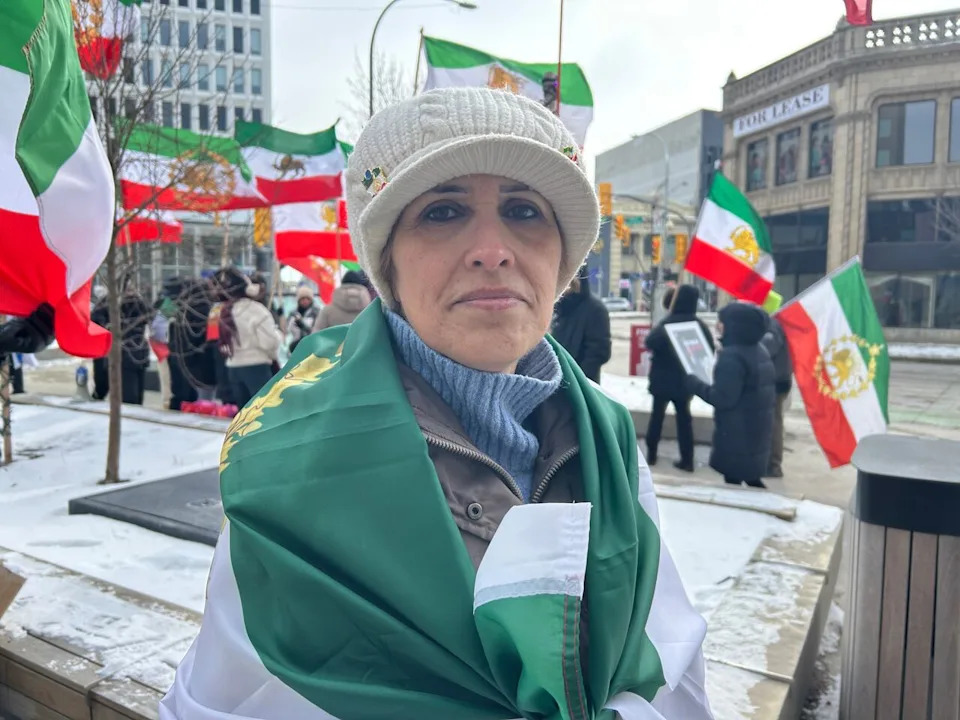
Shahla Shojaei, a member of the Iranian Monarchists of Manitoba, says reports of Ayatollah Ali Khamenei’s death have her feeling hopeful for future regime change in Iran. (Gavin Axelrod/CBC)
Shojaei said she hopes Reza Pahlavi, the exiled son of Iran’s last shah, will come to power in the wake of the strikes to lead a transitional government toward democracy.
“I feel that it will be a very good opportunity to get rid of this brutal regime and for a return of the Pahlavi dynasty to Iran,” she said.
“Iran will have a very good future and prosperity and freedom will be back to Iran.”
Iran’s state media says 57 people were killed in Tehran during the first 24 hours of air strikes. The U.S. said Sunday that three members of its military have died.
Canada can’t support this, protesters say
But some Manitobans are condemning the U.S. and Israeli aggression, saying the attacks were yet another violation of international law by the Trump and Netanyahu administrations — and accusing the Canadian government of being complicit.
About 40 people gathered outside the U.S. consulate in Winnipeg about an hour before the monarchists group gathered at the same location on Sunday.
“We can’t have the Americans and the Israelis going around as the world police, assassinating leaders,” said Candice Bodnaruk with Peace Alliance Winnipeg, which organized the rally.
“We’re seeing chaos. We’re seeing a complete world order falling apart if we allow that,” she said, expressing worries that a wider war could possibly break out in the region.
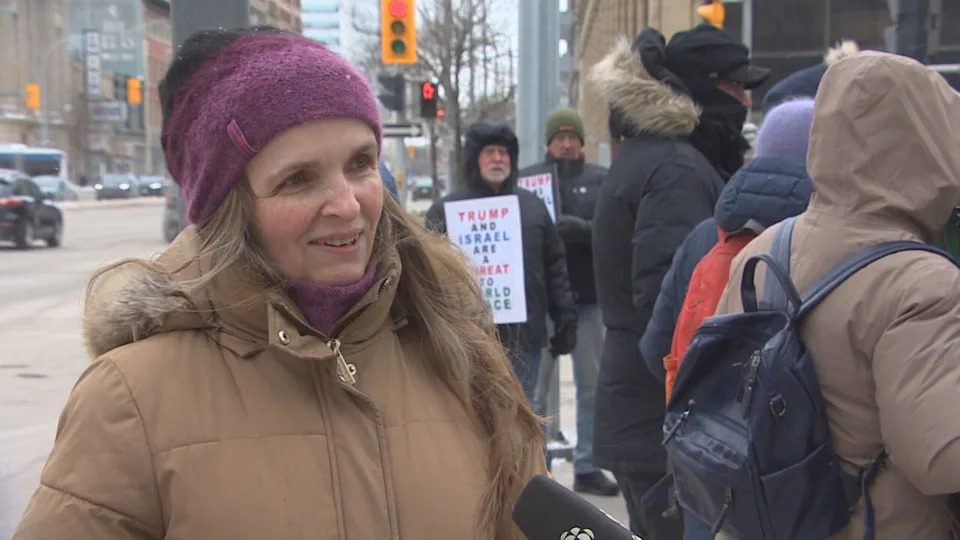
Candice Bodnaruk with Peace Alliance Winnipeg condemned joint United States-Israel attacks on Iran at a rally in Winnipeg on Sunday. (Prabhjot Singh Lotey/CBC)
On Saturday, Prime Minister Mark Carney said he supported U.S. action to prevent Iran from obtaining a nuclear weapon. Carney said in a statement that despite diplomatic efforts, Iran failed to dismantle its nuclear program or end support for “terrorist proxy groups” in the region.
Bodnaruk said she’s disappointed the Canadian government is backing Trump.
“Canada … claims to support human rights and is also, you know, a signatory to all these [United Nations] conventions,” she said. “We cannot just stand by as they invade these countries over and over again.”
Hussein Chokr, who’s Lebanese, said Iranians will not be the only people impacted.
“I’m being affected by it. My people are being affected by it,” he said at the rally. “Sooner rather than later, this is going to … spread to other countries.”
Attacks have no basis in international law: professor
Nathan Derejko, assistant professor of law at the University of Manitoba specializing in international human rights law, told CBC News the attacks come amid an erosion to the rules that are supposed to govern use of force in international conflicts.
Derejko pointed to the UN Charter, which prohibits the use of force against member countries unless it’s for self-defence or if its allowed by the Security Council.
“There’s no legal basis to say that there was an imminent armed attack going to happen against Israel or the United States that would justify [self-defence],” Derejko said. “Because the United States sits on [the Security Council] and has a veto, it’s rendered inoperative a lot.”
Derejko said there’s no basis in international law for regime change “no matter how horrible the government is.”
He said as a third state, Canada has an obligation to make sure those laws are observed. He said Carney’s decision to back the U.S. was “shocking” given his widely-praised Davos speech that called for middle powers to come together amid a decline in the U.S.-led, rules-based international order.
“He even spoke specifically to the use of force under the UN Charter and said that we must respect the UN Charter,” Derejko said. “Then here it is … not long after and he’s singing an entirely different tune.”