

Listen to this article
Estimated 5 minutes
The audio version of this article is generated by AI-based technology. Mispronunciations can occur. We are working with our partners to continually review and improve the results.
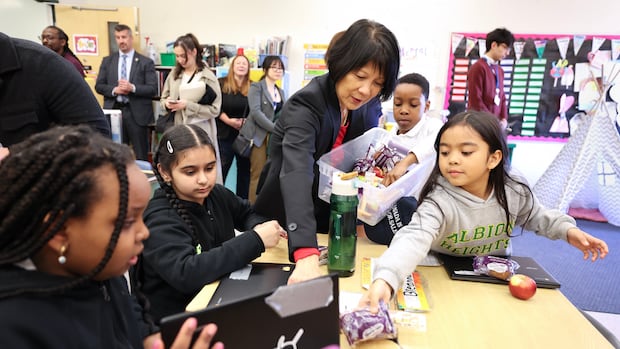
Toronto Mayor Olivia Chow is a step closer to realizing one of her top priorities, after the city won an international innovation challenge that will help it create a community food hub pilot project.
In the document laying out the mayor’s 2026 budget, the first initiative mentioned is the city’s school food program, touting an expansion of a free morning meal from 73 to 228 schools. The ultimate goal is to achieve a universal lunch program by 2030.
The city now has an extra $1.4 million to get there, with expert advice to go along with it, courtesy of the 2026 mayor’s challenge contest by Bloomberg Philanthropies.
Toronto is one of 24 cities that won the innovation challenge out of more than 630 applicants.
“We’re not just feeding kids, we’re rebuilding how food gets to them,” Chow said last Tuesday at an announcement about the award. “Buying in bulk, cutting costs, supporting local farmers, and creating jobs for parents and community members right here in our city.”
WATCH | The program feeds hundreds of Toronto students: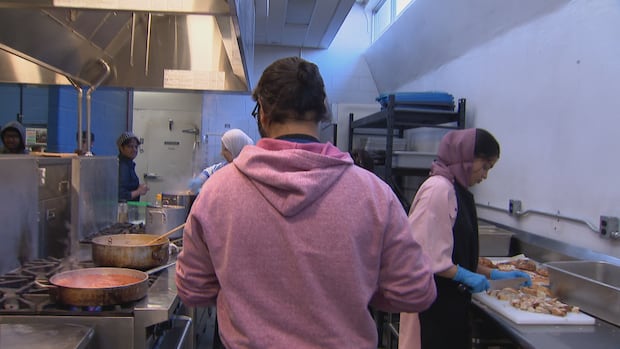
How this school food program feeds hundreds of Toronto students
Students at Thorncliffe Park’s Marc Garneau Collegiate Institute are learning in more than just a traditional classroom. Volunteers are in the kitchen, learning how to cook sustainable meals. It’s all part of a breakfast and lunch program, which services hundreds of students in the school while also meeting the needs of a diverse student population.
The prize money will help the city with the logistics of creating the food hub that’s supposed to do all that, but funding from higher levels of government will remain a fundamental piece towards actually achieving the 2030 goal.
What is a school food hub?
The school food hub idea is essentially about using the sheer scale of the project — getting a free morning meal and lunch to every student in Toronto — to its advantage.
“Think about every school in town, think about if they were all local restaurants,” said Debbie Field, national coordinator for Coalition for Healthy School Food, the country’s largest school food advocacy network.
“Obviously they’re not going to get the best price. But when you can consolidate this and can show a supplier that you’re buying for a multitude of schools, you can get a better price.”
Field, who worked with the mayor’s office on its application for the prize, said that bulk buying not only drives down costs, but makes it easier to source the food from within Ontario.
She said there may be an apple farmer who would never drive into Toronto to deliver to one school, but could now truck in crates of apples to be delivered somewhere that has distribution infrastructure, like the North York Harvest Food Bank. The food bank could then divide the shipment up into smaller deliveries within the city.
“So, we’re going to be able to increase the quality of the food, the local food and get a better price,” she said.
While the food hub may sound like one location, Field said it may actually need to be several spread out across a city that’s as big and congested as Toronto.
At the North York Harvest Food Bank, executive director Ryan Noble said the pilot project will also be an opportunity to demonstrate how delivering a school food program in partnership with a non-profit like his can also create jobs.
WATCH | Canadian food banks record millions of visits: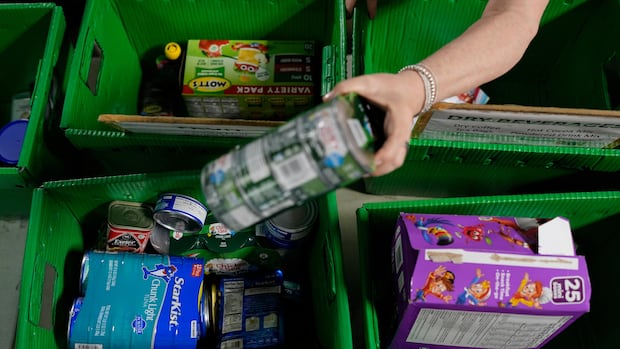
Canadian food banks record over 4 million visits this year
The Daily Bread Food Bank in Toronto is seeing a spike in young adults, between the ages of 19 and 44, in need of a food bank. The CBC speaks with the food bank’s CEO, Neil Hetherington.
The North York food bank has a program where people who come to get food can sign up for warehouse job training, earn a forklift licence and get work with the non-profit’s private sector partners.
Other levels of government needed to achieve goals
When it comes to achieving Chow’s vision, Field said the city will need financial help from higher levels of government.
In 2024, the federal government announced it would spend $1 billion over five years to work with provinces on implementing a school food program. Prime Minister Mark Carney’s first budget includes plans to give the program permanent funding of $216.6 million.
In October, the provincial government added $5 million in spending to its student nutrition program, bringing it to a $37.5 million total spend for 2025.
According to a Toronto Public Health presentation from last year, in 2024-2025, the city received $4.7 million in federal funding and $8.5 million in provincial funding for school food programs. That left the city as the largest funding source at $21.9 million, which was upped to $32 million in the 2026 budget.
Field said her organization will be advocating for those provincial and federal numbers to be higher.
“We say sometimes it takes a village to feed a kid,” Field said. “This is true. This is not any one government’s responsibility. Everybody plays a role in this.”