
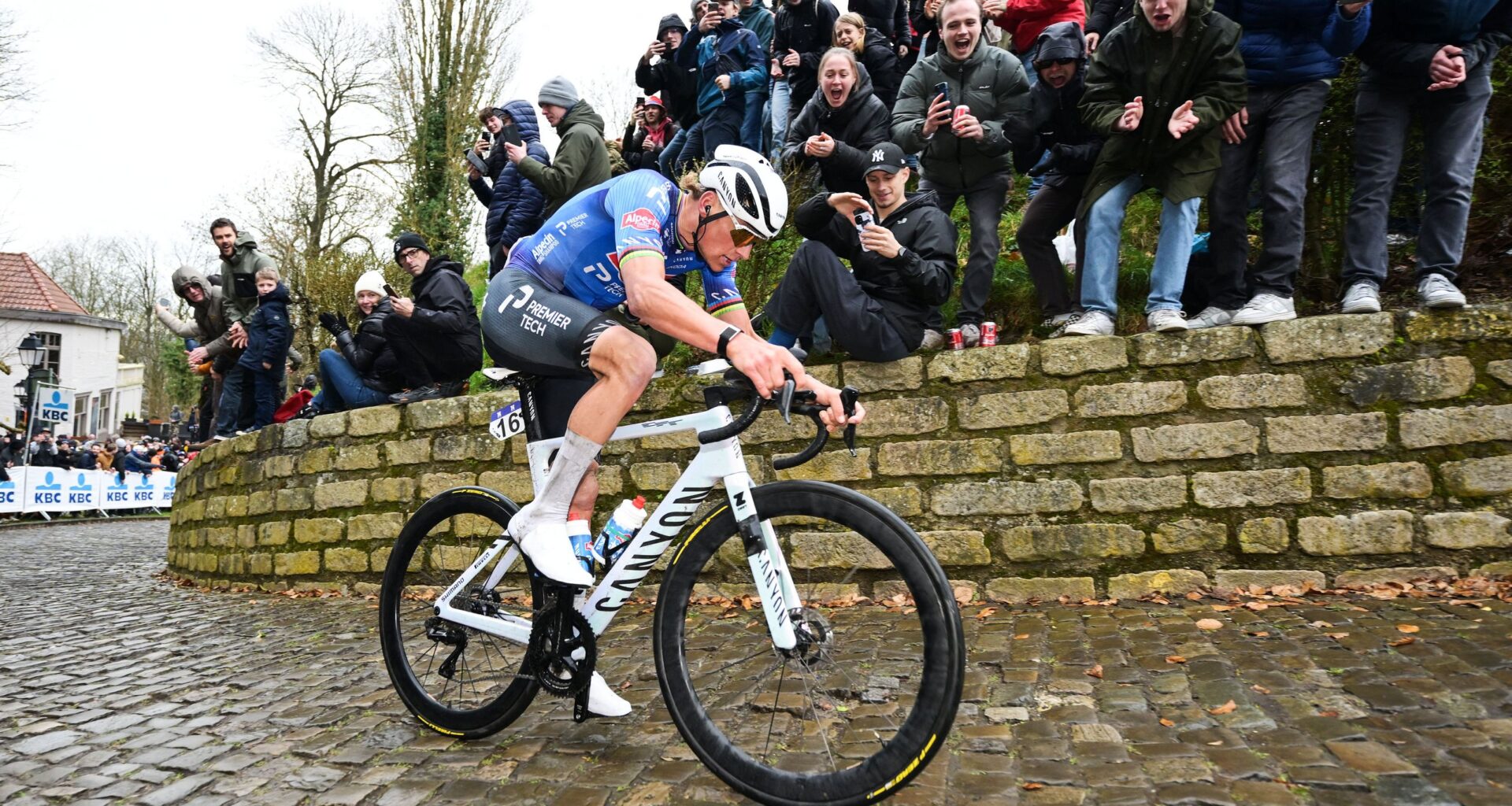
The cobbled Classics season officially got underway at Omloop Het Nieuwsblad and Kuurne-Brussel-Kuurne this weekend, and given its traditional role as an indicator of the shape of things to come, there’s always plenty of room for interpretation and speculation.
Even before the riders stepped out into the arena at Ghent velodrome on Saturday morning for one of the most spectacular settings possible for a race presentation, Wout van Aert’s last-minute absence from Omloop was already making the headlines in Belgium. And so, too, was the not-quite-so-surprising addition of Mathieu van der Poel to the men’s line-up.
You may like
Mathieu van der Poel is already on course to fight against Tadej Pogačar
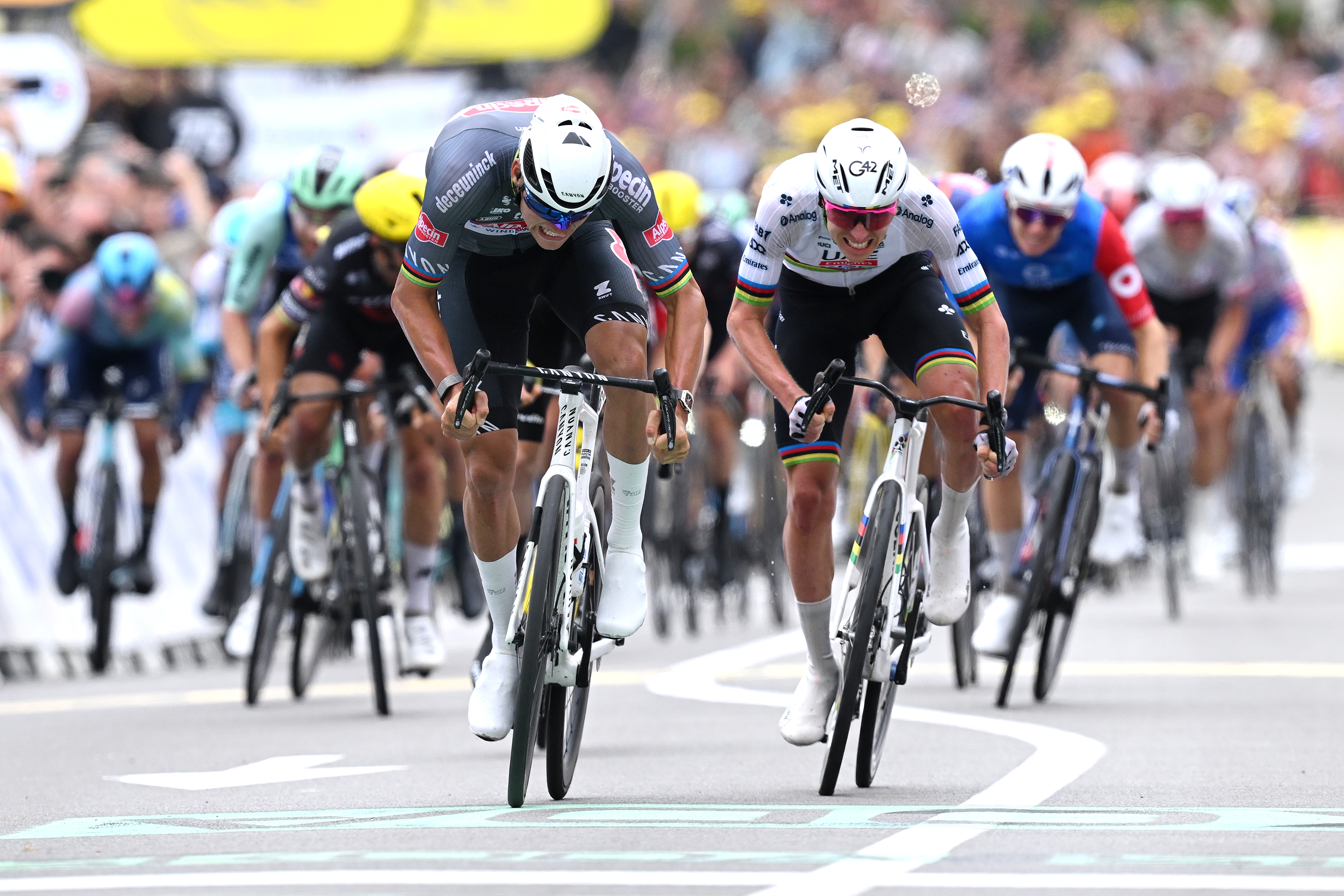
A sign of what’s to come at the Classics between Pogačar and Van der Poel (Image credit: Getty Images)
After winning every cyclo-cross race he took part in this winter, right up to his record-equalling World Championships, it seemed only logical that Mathieu van der Poel would be in top condition for the Omloop Het Nieuwsblad.
After all, had he not been confident of his chances or form on the cobbles this Saturday, he’d likely never have announced his late participation. Only one result counts when you are a stand-out favourite, and on Saturday Van der Poel was certainly that.
Yet at the same time, for all the sense of inevitability produced when Van der Poel opened up a gap of 20 seconds in no time at all on the Muur van Geraardsbergen and then disappeared from his rivals in a cloud of dust and smallish pebbles, riding a Classic as difficult as OHN remained new territory for Van der Poel – at 31, a gap in his palmarès that needed filling for some time – and that always produces something of a question mark. So too, did the fact that the Alpecin-Premier Tech rider was racing on the road for the first time this season and that all his rivals would be, on paper, at least as fresh as he was.
As a result, you might argue that perhaps the gap could not be as large as in other events later in the season when legs are more tired, and Van der Poel’s outrageous victory margins are likely even greater.
Furthermore, Van der Poel said later that he had planned to launch his race-winning move on the Geraardsbergen, ‘only’ 16 kilometres from the finish and being such a short distance – for Van der Poel and Pogačar – perhaps an indication of a slight degree of uncertainty about how well he’d perform on the day.
You may like
Obviously, no one was taken in by Alpecin-Premier Tech boss Christoph Roodhoft’s pre-race claims that nobody, including Van der Poel, would be strong enough to go clear alone. But it wasn’t quite as automatic as it can be when Pogačar isn’t around and barring a disaster of some kind, that he would win, either. And wobbles and major glitches can happen even to the super galacticos of modern cycling, as Remco Evenepoel (Red Bull-Bora-Hansgrohe) and Jonas Vingegaard (Visma-Lease a Bike) know only too well after Remco’s Middle Eastern mountain glitches and Vingegaard’s delayed season start.
However, Van der Poel has hit the highest of high notes from the word go, and not just because of his ultra-deft zip around a fallen Rick Pluimers (Tudor) on the Molenberg, even if that was really when the fireworks started.
Rather, it was his willingness and confidence about changing his own plan to the race circumstances, and that wasn’t to make it easier for himself, either. In fact, it was to open up a gap much earlier than expected, with 42 kilometres to go on the Molenberg with Tim van Dijke (Red Bull-Boras-Hansgrohe) and Florian Vermeersch (UAE Team Emirates-XRG) rather than wait for the Muur de Geraardbergen.
Whether he felt better than expected or simply noted his rivals were not as on-song as they might have been, once he was ahead with Vermeersch, Van der Poel had no problem switching lanes to go from distance for the win.
Equally importantly, having clinched one of the few top Classics still missing from his palmares, he did not take too many risks and go too deep by going for a second victory in Kuurne-Brussels.
It’s true that Milan-San Remo, the Tour of Flanders and Paris-Roubaix, the three Classics where Van der Poel will have his big 2026 showdown, are still far away. But when it comes to Van der Poel’s challenges against Pogačar, such a standout performance so soon is bound to have been noticed in the UAE camp.
Van der Poel has already shown he is back where he needs to be to challenge Pogačar in April. And with margin to progress between now and the end of March, regardless of how well Pogačar does at Strade Bianche this weekend, it’s clear after Omloop that the Slovenian will once again have a real fight on his hands against the Dutchman in San Remo and once again much further north. Not that anybody is complaining about that.
Demi Vollering makes an even bigger statement of intent than at Strade 2025
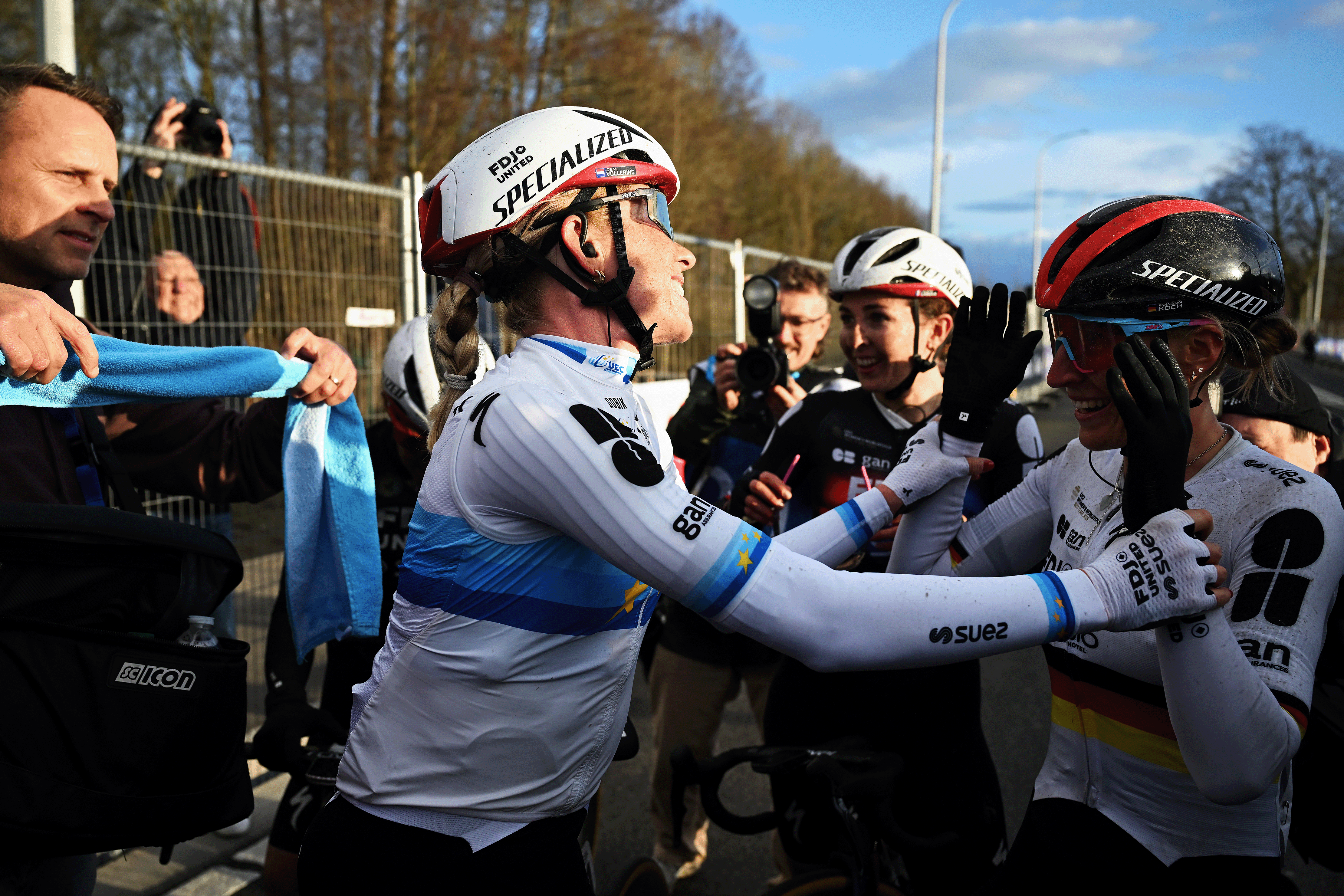
Vollering celebrates with team MVP Koch past the finish line (Image credit: Getty Images)
If you rewind 12 months to Strade Bianche for a moment, when Demi Vollering out-powered former teammate Anna van der Breggen (SD Worx-Protime) to take her first major victory for FDJ United-SUEZ, Vollering was already singing the praises of her new squad and how much support they were able to give her.
The point was that Vollering did not win on strength alone. Thanks to dedicated teamwork from Juliette Labous and Évita Muzic to shut down the efforts of rival squads that, up until that March, had got the better of the French team, Vollering had much more fuel in the tank left when she went clear and then subsequently comprehensively out-duelled Van der Breggen. It wasn’t that she had victory in Strade handed to her on a plate – on a course as difficult as that, it really couldn’t ever be – rather it was that much more assured, and collective, a victory.
Back to 2026 and once again, we had Vollering in unstoppable form in her first race, the Setmana Valenciana. But rather than wait until Strade Bianche for her first big WorldTour victory like in 2025, this time it’s come a week earlier and in an event which Vollering had never previously managed to win in five previous participations. And once again, she was keen to underline the level of comprehension between herself and her teammates, with Elise Chabbey in the leading group and new teammate Franzi Koch giving her ‘the perfect leadout, so hard I hardly had to do anything’ on the Muur.
Omloop is often taken as a pointer for the rest of the Classics, and the first thing it indicates for Vollering is that she’ll be in pole position for a third win in four editions of Strade Bianche on Saturday. But secondly, if Strade showed last year that the team was quickly ironing out any wrinkles following her change of squad, this time round, they are barely visible at all. All of which will give other powerhouse Classics teams like UAE Team ADQ and SDWorx-Protime a great deal of food for thought in the days to come.
One missed opportunity for Lotte Kopecky will only make her hungrier in the Classics to come

Kopecky during Saturday’s race (Image credit: Getty Images)
With nine top Classics on her calendar between February and the end of April, all of them bar two (Nokere Koerse and Dwars door Vlaanderen) at WorldTour level, Lotte Kopecky’s return to a more traditional one-day race program is bulging with top events to shine in. But in her first event of the year, on home soil in a race she won in a solo move back in 2023, at Omloop 2026, the 30-year-old SDWorx-Protime leader was unable to put on a show.
A crash at the worst moment possible, just before the crunch climb of the Muur de Geraardsbergen, left Kopecky out for the count. Unable to get back on terms, Kopecky was unable to even try to chase down Kasia Niewiadoma-Phinney (Canyon-SRAM zondacrypto) and Demi Vollering (FDJ United-SUEZ) when they attacked.
So what we were left with – and in Omloop’s crash-fest for the men and the women, this was true for so many teams – was a big question mark, rather than a defeat.
Vollering and Niewiadoma were clearly on a great level, but it’s not at all clear what Kopecky might have achieved under other circumstances. You could argue, though, that limiting the damage in her first race of the season with a top 20 finish – she was 18th in Ninove – was certainly a step in the right direction. And with eight more one-day races to set the record straight, Omloop has been just one event of many where Kopecky’s real level can be judged.
The biggest test of all, most likely, will once again be in Belgium, at the Tour of Flanders, the one major highlight of her below-expectations 2025 season. And after the setback of Omloop, Belgium’s second biggest cobbled Classic, there’ll likely be a sense of unfinished business too, and showing what she can do on the same kind of terrain when there aren’t any crashes to hinder her and in the biggest Belgian race arena of them all.
Much was made of how the FDJ United-SUEZ domination has left top rival squads like SD Worx-Protime trailing a little, but actually, it’s worth noticing that Kopecky’s teammate Lorena Wiebes did exactly what was expected of her and claimed her umpteenth sprint victory, albeit in this case only for third.
Rather like Pogačar and Van der Poel, anything less than a top performance in a sprint for Wiebes is so unusual it automatically feels like something is missing in the natural order of things. But if filling the last place on the podium was realistically Wiebes’ best option, the world’s top sprinter has clearly made the transfer from crushing domination in the flat finales of the UAE Tour Women to the much tougher arena of Omloop once again. In a word, chapeau.
Visma-Lease a Bike get a much-needed boost to collective morale

Brennan and Laporte celebrate the much-needed victory in Kuurne (Image credit: Getty Images)
Context is everything, in cycling as in any other walk of life, and the sight of UAE sprint dominator Jonathan Milan trailing along gloomily in the wake of the main group at Kuurne-Brussel-Kuurne, or Arnaud De Lie’s repeated absence from the front running on both Saturday and Sunday were both timely reminders of how rapidly a Classics campaign can get off to a resoundingly wrong foot.
In the absence of Mads Pedersen, Lidl-Trek’s star rider on Sunday was, somewhat improbably, the untested (yet very promising) 19-year-old Spanish rider, Hector Alvarez, who managed to break off the front for a couple of kilometres in the run-in to Kuurne. But bouncebacks are possible, and after their challenging Omloop, yet another major Classics player, Visma-Lease a Bike, found themselves back in the thick of things thanks to Matthew Brennan.
Just a year older than Alvarez, but already with 13 wins in his palmares pre-Kuurne, a Brennan victory is no longer a surprise, particularly given his tried-and-tested ability in 2025 to get over some tough climbs or stretches of cobbles and still have enough energy to go for the sprint.
What was equally impressive from Visma-Lease a Bike was their deft handling of the race all the way to the finish line in Kuurne, both whittling out the Milans and De Lies of this world and simultaneously keeping the breaks under control on the front. Even without Matteo Jorgenson, for the last two years one of their powerhouses for the Opening Weekend, a newly revived Christophe Laporte – fourth on Saturday as well in an impressive step back in the right direction in his first Spring Classic in over a year – was able to step up to the break. But so, too, were lesser-known riders like Timo Kielich and Matisse van Kerckhove.
Then there was Brennan. Despite his tough Omloop, the Briton’s insistence that he would take part in Kuurne despite a badly mauled left arm spoke volumes about his tenacity and resilience, even at 20. And for a squad that has had one setback after another this spring, starting with Van Aert’s cyclo-cross injury and the sudden retirement of Simon Yates, to the departure of a top trainer and Vingegaard’s crash and delayed season start, as well as Van Aert’s spell of late sickness, that can only be inspirational.
Is it too much to predict a top performance by Brennan at Milan-San Remo should the unthinkable happen and Pogačar and Van der Poel, together with Jasper Philipsen, somehow cancel each other out on the Poggio? Probably, given his inexperience in a Classic nearly 100 kilometres longer and with a much deeper field than at Kuurne. But, apart from the current doubts about Van Aert’s condition and Jorgenson’s absence from the cobbled Classics, Brennan’s one-handed victory salute was just the message Visma needed both internally and externally right now to keep moving forward.
Crashes played too big a part in deciding the final outcome of the Opening Classics
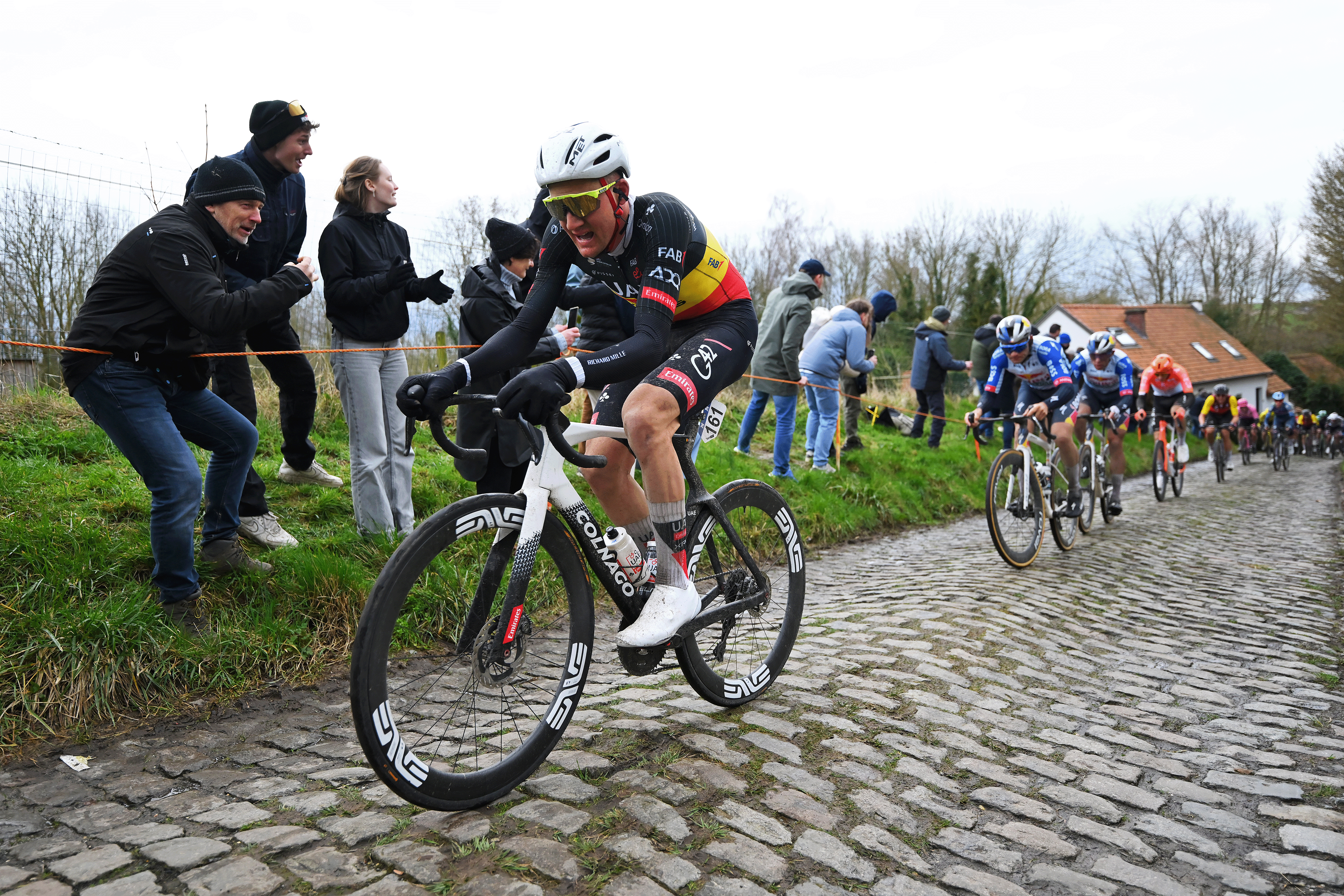
Pogačar has lost a key helper for the Classics with Wellens crashing out (Image credit: Getty Images)
39 abandons in Omloop Het Nieuwsblad men’s race and 28 in the women’s event were a grim toll even for races run off in the most traditional of Belgian spring Classics weather – incessant rainshowers, gusting winds and very chilly temperatures, particularly on Saturday. And from Rick Pluimers (Tudor) dramatic, tooth-loosening accident on Saturday at the foot of the Molenberg and Mathieu van de Poel’s bike through to Tim Wellens (UAE Team Emirates-XRG) reeling with pain across an anonymous waterlogged field in central Flanders, too often, images of crashes became the most memorable moments of the Opening Weekend.
The list of serious injuries was far too long in general, including Stefan Küng (Tudor) and Ben Swift (Ineos Grenadiers), Flanders and San Remo podium finishers respectively, both of whom are out for the count – thanks to a broken femur in the Swiss rider’s case and a busted pelvis for the Briton. Wellens, too, is likely to be missing from much of the spring with a broken collarbone and will be sorely missed by Tadej Pogačar as a key lieutenant. Not for nothing did riders as tough as Arnaud De Lie (Lotto-Intermarché) complain of the ‘most dangerous Omloop I’ve ever ridden.’
The question of why there were so many crashes is possibly as simple as the poor weather, as Pinarello-Q36.5’s CEO Doug Ryder – whose riders also knew their fair share of crashes and misfortunes, including Tom Pidcock – told Cyclingnews. But it was horrendous all the same.
“There’s a lot of pressure on riders to perform and teams to perform, but there was a lot of inclement weather yesterday [Saturday],” Ryder said. “They were super-cold, so they make mistakes, so they’re not in 100% control of their bikes, and the speed is high. And teams want to have a good start as well. But I don’t think it’s anything untoward from anything else, other than slippy roads, and sometimes you can get the tyre pressures wrong.
“There’s nothing that we as a team are doing differently; we were just lucky that we were on the right side of those incidents. I’m just so sorry for a team like Tudor, they had six riders on the floor.
“There was no reckless riding; it’s just the complexity of racing in challenging racing conditions. And it’s not nice to see so many guys on the ground, not this time of year.”
Other experienced former racers and directors like Jayco-AlUla’s Tristan Hoffman, a top-five finisher in Roubaix and the Tour of Flanders in his time, and a winner of Dwars door Vlaanderen and Veenendaal-Veenendaal, argued that a lot of it was down to nerves, freshness and the weather, as well.
“It’s the first race in Belgium, everybody’s quite sharp and tense, and then the roads are wet,” he told Cyclingnews. “I think it’s a combination of the weather conditions, the turns in the roads and the pressure – but I’ve never seen so many crashes in a race before.”
It remains to be seen if the trend continues, of course, but if Omloop is traditionally taken as a pointer for the rest of the Classics season, this is one bad omen nobody wishes to see repeated in the near future.
Get unlimited access to our unrivalled 2026 Spring Classics coverage with a Cyclingnews subscription. We’ll bring you breaking news, reports, and analysis from some of the biggest races on the calendar, including Milan-San Remo, Paris-Roubaix and the Tour of Flanders. Find out more.