

Listen to this article
Estimated 3 minutes
The audio version of this article is generated by AI-based technology. Mispronunciations can occur. We are working with our partners to continually review and improve the results.
New Brunswickers will wake up to a morning treat on Tuesday — a lunar eclipse.
But the event will only be witnessed by early risers. Amateur astronomer C.J. Bernard of Neqotkuk, or Tobique First Nation, will be one of them.
Bernard said something interesting about this eclipse, which will only be partially seen in New Brunswick, is that, for a short period during it, the sun will be rising, causing a phenomenon known as a selenelion.
“These two don’t like to share the sky,” he said. “But the atmosphere is doing the small favours. It bends the light just enough to keep the moon hanging a little longer. That’s how you can see a partially eclipsed moon at the same time near sunrise.”
Lunar eclipses, unlike solar eclipses, take place over hours with different phases.
The first phase is when the moon passes through Earth’s faint outer shadow called the penumbra. At this phase, it’s pretty much impossible to notice any real difference in the moon’s brightness. This will start at around 4:44 a.m.
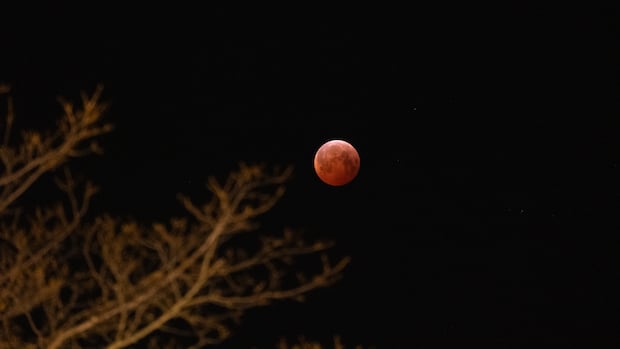
 Amateur astronomer C.J. Bernard will be watching for Tuesday morning’s blood worm moon. (Submitted by C.J. Bernard)
But at around 5:50 a.m., Bernard said people will start to notice. The moon will start to dim and turn a reddish colour.
Some parts of Canada will experience the eclipse’s totality, including Vancouver, where the entire moon enters that inner shadow, but it doesn’t disappear — often turning a reddish or orange colour as Earth blocks direct sunlight from reaching it, giving it the name the “blood moon.”
This eclipse could also be called a blood worm moon, since the first full moon of March is called a “worm moon.”
In New Brunswick, it will still have that blood moon effect, according to Bernard, but it will closer resemble a “burnt chocolate chip cookie.”
The best viewing window, he said, is right around 6:57 a.m., when the eclipse reaches the local maximum while the moon is still above the horizon.
Those west of Fredericton will have the best chance of seeing the eclipse, he said.
“You’re going to want a clear view of the west,” said Bernard. “Hills are good, trees are not and your neighbour’s shed will absolutely obstruct your view.”
While totality doesn’t begin until around 7:04 a.m., it will not be visible to New Brunswick residents.
According to TimeandDate, New Brunswickers won’t witness totality of a lunar eclipse until June 2029.
In April 2024, some parts of New Brunswick had a front row seat to a total solar eclipse. Ahead of that event, people were warned to get specialized eclipse glasses to avoid eye damage.
But lunar eclipses are safe to view with the naked eye.
Bernard said clouds could affect if people are able to see the eclipse on Tuesday, as cloud cover can obstruct the view.