
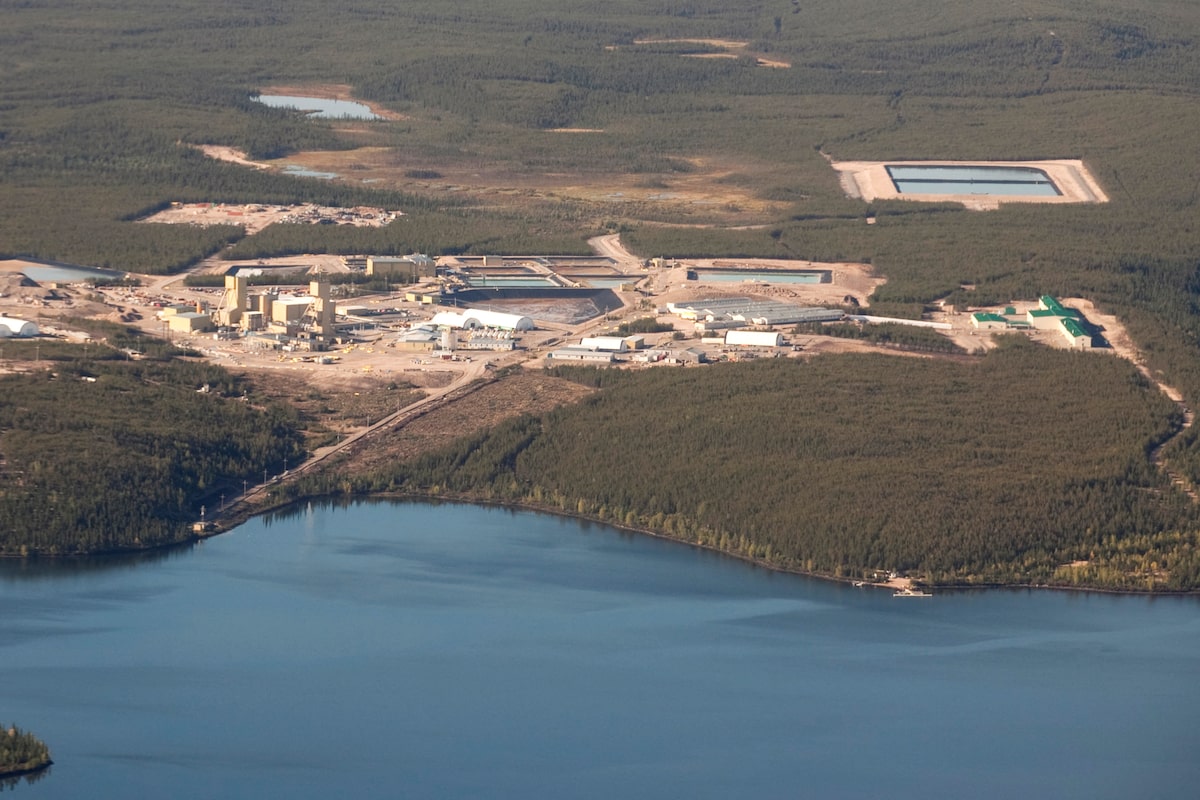
Denison Mines Corp.’s Phoenix mine, which is expected to begin producing by mid-2028, would be the first large uranium mine to enter production since Cameco Corp.’s Cigar Lake mine in 2014. The Cigar Lake mine site is shown in September, 2010.David Stobbe/Reuters
Two new uranium mines in Saskatchewan are poised to begin construction amid expectations of surging demand for nuclear fuel.
Earlier this month, the Canadian Nuclear Safety Commission issued Denison Mines Corp. DML-T a licence to construct a new uranium mine and mill known as the Wheeler River Project, located roughly 600 kilometres north of Saskatoon. The first phase of the project, the Phoenix mine, is expected to begin producing by mid-2028.
“We will start construction of Phoenix in March,” said Denison chief executive officer David Cates.
“But we’re only in that position because we worked tirelessly over the last seven years to get it permitted and to advance the engineering design, the procurement, the project financing.”
It would be the first large uranium mine to enter production since Cameco Corp.’s CCO-T Cigar Lake mine, in 2014. Denison recently revealed that Phoenix’s capital cost had increased to $600-million, up from roughly $420-million cited in a 2023 feasibility study. The company pitches it as one of the world’s few new large mines poised to come online this decade.
Carney secures $2.6-billion uranium supply deal with India, launches talks on trade deal
The Rook I project follows closely on its heels. In February the CNSC held public hearings to consider a licence application from NexGen Energy Ltd. for the proposed underground mine and mill in northwest Saskatchewan. A CNSC decision on the application is expected by June. NexGen estimated its capital costs at $2.2-billion in 2024, a significant increase from previous estimates, and said it would take four years to build.
Travis McPherson, NexGen’s chief commercial officer, said the company committed to build the mine years ago and is poised to begin work the very day it receives the licence. Equipment has already been purchased and detailed construction plans drawn up.
“We know exactly what we’re doing throughout the whole four years, day by day, week by week,” he said.
A proposed conventional surface mine, Patterson Lake South, is at an earlier stage. Its proponent, Paladin Canada Inc., reports it’s working on early engineering and design. Paladin has said the project would take three years to construct, and estimated capital costs at $1.6-billion. Paladin (formerly known as Fission Uranium Corp.) submitted its licence application to the CNSC in 2023 but hearings before the commission haven’t yet been held.
These proposed mines progress amid expectations of surging uranium demand and rising prices, following an extended period of painfully low prices that led to suspended operations and paltry investment.
Uranium’s geopolitical significance also seems to be mounting: on Monday Cameco unveiled a $2.6-billion agreement under which it will supply 22 million pounds of uranium to India between 2027 and 2035. (The company previously had a five-year uranium supply contract with India that began in 2015.)
Made in Canada: Inside an urban Toronto facility making uranium fuel for CANDU reactors
Uranium is used mostly to fuel nuclear power reactors, and utilities buy most of what they need well in advance through long-term contracts. Most reactors require uranium that has been enriched to higher levels of the fissile uranium-235.
The U.S. government seeks to shed its reliance on foreign uranium and enrichment capacity – a tall order. According to the U.S. Energy Information Administration, total production of uranium concentrate in the United States for the year ended Sept. 30 amounted to under 1.5 million pounds. The U.S. reactor fleet remains, for now, the world’s largest; owners and operators have purchased between 40 million and 70 million pounds of the stuff over the past 20 years. (China’s fleet is expanding rapidly and is expected to be larger than that of the U.S. within a few years.)
Kazakhstan is the world’s largest uranium producer, followed by Canada, Namibia and Australia. All of Canada’s operating uranium mines and mills are found in northern Saskatchewan, which boasts the world’s most concentrated uranium deposits. Canada was the largest source of U.S. uranium in 2024, accounting for more than one-third of deliveries.
Cameco, which operates the Cigar Lake mine and McArthur River/Key Lake operation, produced 21 million pounds of uranium last year. It told investors in February that even as demand for uranium and nuclear fuel continues rising, supply is not keeping pace. Rising concerns about the future availability of nuclear fuel prompted the world’s nuclear utilities to secure 116 million pounds of uranium last year under long-term contracts.
“The growth in demand is not just long-term and in the form of new [reactor] builds, but medium-term in the form of reactor restarts and life extensions, and near-term with early reactor retirement plans being deferred or cancelled,” Cameco reported in an end-of-year management discussion.
Uranium prices have been rising accordingly.
Even so, Cameco is cautious, continuing to pay tens of millions of dollars to keep idled properties (including the Rabbit Lake mine and mill in Saskatchewan, which suspended production a decade ago) in care and maintenance. It warns of the same dynamics observed in countless commodity markets: higher prices attract higher-cost producers, which “due to lengthy development timelines” tend to “ramp up after demand has already been captured by proven producers,” such as Cameco.
NexGen and Denison insist they will be among the world’s lowest-cost producers, and are not concerned that uranium prices will crater in a few years time. Both argue their costs will be low, and they expect demand for uranium will remain high.
There’s been “no investment for the last 15 years post-Fukushima,” Mr. McPherson said, referring to the 2011 Japanese nuclear disaster in which three reactors suffered meltdowns. “By 2040 there’s estimated to be an over 300-million-pound annual deficit.”
Mr. Cates said Denison would have built the Phoenix mine even at uranium prices half of what they are today.
“We have an all-in cost, including initial capital, of US$18 per pound, so the mine generates a good return in all scenarios,” he said.
Mr. Cates said he expected higher-cost producers will eventually enter the market. But they’ll have to go through the same arduous process as Denison and NexGen did to develop their mines.
“Where will the new supply come from? Well, in the long run, it’ll come from a variety of places. But in the next 10 years, there’s very few projects that are actually staged and ready, or investable still, to move ahead.”