
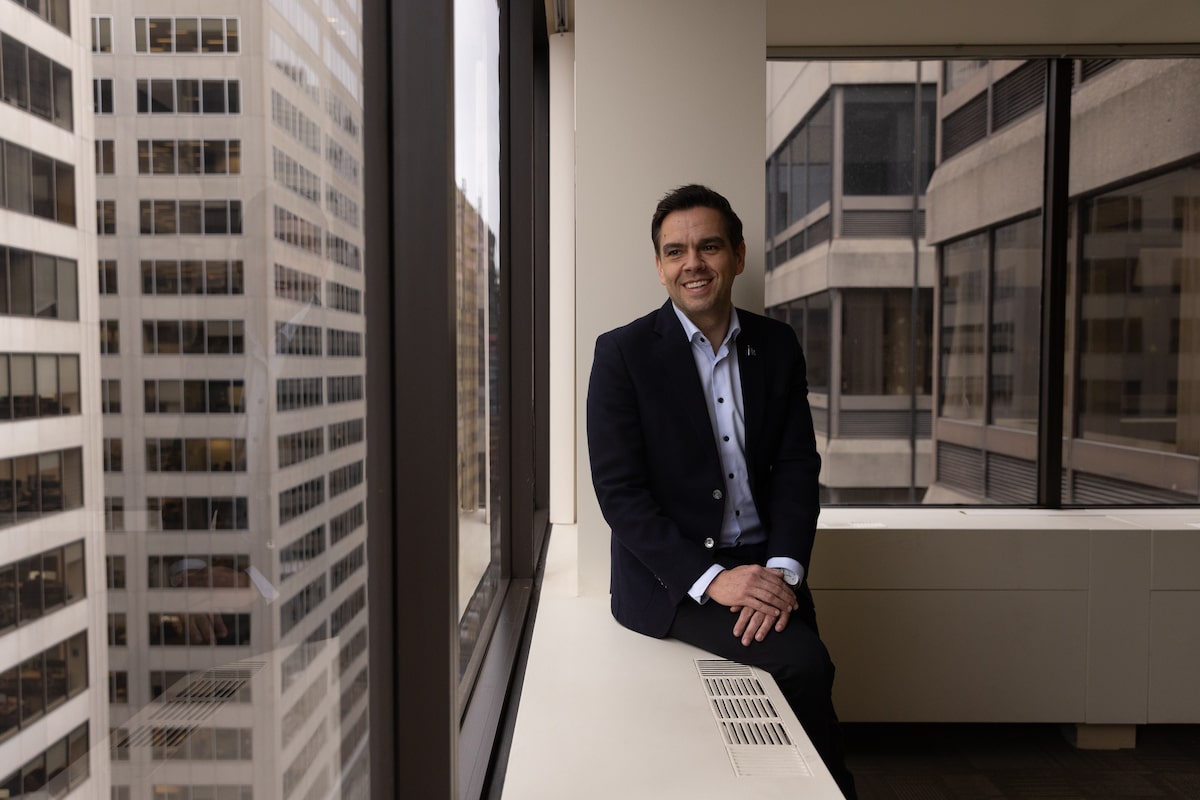
Quebec Liberal Leader Charles Milliard in downtown Montreal.Nasuna Stuart-Ulin/The Globe and Mail
Charles Milliard says he’s ready to be Captain Canada. Or, as he puts it, “Captain Quebec within Canada.”
Quebec’s new Liberal leader is auditioning for two roles at once. If his party loses this year’s provincial election to the sovereigntist Parti Québécois, he could soon be leading the campaign for Canadian unity in a third referendum on independence.
But Mr. Milliard would prefer to avoid all that. The part he really wants is the province’s top job.
The Quebec Liberals have a steep hill to climb, with just months to go until an election the PQ has seemed set to win. Still, chinks are starting to appear in the armour of PQ Leader Paul St-Pierre Plamondon, especially after he cast doubt last week on the timing of a referendum he has promised to hold by 2030 should his party win the election. As new challengers emerge in Quebec’s volatile political landscape, the question now is whether anyone has what it takes to beat him.
“I know the stakes are high. I know I’m coming into the game in the playoffs,” said Mr. Milliard in an interview late last month. “But I think it’s entirely achievable.”
Konrad Yakabuski: As an election approaches, the PQ begins to soft pedal its referendum plans
After leading in the polls for more than two years, the Parti Québécois is selling itself as a government-in-waiting ahead of the election scheduled for October. Last week , the party won a fourth straight by-election, easily flipping a riding in Quebec’s Saguenay region from the governing Coalition Avenir Québec, whose popularity has collapsed.
The result was unsurprising – the PQ had held the riding for decades before the CAQ formed government in 2018. But Mr. St-Pierre Plamondon’s comments after the victory turned heads. He said he understands some voters “are genuinely afraid” of a referendum in the current geopolitical context, and suggested his government could wait to hold a vote until after U.S. President Donald Trump leaves office.
“The Parti Québécois will use intelligence and judgment in choosing the right moment for all decisions because our priority will always be to protect Quebeckers,” he said.
His opponents pounced, accusing him of backing down on his commitment to a referendum most Quebeckers don’t want. Mr. Milliard called it a “political pirouette.”
Mr. St-Pierre Plamondon is still promising a referendum within four years. But his softer tone, combined with a new poll showing a narrowed gap between the PQ and the second-place Liberals, suggest some measure of vulnerability.
Parti Québécois stays course on referendum despite Carney’s call for unity
“He’s trying to muddy the waters,” said Christine Fréchette, a CAQ caucus member and leadership candidate in the race to replace Premier François Legault, who announced his resignation in January. “He’s hoping semantics will make this an easier pill to swallow.”
Mr. Milliard, who was acclaimed as leader last month after Pablo Rodriguez resigned amid a campaign-financing scandal, says he wants to talk about “bread-and-butter” issues that get ignored amid the focus on sovereignty.
At 46, the Liberal leader has never held elected office. A trained pharmacist and the former head of Quebec’s federation of chambers of commerce, he calls himself both a federalist and a nationalist.
Last week, a Pallas Data poll found support for the PQ had dropped to 30 per cent, while the Liberals under Mr. Milliard had climbed to 27 per cent. It also found 60 per cent of respondents said they would vote “no” in a referendum, a jump of six points compared to the firm’s previous survey. (The poll surveyed 1,075 adults on Feb. 21 and 22, and has a margin of error of plus or minus three points, 19 times out of 20.)
Philippe J. Fournier, founder of poll aggregator Qc125.com, said the results suggest people are paying more attention as the question of a referendum becomes “less and less hypothetical.”
PQ Leader says ‘battle of ideas’ has begun, garnering support for independence
Still, he cautioned that the three-point gap belies the fact that the Liberals are still trailing by 19 points among francophones. “You don’t win an election in Quebec on those numbers,” said Mr. Fournier, who commissioned the poll.
Meanwhile, Ms. Fréchette is hoping the CAQ leadership race will inject new life into her moribund party. In an interview, she said Quebeckers want a government focused both on the economy and Quebec nationalism.
“Voting for the Liberals is like voting for the federal government’s little brother,” she said. (Mr. Milliard calls her an “aspiring captain of the Titanic.”)
Ms. Fréchette appears to have a strong lead on her opponent, Bernard Drainville. Both are former ministers in Mr. Legault’s government, but Mr. Drainville is more closely linked to the CAQ’s identity policies, including tighter rules on secularism.
“I’ve led some pretty polarizing battles,” Mr. Drainville said in an interview last month. “Sometimes I think I may come across as a bit harsh.”
The new leader, to be chosen in April, may find it difficult to restore Quebeckers’ faith in a nearly eight-year-old government. Current polling suggests the CAQ could be eclipsed even by the Conservative Party of Quebec, which finished second in the most recent by-election.
The Conservatives, led by former shock-jock Éric Duhaime, currently hold no seats in the provincial legislature but are in a good position to win ridings around Quebec City, Mr. Fournier said.
For now, the election remains the PQ’s to lose. And in an unusual move for someone hoping to be premier, Mr. Milliard speaks openly about the possibility of finishing second, and the referendum that could follow.
“If that happens, of course I will take the helm and bring our side to victory,” he said. “I think Canada is the best deal in town for Quebec.”