
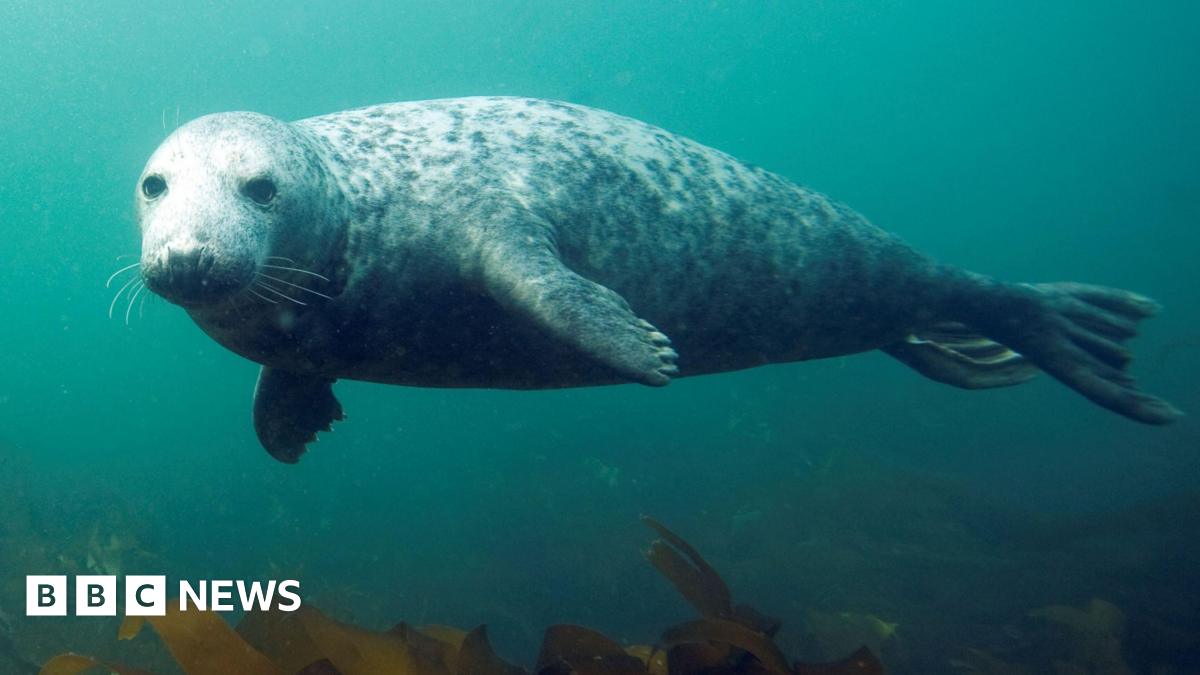
Grey seals typically feed on fish such as sand eels, cod and herring, as well as squid and crustaceans. Adult males can grow to more than 8ft (2.5m) in length and weigh over 660lb (300kg).
Dr Izzy Langley, of the Sea Mammal Research Unit at the University of St Andrews, said there was growing evidence grey seals prey on a wider range of marine mammals than previously thought.
She said they knew about grey seals killing other seals, including harbour seals.
“But now there is evidence from both direct observations and also from strandings data, that it also occurs between grey seals and harbour porpoises, and common dolphins,” said Langley.
She said the behaviour appeared to be limited to certain individuals rather than widespread across the population, with every recorded case involving an adult male seal.
While some people have speculated the Pembrokeshire dolphin may have been injured or unwell in order for a seal to catch it, Langley said previous research has not found evidence that dolphins targeted in such attacks are already sick.
Researchers believe the behaviour may involve ambush attacks from below, with dolphins potentially unaware of the threat.
She said the behaviour appeared to be linked solely to adult males and may have been learned.
“I would suspect that it’s probably come out of adverse interactions that have then resulted in, ‘oh, hang on, I’ve killed this animal, now I can actually feed on it’. And then that’s a learnt behaviour.”
Researchers have also struggled to explain how the seals are able to catch fast-moving cetaceans such as common dolphins.
“We’ve always found it tricky to understand how grey seals would kill a healthy dolphin or porpoise,” Langley said.
“This kind of implies that it’s not evolved behaviour, in the sense that porpoises and dolphins haven’t learnt to be scared of grey seals, and so they’re probably foraging in similar areas.
“I assume it’s more like an ambush attack.”