
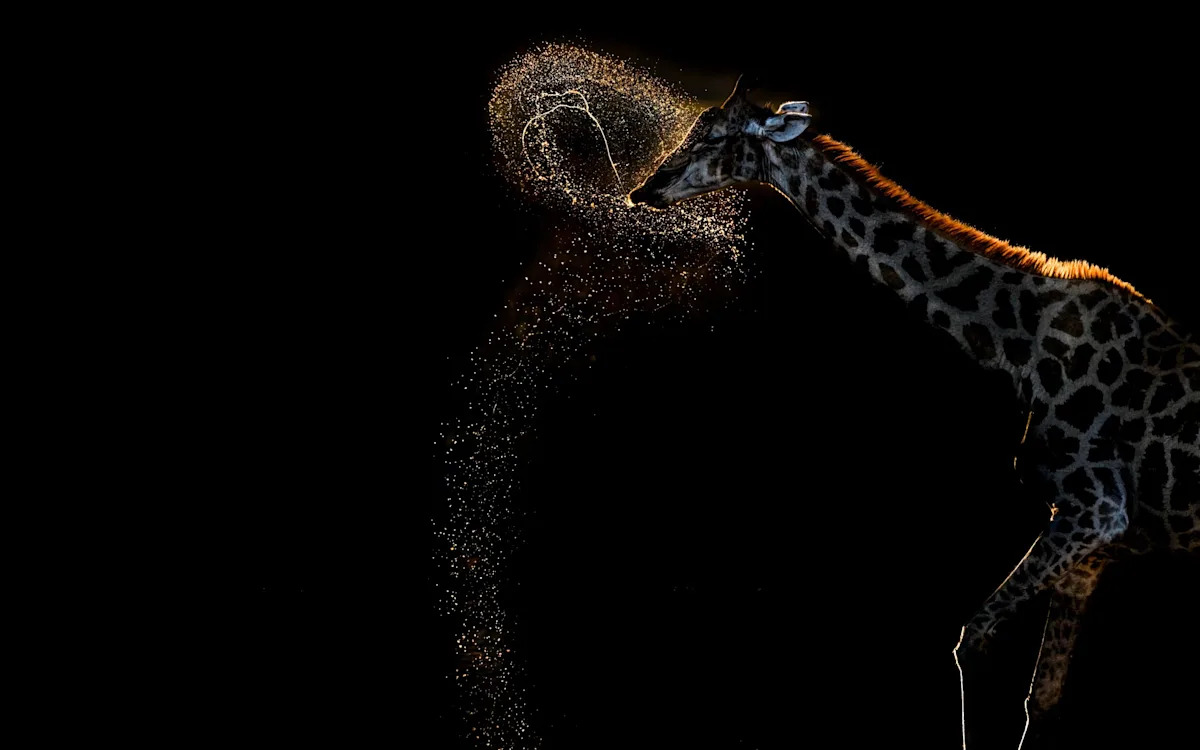
SINGAPORE – The moment she saw a lone giraffe approaching the waters at a national park in Botswana, Mrs Vaidehi Chandrasekar held her breath and waited.
As the animal lowered its neck for a drink, the 72-year-old amateur photographer lifted her camera.
The magic arrived when the giraffe raised its head and, lit from behind by the setting sun, sent water circling through the air like a shower of falling stars.
The rare shot, titled Water Ballet, won the Singapore permanent resident a gold award at the recent 2026 World Nature Photography Awards in late February.
The 2026 edition of the competition, which is now in its seventh year, received thousands of entries from photographers across 51 countries and six continents.
Among them, Mrs Chandrasekar is the only winner from Singapore, taking the top prize in the Behaviour – Mammals category.
Speaking to The Straits Times on Feb 27, the retiree said of her shot taken at the Makgadikgadi Pans National Park: “I got very lucky.”
In her entry, she described the scene as “a moment of magic”, adding that she had wanted to capture the interplay of the golden light and the swishing motion of the water.
While she has photographed giraffes before, it was unusual for one to expel so much water, she told ST.
“I was totally overwhelmed,” she added, recounting how she felt when she found out that she had won on Feb 20.
The World Nature Photographer of the Year title was awarded to Jono Allen from Australia, who captured a rare white humpback whale swimming next to its mother in the waters off islands in Oceania.
Mr Adrian Dinsdale, co-founder of the competition, said in a statement: “This year’s winning images are a powerful reminder of both the wonder of our planet and the importance of protecting it.”
The competition’s conservation effort – which involves partnering with Ecologi, a British environmental conservation organisation, to plant a tree for every entry – is what drew Mrs Chandrasekar to it.
She believes that photography can make an impact on wildlife conservation and animal protection.
“It’s not just taking a picture. By looking at it, a lot of others can learn from it,” she added.
“They learn about the animals and how they must be left alone in their habitats.”
Mrs Chandrasekar said that she started becoming more involved in photography in 2019 after she retired.
Together with her husband, she picked up photography techniques through videos on YouTube and trial and error.
While she frequently travels overseas to photograph exotic animals like leopards and polar bears, she has also taken shots of birds that pass through Singapore during their migratory season.
“When I learn of some new bird that has come, I’m definitely there to try to catch (a photo of) it,” she said, adding that she occasionally posts these photos on her Instagram account _wingsgalore_.
She also counts the wildlife photography community in Singapore as a source of great help.
On Facebook, users have shared with her where and when to find specific birds that she wishes to photograph, she said.
At parks across Singapore, she has also met fellow photographers who have given her tips on how to get the best angles, which she says are difficult to capture because of the birds’ constant movement.
Recounting her experience camping in the Botswanan safari with her husband, who is also in his 70s, she said it was “definitely not easy”.
“Sometimes we ourselves think we are crazy, doing this,” she said, with a laugh. “But we do it anyway.”
Other animals on her bucket list include the Indonesian orang utans and the penguins in the Antarctic.
“It’s a long list that we want to finish before we get too old,” she said.
Source: The Straits Times © SPH Media Limited. Permission required for reproduction